
Levels, Source Apportionment and Health Risk Assessment of Polycyclic Aromatic Hydrocarbons in Soils Around Selected Petrol Filling Stations in Kogi State, Nigeria
DOI:
https://doi.org/10.33003/fjs-2026-1015-5736Keywords:
Polycyclic aromatic hydrocarbons, petrol filling stations, soil pollution, diagnostic ratio, benzo[a]pyrene equivalent, Kogi StateAbstract
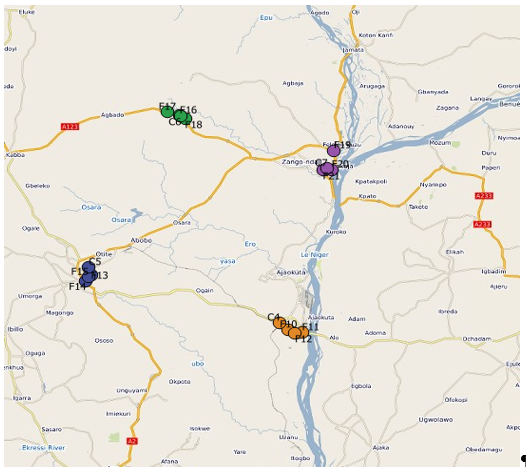
Soils around petrol filling stations are exposed to polycyclic aromatic hydrocarbons (PAHs) from fuel spillage, storage tank leakage, and incomplete combustion of petroleum products. This study assessed the levels, distribution, sources and health risk of the 16 USEPA priority PAHs in soils around petrol filling stations in Kogi Central (Zone 1: Ajaokuta, Okene) and Kogi West (Zone 2: Obajana, Lokoja), Kogi State, Nigeria. Twelve soil samples from filling stations and four controls were analyzed using Gas Chromatography-Mass Spectrometry (GC-MS). Surrogate (o-terphenyl) recoveries ranged from 94.0 to 101.6%. Total PAH (Σ16PAHs) concentrations ranged from 0.540 to 5.90 µg/kg, with mean values of 2.55 µg/kg in Zone 1 and 3.45 µg/kg in Zone 2 (combined mean 3.00 µg/kg). A two-sample t-test showed significantly higher PAH concentrations at filling stations than controls (t = -2.30, p = 0.038), with no significant difference among the four towns (p = 0.094). Low molecular weight (2-3 ring) PAHs dominated the distribution (65.7%), followed by 4-ring (30.2%) and 5-6 ring PAHs (4.12%). All individual and total PAH concentrations were below the Dutch maximum permissible concentrations, indicating unpolluted soils. Diagnostic ratios (LMW/HMW = 1.91; Ant/(Ant+Phe) = 0.77; Flt/(Flt+Pyr) = 0.90; BaA/(BaA+Chr) = 0.68) revealed a predominantly pyrolytic origin for the PAHs, with a minor petrogenic contribution. The mean benzo[a]pyrene equivalent concentration (BaPeq) was 0.0595 µg/kg, far below the 600 µg/kg Canadian soil quality guideline, denoting low carcinogenic potential. The results supply baseline data for PAH monitoring in the study area and complement previously published data for Kogi East.
References
Adesina, O.A., Fakayode, O.A., Lala, M.A., Adewale, A.J. & Sonibare, J.A. (2024). Levels of Polycyclic Aromatic Hydrocarbon in the Soil Around Typical automobile Repair Workshops in Nigeria. F1000Research. 12: Chem Inf Sci-861. https://doi.org/10.12688/f1000research.134682.3
Akinsete, S.J. & Olatimehin, A.D. (2024). Priority Polycyclic Aromatic Hydrocarbons and Heavy Metals in Urban Roadside Soils of Heavy-Traffic Density Areas in Ibadan, Nigeria: Levels, Sources and Health Risk Assessment. Environmental Forensics. 25(4): 239-253. https://doi.org/10.1080/15275922.2023.2172092
Al-Assi, G., Abosaoda, M.K., Ahmed, M.M., Malathi, H., Panigrahi, R., Thyagarajan, Sharma, V. & Pramanik, A. (2026). Global Distribution of Polycyclic Aromatic Hydrocarbons in Environmental Media: A Systematic Review and Meta-Analysis. Water, Air, & Soil Pollution. 237(14): Article 835. https://doi.org/10.1007/s11270-026-09508-y
Ana, G.R.E.E., Mynepalli, K.C., Sridhar, C. & Emerole, G.O. (2009). A Comparative Assessment of Soil Pollution by Polycyclic Aromatic Hydrocarbons in Two Niger Delta Communities, Nigeria. African Journal of Pure and Applied Chemistry. 3(3): 031-041.
Anderson, J.M. & Ingram, J.S.I. (1989). Tropical Soil Biology and Fertility: A Handbook of Methods. CAB International, UK, pp. 1-100.
Andersson, B.E., Lundstedt, S., Tornberg, K., Schnürer, Y., Öberg, L.G. & Mattiasson, B. (2003). Incomplete Degradation of Polycyclic Aromatic Hydrocarbons in Soil Inoculated with Wood-rotting Fungi and their Effect on the Indigenous Soil Bacteria. Environmental Toxicology and Chemistry. 22(6): 1238-1243.
Anegbe, B., Okuo, J.M. & Okieimen, F.E. (2016). The Impact of Inorganic and Organic Pollutants in Soil from the Vicinity of Mechanic Workshops in Benin City. International Journal of Chemical Studies. 4(3): 106-112.
Barber, C., Power, T., Lambert, M., Patterson, B. & Bates, L. (1990). Groundwater Pollution from Underground Storage of Fuels on the Swan Coastal Plain, Western Australia: Stage 2, Preliminary Assessment of the Effects of Subsurface Discharges on Groundwater Quality. Report for the Authority of Western Australia, Division of Water Resources, 1-9.
Bortey-Sam, N., Ikenaka, Y., Nakayama, S., Akoto, O., Yohannes, B.Y., Baidoo, E., Mizukawa, H. & Ishizuka, M. (2014). Occurrence, Distribution, Sources and Toxic Potential of Polycyclic Aromatic Hydrocarbons (PAHs) in Surface Soils from the Kumasi Metropolis, Ghana. Science of the Total Environment. 496: 471-478.
Bouyoucos, G.J. (1951). A Recalibration of the Hydrometer Method for Making Mechanical Analysis of Soils. Agronomy Journal. 43: 435-438.
Cao, W., Yin, L., Zhang, D., Wang, Y., Yuan, J., Zhu, Y. & Dou, J. (2019). Contamination, Sources, and Health Risks Associated with Soil PAHs in Rebuilt Land from a Coking Plant, Beijing, China. International Journal of Environmental Resources and Public Health. 16: 670-673.
Cheng, Y. & Nathanail, C.P. (2009). Generic Assessment Criteria for Human Health Risk Assessment of Potentially Contaminated Land in China. Science of the Total Environment. 408(2): 324-329.
Day, P.R. (1965). Particle Fractionation and Particle Size Analysis. In: Methods of Soil Analysis, Part 1. American Society of Agronomy, Madison, WI, pp. 454-467.
Emoyan, O.O., Onocha, E.O. & Tesi, G.O. (2020). Concentration Assessment and Source Evaluation of 16 Priority Polycyclic Aromatic Hydrocarbons in Soils from Selected Vehicle Parks in Southern Nigeria. Scientific African. 7(3): 296.
Eneji, I.S., Vesuwe, R.N. & Sola, O.O. (2017). Analysis of Polyaromatic Hydrocarbons in Soil Around Auto-mechanic Workshops in Major Towns in Benue State, Nigeria. FUW Trends in Science and Technology Journal. 2(1A): 79-84.
FAO (2020). Standard Operating Procedure for Soil Organic Carbon: Walkley-Black Method - Titration and Colorimetric Method. Global Soil Partnership. Rome: Food and Agricultural Organization of the United Nations.
Halek, F., Nabi, G. & Kavousi, A. (2008). Polycyclic Aromatic Hydrocarbons Study and Toxic Equivalency Factor (TEFs) in Teheran, Iran. Environmental Monitoring and Assessment. 143: 303-311.
Ibe, K.A., Osabor, V.N., Nganje, T.N., Neji, P.A. & Adamu, C.I. (2013). Polycyclic Aromatic Hydrocarbon Levels in Rural/Semi-urban Areas of Cross River State. International Journal of Experimental and Theoretical Chemistry. 2(1): 10-14.
Itodo, A.U., Akeju, T.T. & Itodo, H.U. (2019). Polycyclic Aromatic Hydrocarbons (PAHs) in Crude Oil Contaminated Water from Ese-Odo Offshore, Nigeria. Annals of Ecology and Environmental Science. 3(1): 12-19.
Kadili, J. A. (2021). Impact and Risk Assessment of Polycyclic Aromatic Hydrocarbons (PAHs) and Heavy Metals in Soils from the Vicinity of Some Selected Filling Stations in Kogi State. [PhD thesis, University of Agriculture, Makurdi, Nigeria].
Kadili, J.A., Eneji, I.S., Itodo, A.U. & Sha'Ato, R. (2021). Concentration and Risk Evaluation of Polycyclic Aromatic Hydrocarbons in Soils from the Vicinity of Selected Petrol Stations in Kogi State-Nigeria. Open Access Library Journal. 8: e07659. https://doi.org/10.4236/oalib.1107659
Lorenzi, D., Cave, M. & Dean, J.R. (2010). An Investigation into the Occurrence and Distribution of Polycyclic Aromatic Hydrocarbons in Two Soil Size Fractions at a Former Industrial Site in NE England, UK Using in situ PFE-GC-MS. Environmental Geochemistry and Health. 32: 553-565.
Means, J.C., Wood, S.G., Hasset, J. & Banwart, J. (1980). Sorption of Polynuclear Aromatic Hydrocarbons by Sediments and Soils. Environmental Science and Technology. 14(2): 524-528.
Mosaed, H.P., Sobhanardakani, S., Merrikhpour, H., Farmany, A., Cheraghi, M. & Ashorlo, S. (2015). The Effect of Urban Fuel Stations on Soil Contamination with Petroleum Hydrocarbons. Iranian Journal of Toxicology. 9(30): 1378-1384.
Neff, J.M., Boehm, P.D., Kropp, R., Stubblefield, W.A. & Page, D.S. (2003). Monitoring Recovery of Prince William Sound, Alaska, Following the Exxon Valdez Oil Spill: Bioavailability of PAH in Offshore Sediments. In: Proceedings of the International Oil Spill Conference, Publication No. I 4730 B. Washington, DC: American Petroleum Institute.
Nganje, T.N., Edet, A.E. & Ekwere, S.J. (2007). Concentration of Heavy Metals and Hydrocarbons in Groundwater Near Petrol Stations and Mechanic Workshops in Calabar Metropolis, Southeastern Nigeria. Environmental Geosciences. 14(1): 15-29.
Nganje, T.N., Neji, P.A., Ibe, K.A., Adamu, C.I. & Edet, A. (2014). Fate, Distribution and Sources of Polycyclic Aromatic Hydrocarbons (PAHs) in Contaminated Soils in Parts of Calabar Metropolis, South Eastern Nigeria. Journal of Applied Science and Environmental Management. 18(2): 309-316.
Odali, E.W., Iwegbue, C.M.A., Egobueze, F.E., Nwajei, G.E. & Martincigh, B.S. (2024). Distribution, Sources, and Risk of Polycyclic Aromatic Hydrocarbons in Soils from Rural Communities Around Gas Flaring Points in the Niger Delta of Nigeria. Environmental Science: Processes & Impacts. 26: 721-733. https://doi.org/10.1039/D3EM00067B
Ojo, I.O., Ojo, J.O. & Oladele, O. (2015). Analysis of Heavy Metals and Some Physicochemical Parameters in Soil of Major Industrial Dumpsites in Akure Township, Ondo State of South Western Nigeria. International Journal of Chemistry. 7(1): 225-228.
Olawoyin, R.O. (2012). Application of Expert Systems in the Characterization and Impact of Petroleum Derivatives on Human Health. PhD Thesis, Pennsylvania State University.
Petruzzelli, G., Gorini, F., Pezzarossa, B. & Pedron, F. (2010). The Fate of Pollutants in Soil. In: Environmental Health Inter-Department Project. Consiglio Nazionale delle Ricerche, pp. 1-31.
Renata, R., Armin, M. & Elie, S. (2012). Environmental Risk Assessment of the Fuel Stations in the Jeita Spring Catchment. German-Lebanese Technical Cooperation Project, Special Report No. 14.
Teixeira, J., Delerue-Matos, C., Morais, S. and Oliveira, M. (2024). Environmental Contamination with Polycyclic Aromatic Hydrocarbons and Contribution from Biomonitoring Studies to the Surveillance of Global Health. Environmental Science and Pollution Research. 31(42): 54339-54362. https://doi.org/10.1007/s11356-024-34727-3
Tsai, P.J., Shih, T.S., Chen, H.L., Lee, W.J., Lai, C.H. & Liou, S.H. (2004). Assessing and Predicting the Exposures of Polycyclic Aromatic Hydrocarbons (PAHs) and their Carcinogenic Potencies from Vehicle Engine Exhausts to Highway Toll Station Workers. Atmospheric Environment. 38: 333-343.
Udom, G.J., Frazzoli, C., Ekhator, O.C., Onyena, A.P., Bocca, B. & Orisakwe, O.E. (2023). Pervasiveness, Bioaccumulation and Subduing Environmental Health Challenges Posed by Polycyclic Aromatic Hydrocarbons (PAHs): A Systematic Review to Settle a One Health Strategy in Niger Delta, Nigeria. Environmental Research. 226: 115620. https://doi.org/10.1016/j.envres.2023.115620
Ugbune, U. & Okuo, J. (2011). Sequential Fractionation and Distribution of Heavy Metals in Soil from Battery Work Sites. Nigeria Journal of Applied Science. 29: 132-141.
USEPA (1993). Provisional Guidance for Quantitative Risk Assessment of PAHs. Environmental Protection Agency, Office of Research and Development, Office of Health and Environmental Assessment, Washington, DC. EPA/600/R-93/089.
USEPA (1996). Soil Screening Guidance: Technical Background Document. Office of Solid Waste and Emergency Response, Washington, DC.
Verbruggen, E.M.J. (2012). Environmental Risk Limits for Polycyclic Aromatic Hydrocarbons (PAHs) for Direct Aquatic, Benthic, and Terrestrial Toxicity. National Institute for Public Health and the Environment (RIVM), Bilthoven, The Netherlands, No. 607711007.
VROM (2000). Circular on Target Values and Intervention Values for Soil Remediation. The Hague, The Netherlands: Ministry of Housing, Spatial Planning and the Environment.
Wang, H., Yang, Y., Walker, T.R., Wang, Y., Wu, H., Wang, X. & Luo, Q. (2022). Characterization, Source Apportionment, and Risk Assessment of Polycyclic Aromatic Hydrocarbons (PAHs) in Urban Soils from 23 Cities in China. Environmental Science and Pollution Research. 29(48): 73401-73413. https://doi.org/10.1007/s11356-022-21025-z
WHO (2000). Air Quality Guidelines for Europe, 2nd edition. WHO Regional Publications, European Series No. 91, Copenhagen.
Wild, S.R. & Jones, K.C. (1995). Polynuclear Aromatic Hydrocarbons in the United Kingdom Environment: A Preliminary Source Inventory and Budget. Environmental Pollution. 88: 91-108.
Wilson, S.C. & Jones, K.C. (1993). Bioremediation of Soil Contaminated with Polynuclear Aromatic Hydrocarbons (PAHs): A Review. Environmental Pollution. 81(3): 229-249.
Xu, J., Kleja, D.B., Biester, H., Lagerkvist, A. & Kumpiene, J. (2014). Influence of Particle Size Distribution, Organic Carbon, pH and Chlorides on Washing of Mercury Contaminated Soil. Chemosphere. 109: 99-105.
Yang, Y., Woodward, L.A., Li, Q.X. and Wang, J. (2014). Concentrations, Source and Risk Assessment of Polycyclic Aromatic Hydrocarbons in Soils from Midway Atoll, North Pacific Ocean. PLoS ONE. 9(1): e86441.
Yu, Y., Sun, X., Zou, L., Zhang, H., Liu, Y. & Liu, M. (2020). Polycyclic Aromatic Hydrocarbons (PAHs) in Surface Soil from the Guan River Estuary in China: Contamination, Source Apportionment and Health-risk Assessment. Science Asia. 46: 80-86.
Yunker, M.B., Macdonald, R.W., Vingarzan, R., Mitchell, R.H., Goyette, D. & Sylvestre, S. (2002). PAHs in the Fraser River Basin: A Critical Appraisal of PAH Ratios as Indicators of PAH Source and Composition. Organic Geochemistry. 33: 489-515.
Yunker, M.B., Snowdon, L.R., Macdonald, R.W., Smith, J.N., Fowler, M.G., Skibo, D.N., McLaughlin, F.A. & Danyushevskaya, A.I. (1996). Polycyclic Aromatic Hydrocarbon Composition and Potential Sources for Sediment Samples from the Beaufort and Barents Seas. Environmental Science and Technology. 30: 1310-1320.
Downloads
Published
Issue
Section
Categories
License
Copyright (c) 2026 Julius Attah Kadili, Godwin John, Ishaq Shaibu Eneji, Adams Udoji Itodo, Rufus Sha'Ato

This work is licensed under a Creative Commons Attribution 4.0 International License.


