
Comparative Antifungal Activities of Clove (Syzygium Aromaticum), Mint (Mentha Spicata) and Scent Leaves (Ocimum Gratissimum) Extracts on Postharvest Moulds in Maize, Preliminary Aflatoxin and Amylase Screenings
DOI:
https://doi.org/10.33003/fjs-2026-1016-5732Keywords:
Postharvest Maize, Botanical Extracts, Antifungal Activity, Storage Moulds, Agar Well Diffusion, N-Hexane Extraction, Botanical BiocontrolAbstract
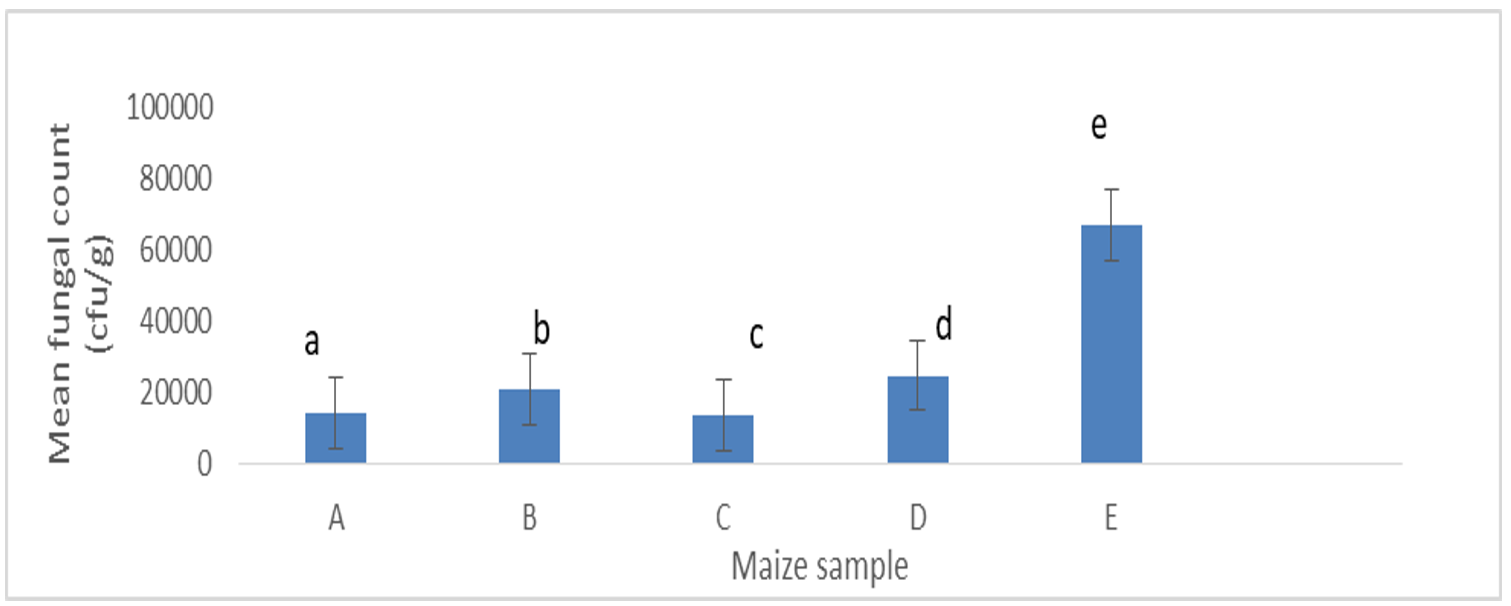
Postharvest moulds cause degradation in maize nutrients quality, and some produce aflatoxin. This study compares the potential of clove buds, mint and scent leave extracts on post-harvest moulds of maize, and preliminary aflatoxins and amylase screenings. Maize samples were collected from five cultivating communities in Ogun and Osun States. Grains were decontaminated for mould isolation, and characterized using morphological and microscopic features. Twenty gram each of botanical was extracted with n-Hexane using Soxhlet extractor, and 5, 25, 50, 75% dilutions was tested on six moulds isolates in agar well diffusion. n-Hexane, Tween 80, Ketoconazole were controls. Zone of inhibition (ZOI) was measure in millimeter. Amylase and ammonia vapour tests were done. Three-way ANOVA (p<0.001) and descriptive statistics carried out. Mould counts varied significantly (1.40 - 6.70 x 10⁴ cfu/g) across locations. Thirteen mould species of Aspergillus, Penicillium and Trichoderma genera were found with occurrence of 69.08, 23.08, and 7.69% respectively. About 53.08% Aspergillus was positive for amylase, whereas ammonia vapour test was negative for all isolates. Clove differed significantly in antifungal potency to scent and mint leaves, whereas both were statistically similar. ZOI increased significantly with extract concentration, and highest (38±0.1 mm) was by clove at 75 and 50% dilution against Penicillium species and A. niger. A significant three-level interaction occurred between extract type, concentration, and mould species, indicating that antifungal activity was influenced by their combined effects. Therefore, plant extracts demonstrated concentration and mould species dependent efficacy, and could be useful in biocontrol of postharvest mould in maize.
References
Abd El-Aziz, A. R.M., Shehata, S. M., Hisham, S. M., & Alobathani A. A. (2021). Molecular profile of aflatoxigenic and non-aflatoxigenic isolates of Aspergillus flavus isolated from stored maize. Saudi Journal of Biological Sciences, 28, 1383–1391.
Abdi-Moghadam, Z., Mazaheri, Y., Rezagholizade-Shirvan, A., Mahmoudzadeh, M., Sarafraz, M., Mohtashami, M., Shokri, S., Ghasemi, A., Nickfar, F., Darroudi, M., et al. (2023). The significance of essential oils and their antifungal properties in the food industry: A systematic review. Heliyon, 9, e21386.
Adiaha, S. M. (2018). Economic value of Maize (Zea mays L.) in Nigeria and its impacts on global food production. International Journal of Scientific World. 6(1), 27–30. https://doi.org/10.14419/ijsw.v6i1.8771
Akande, T.O., Agboola, A.S., & Okunola, F.P. (2017). Mycological and chemical screening of maize at open Nigeria. Nigerian Journal of Animal Production 44(4), 232–240. https://doi.org/10.51791/njap.v44i4.507
Atehnkeng, J., Ojiambo, P.S., Donner, M., Ikotun, T., Sikora, R.A., Cotty, P. J., & Bandyopadhyay, R. (2008). Distribution and toxigenicity of Aspergillus species isolated from maize kernels from three agroecological zones in Nigeria. International Journal of Food Microbiology, 122, 74–84. https://doi.org/10.1016/j.ijfoodmicro.2007.11.062
Awojide, S.H., Ezekiel, Fadunmade, O., Adegboye, E.O., Oyewole, A. A., Adedotun, A.K., Abayomi I. S., Gideon Adeyemo, A.G., & Ayeni, J.V. (2024). A comparative study on the synergistic activities of fractions and crude essential oil of Syzygium aromaticum. Bulletin of the National Research Centre, 48, 47. https://doi.org/10.1186/s42269-024-01205-2
Atnafu, B., Abedeta, C., Lemessa, F., Mohammed, A., Oufensou, S., & Chala A. (2024). Chemical composition of selected aromatic plant essential oils and their antifungal efficacy against toxigenic fungi associated with maize (Zea mays L). Cogent Food & Agriculture, 10(1), 2329116. https://doi.org/10.1080/23311932.2024.2329116
Campolo, O., Giunti, G., Russo, A., Palmeri, V., & Zappalà, L. (2018). Essential Oils in Stored Product Insect Pest Control. J. Food Qual., 2018, 6906105, 18 pages.
Dauqan, E.M., & Abdullah, A. (2017). Medicinal and functional values of thyme (Thymus vulgaris L.) herb. J. Appl. Biol. Biotechnol., 5, 17–22.
Diop, S. M., Guèye, M.T., Ndiaye, I., Ndiaye, E.H.B., Diop, M. B., Heuskin, S., Fauconnier, M. L., & Lognay, G. (2016). Chemical characterization of essential oils of mints from Senegal. Nat. Prod. Commun. 11, 1–2.
Eloff, J. N. (2019). Avoiding pitfalls in determining antimicrobial activity of plant extracts and publishing the results. BMC Complementary Altern. Med., 19, 106.
Essential Oils Market Size, Share & Trends Analysis Report by Application (Food & Beverages, Spa & Relaxation), By Product (Orange, Peppermint), By Sales Channel, and Segment Forecasts, 2020–2027. Available online: https://www.grandviewresearch.com/industry-analysis/essential-oils-market
(accessed on 25 September 2024).
Ezekiel, C.N., Ayeni, K.I., Akinyemi, M.O., Sulyok, M., Oyedele, O.A., Babalola, D.A., Ogara, I. M., & Krska, R. (2021). Dietary risk assessment and consumer awareness of mycotoxins among household consumers of cereals, nuts and legumes in north-central Nigeria. Toxins, 13, 635. https://doi.org/10.3390/toxins13090635
Ezekiel, C.N., Oyedele, O.A., Kraak, B., Ayeni, K.I., Sulyok, M., Houbraken, J., & Krska, R. (2020). Fungal Diversity and Mycotoxins in Low Moisture Content Ready-To-Eat Foods in Nigeria. Front. Microbiol. 11, 615. https://doi.org/10.3389/fmicb.2020.00615.
FAOSTAT. (2022). Country profile. Federal republic of Nigeria. Online available at maize production in Nigeria.
Food and Agriculture Organization of the United Nations. (2017). FAOSTAT statistical database. FAO. https://www.fao.org/faostat/en/
Gwad, M. M. A., El-Sayed, A. S., Abdel-Fattah, G. M., Abdelmoteleb, M., Abdel-Fattah, G. G. (2024). Potential fungicidal and anti-aflatoxigenic effects of cinnamon essential oils on Aspergillus flavus inhabiting the stored wheat grains. BMC Plant Biol., 24, 394.
Grillo, A.J., Ukhureigbe, O.M.,Egwari, L.O., Olasupo, N.A., & Adeniyi, B.A. (2026). Antifungal effects of Azadirachta indica and Ocimum gratissimum on dermatophytes. FUDMA Journal of Sciences, 10(5), 57– 65. https://doi.org/10.33003/fjs-2026-1005-4876
Owoo, H. A., & Oladipo, I. C. (2026). “Isolation and Molecular Characterization of Fungi Associated With Maize from Five Farms in Osogbo, Osun State, Nigeria”. Journal of Advances in Biology & Biotechnology, 29 (1), 784 - 794. https://doi.org/10.9734/jabb/2026/v29i13576.
Harwood, C. R., Mouillon, J., Pohl, S., & Ar, J. (2018). Secondary metabolite production and the safety of industrially important members of the Bacillus subtilis group. FEMS Microbiology Reviews, fuy028 (42), 721–738. https://doi.org/10.1093/femsre/fuy028
Hu, F., Tu, X. F., Thakur, K., Hu, F., Li, X.L., Zhang, Y.S., Zhang, J.G., & Wei, Z.J. (2019). Comparison of antifungal activity of essential oils from different plants against three fungi. Food Chem. Toxicol., 134, 110821.
Jackson-Davis, A., White, S., Kassama, L.S., Coleman, S., Shaw, A., Mendonca, A., Cooper, B., Thomas-popo, E., Gordon, K., & London, L. (2023). A review of regulatory standards and advances in essential oils as antimicrobials in foods. J. Food Prot., 86, 100025.
Karaca, G., Bilginturan, M., Olgunsoy, P. (2017). Effects of some plant essential oils against fungi on wheat seeds. Indian J. Pharm. Educ. Res., 51, S385–S388.
Kaur, H., & Garg, H. (2014). Pesticides: Environmental Impacts and Management Strategies. Pestic.-Toxic Asp. 8, 187.
Klich, M. A. (2007). Aspergillus flavus: The major producer of aflatoxin. Molecular Plant Pathology, 8(6), 713–722. https://dio.org/10.1111/j.1364-3703.2007.00436.x
Kolawole, O., Graham, A., Donaldson, C., Owens, B., Abia, W.A., Meneely, J., Alcorn, J. M., Connolly, L, & Elliott, C. T. (2020). Low doses of mycotoxin mixtures below EU regulatory limits can negatively affect the performance of broiler chickens: A longitudinal study. Toxins 12(7), 433. https://doi.org/10.3390/toxins12070433
Liu, S. J., Wu, Y. N., & Chan, L. (2020). Application of metabolomics approach in food safety research-A review. Food Reviews International, 36(6), 547–558. https://doi.org/10.1080/87559129.2019.1694162
Maurya, A., Yadav, A., Soni, M., Paul, K. K., Banjare, U., Jha, M. K., Dwivedy, A. K., & Dubey, N. K. (2024). Nanoencapsulated Essential Oils for Post-Harvest Preservation of Stored Cereals: A Review. Foods, 13, 4013. https://doi.org/10.3390/foods13244013
Mohapatra, D., Kumar, S., Kotwaliwale, N., & Singh, K. K. (2017). Critical factors responsible for fungi growth in stored food grains and non-Chemical approaches for their control. Ind. Crops Prod., 108, 162–182.
Pimentel, D. (2005). Environmental and Economic Costs of the Application of Pesticides Primarily in the United States. Environ. Dev. Sustain., 7, 229–252.
Rijavec, T., Lapande, A., Dermastia, M., & Rupnik, M. (2007). Isolation of bacterial endophyte from germinated maize kernels. Can. J. Microbiol., 53:802-808.
Samson, R. A., Houbraken, J., Thrane, U., Frisvad, J. C., & Andersen, B. (2019). Food and Indoor Fungi. CBS Laboratory Manual Series 2, 2nd Edn. Utrecht: Westerdijk Fungal Biodiversity Institute.
Seepe, H. A., Nxumalo, W., Amoo, S. O. (2021). Natural Products from Medicinal Plants against Phytopathogenic Fusarium Species: Current Research Endeavours, Challenges and Prospects. Molecules, 26, 6539. https://doi.org/10.3390/molecules26216539
Schmidt, M., Zannini, E., & Arendt, E. K. (2018). Recent advances in physical post-harvest treatments for shelf-life extension of cereal crops. Foods, 7, 45.
Sipasi, K. O. (2022). Mould and aflatoxins levels of Aadun maize snack sold in Akure and Ondo Metropolis. [Bachelor’s Thesis, University of Medical Sciences, Ondo].
Sotayo, O. P., Uzeh, R. E., & Ayejuyo, O. (2026). Antifungal action and metabolic profiling of seed endophytic Bacillus cereus strain JCM 2152 against toxigenic Aspergillus species from maize. Journal of Microbiology Biotechnology and Food Science, 16(1), e14076.
Stack, J. G. (2000). Grain molds and mycotoxins in corn. Hist. Mater. Univ. Neb.-Linc. Ext., 89. Available online: http://digitalcommons.unl.edu/extensionhist/89
(accessed on 27 December 2024).
Stathas, I. G., Sakellaridis, A.C., Papadelli, M., Kapolos, J., Papadimitriou, K., & Stathas, G. J. (2023). The effects of insect infestation on stored agricultural products and the quality of food. Foods, 12, 2046.
Tola, M., Kebede, B., & Yildiz, F. (2016). Occurrence, importance and control of mycotoxins: A review. Cogent Food & Agriculture, 2(1), 1–12. https://doi.org/10.1080/23311932.2016.1191103
Uchengbu, R. I., Akalazu, J. U. N., & Sokwaibe, C. E. (2019). An evaluation of the chemical compositions and antifungal activity of Ocimum gratissimum (Nchuanwu) leaves against some plant pathogens. Asian Journal of Applied Chemistry Research, 2(3-4), 1-7. https://doi.org/10.9734/AJACR/2018/v2i3-430078.
Ugbogu, O.C., Emmanuel, O., Agi, G.O., Iweala, E.E.J., Ezeokpo, B.C., & Ugbunna, N. C. (2021). A review on the traditional uses, phytochemistry, and pharmacological activities of clove basil (Ocimum gratissimum L.). Heliyon, 7(11), e08404.
Wang, H., Wang, Y., Wang, R., Liu, X., Zhang, Y., Zhang, H., & Chi, C. (2022). Impact of long-term storage on multi-scale structures and physicochemical properties of starch isolated from rice grains. Food Hydrocolloids, 124, 107255. https://doi.org/10.1016/j.foodhyd.2021.107255
Watanabe, T. (2010). Pictorial Atlas of Soil and Seed Fungi: Morphologies of Cultured Fungi and Key to Species. Third Edition Taylor and Francis Group, LLC, CRC Press, ISBN: 978-1-4398-0419-3.
Wu, Z., Tan, B., Liu, Y., Dunn, J., Martorell Guerola, P., Tortajada, M., Cao, Z., & Ji, P. (2019). Chemical composition and antioxidant properties of essential oils from peppermint, native spearmint and scotch spearmint. Molecules, 24, 2825.
Yazdani, D., Zainal Abidin, M. A., Tan, Y. H., & Kamaruzaman, S. (2010). Evaluation of the detection techniques of toxigenic Aspergillus isolates. African Journal of Biotechnology, 9(45), 7654-7659.
Yu, J. (2025). Chemical Composition of Essential Oils and Their Potential Applications in Postharvest Storage of Cereal Grains. Molecules, 30, 683. https://doi.org/10.3390/ molecules30030683
Yu, J. & Pedroso, I. R. (2023). Mycotoxins in cereal-based products and their impacts on the health of humans, livestock animals and pets. Toxins, 15, 480.
Zhang, X. Guo, Y., Guo, L., Jiang, H., & Ji, Q. (2018). In vitro evaluation of antioxidant and antimicrobial activities of Melaleuca alternifolia essential oil. Bio. Med. Res. Int., 2018, Article 2396109, 8 pages. https://doi.org/10.1155/2018/2396109
Downloads
Published
Issue
Section
Categories
License
Copyright (c) 2026 Aaron Daniel Boluwatife, Sotayo Olufemi Peter, Uzeh Roseline Ekiomado, Ayejuyo O. Olusegun

This work is licensed under a Creative Commons Attribution 4.0 International License.


