
Post‑operative Appearance and Facial Satisfaction Outcomes among Adults with Repaired Cleft Lip and Palate in Jigawa State, Nigeria
DOI:
https://doi.org/10.33003/fjs-2026-1014-5723Keywords:
Cleft Lip, Cleft Palate, Post Operative Outcomes, Facial Appearance, Patient Satisfaction, Health Related Quality Of LifeAbstract
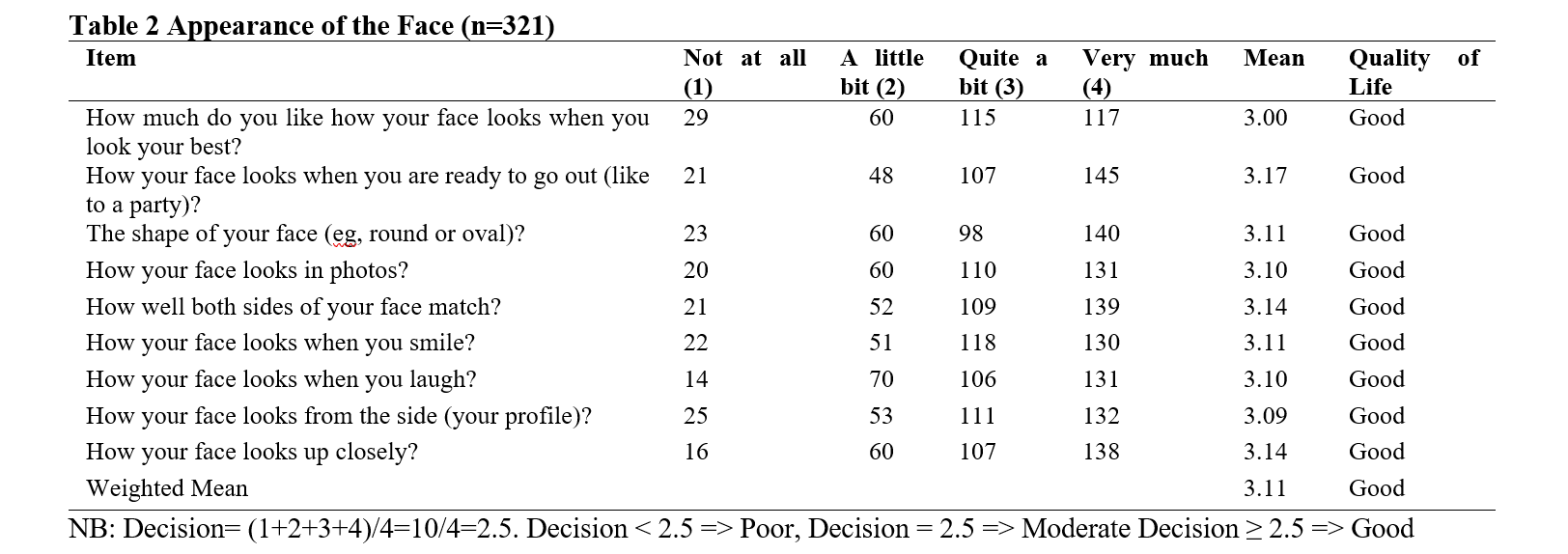
Surgical repair of cleft lip and palate (CLP) aims to restore facial aesthetics and symmetry; however, patient‑reported postoperative outcomes regarding appearance in adulthood remain underreported in Nigeria. This study assessed the postoperative appearance of the face, lips, nose, nostrils, teeth, and jaws, as well as overall satisfaction with facial appearance among adults with repaired cleft lip and palate in Jigawa State, Nigeria. A descriptive cross‑sectional design was employed among adults aged 18–29 years who had undergone cleft repair through Smile Train‑supported missions in Jigawa State. Data were collected using the validated CLEFT‑Q questionnaire focusing on appearance scales and the facial satisfaction domain. Descriptive statistics summarized outcomes, while inferential analysis tested associations between facial appearance and health‑related quality of life (HRQoL) at p < 0.05. Most respondents reported significant satisfaction with their postoperative facial appearance and a reduction in stigma. High satisfaction scores (weighted mean ≥ 2.5) were recorded for the appearance of the face, cleft scar, and jaws. A statistically significant positive relationship was found between facial appearance and overall HRQoL (p < 0.05). However, a subset of participants expressed residual dissatisfaction with nasal symmetry and visible lip scars. Surgical repair significantly enhances aesthetic outcomes and facial satisfaction among young adults. Nevertheless, persistent concerns regarding scarring and asymmetry highlight the importance of viewing cleft treatment as a continuous, multidisciplinary care process rather than a one-time surgical event.
References
Adeyemi, A. S. (2015). Orofacial clefts in Nigeria: Epidemiology and clinical considerations. Nigerian Journal of Plastic Surgery, 11(2): 45–52.
Abdurrazaq, T. O., et al. (2013). Outcome of cleft lip and palate repair in a Nigerian tertiary hospital. African Journal of Paediatric Surgery, 10(4), 345–350.
Beluci, M. L., & Genaro, K. F. (2016). Quality of life of individuals with cleft lip and palate: A systematic review. Journal of Craniofacial Surgery, 27(4), 1043–1047.
Schönmeyr, B et al(2015). Speech and speech-related quality of life after late cleft palate repair: A patient’s perspective. Journal of Craniofacial Surgery, 26(5), 1519–1523.
Sischo, L., & Broder, H. L. (2019). Oral health-related quality of life: What, why, how, and future implications. Journal of Dental Research, 90(11), 1264–1270.
Wong, F. K. . (2025). Long-term speech and quality-of-life outcomes after late cleft palate repair. International Journal of Oral and Maxillofacial Surgery, 54(2), 210–218.
Michael, A. et al. (2024). Preoperative quality of life of patients with cleft lip and palate in Nigeria: a multicentre cross-sectional pilot study. Pan African Medical Journal, 48. https://doi.org/10.11604/pamj.2024.48.50.42111
Michael, A., & Olusaya, A. (2022). Health-related quality of life and facial function in children with repaired cleft palate attending a speech camp: A descriptive cross-sectional study. Nigerian Journal of Medicine, 31(3), 328. https://doi.org/10.4103/njm.njm_42_22
Turner, S, & Sandy, J. R. (1998). Psychological aspects of cleft lip and palate. In European Journal of Orthodontics (Vol. 20). https://academic.oup.com/ejo/article/20/4/407/432303
Vyas, T., (2020). Cleft of lip and palate: A review. Journal of Family Medicine and Primary Care, 9(6), 2621. https://doi.org/10.4103/jfmpc.jfmpc_472_20
Zhao, et al. (2021). Research trends and hotspots of health-related quality of life: a bibliometric analysis from 2000 to 2019. Health and Quality of Life Outcomes, 19(1). https://doi.org/10.1186/s12955-021-01767-z.
Downloads
Published
Issue
Section
Categories
License
Copyright (c) 2026 Abdulrashid Idris, Rabiu Haruna, Shehu Usman Panda, Nasiru Tijjani Nagwamutse, Rahmat Adamu, Ashiru Muhammad, Jidda Umar Abubakar

This work is licensed under a Creative Commons Attribution 4.0 International License.