
Effect of Calcination Temperature on the Structural, Optical, and Photocatalytic Properties of Urea-Derived g-C3N4 for Methylene Blue Degradation
DOI:
https://doi.org/10.33003/fjs-2026-1014-5722Keywords:
Graphitic carbon nitride, methylene blue, dye degradation, photocatalysis, wastewater treatmentAbstract
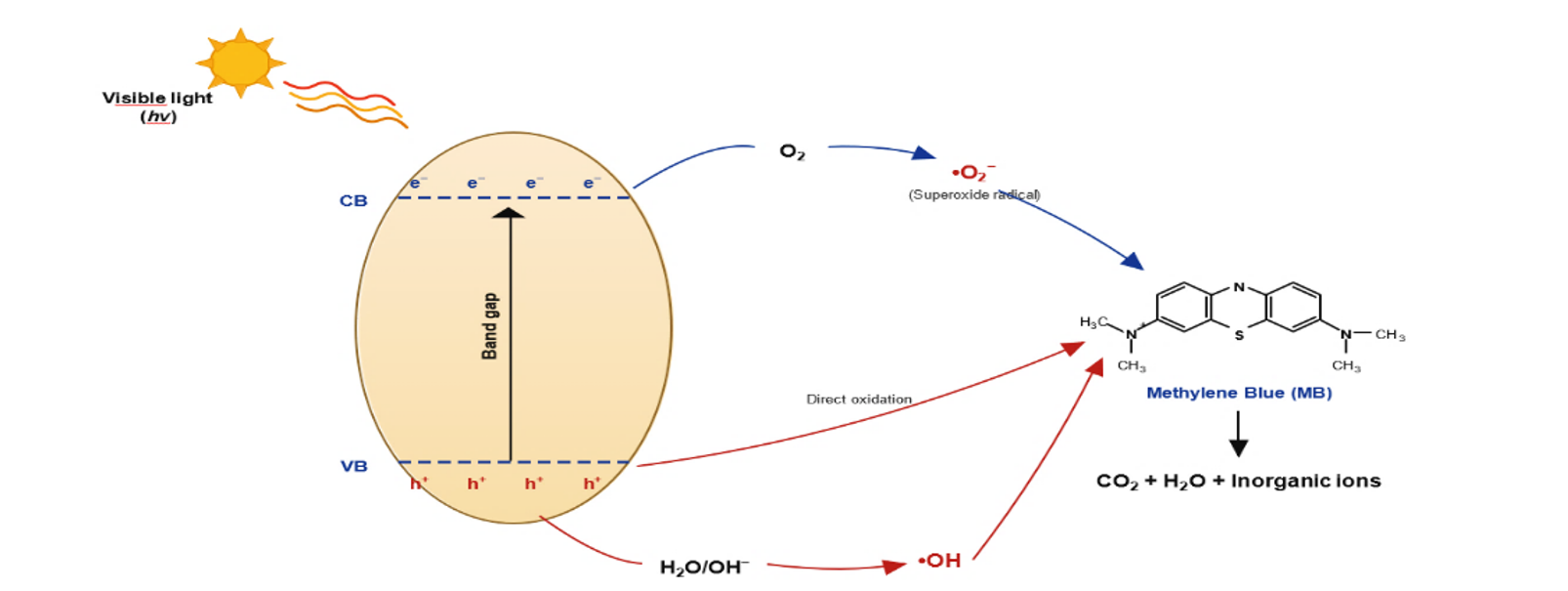
Graphitic carbon nitride (g-C3N4) stands out as an eco-friendly, metal-free photocatalyst for the remediation of dye-contaminated wastewater. Though its efficiency relies heavily on its synthesis conditions. Pristine g-C3N4 was synthesized by thermally polymerizing urea at 500, 550, and 600 , producing samples designated as GCN-500, GCN-550, and GCN-600, respectively. The effect of calcination temperature on the structural, morphological, optical, and photocatalytic properties of the synthesized materials was systematically investigated. FTIR and XRD analyses confirmed the formation of the characteristic g-C3N4 framework, while SEM revealed temperature-dependent morphological changes. The optical band gap energies of GCN-500, GCN-550, and GCN-600 were estimated as 2.89, 2.71, and 2.82 eV, respectively. The photocatalytic activity was evaluated through the visible-light degradation of methylene blue (MB). GCN-550 exhibited the highest photocatalytic performance, achieving approximately 90% MB degradation within 60 mins, compared with 58% and 68% for GCN-500 and GCN-600, respectively. The corresponding apparent rate constant of GCN-550 (0.0352 ) was substantially higher than those of GCN-500 (0.0142 ) and GCN-600 (0.0194 ). Scavenging experiments indicated that superoxide radicals were the dominant reactive species, while hydroxyl radicals and photogenerated holes also contributed to MB degradation. Furthermore, GCN-550 retained approximately 78% degradation efficiency after four consecutive cycles. Generally, calcination at 550 produced g-C3N4 with optimized structural and optical properties, resulting in enhanced photocatalytic performance and promising reusability for dye-contaminated wastewater treatment.
References
Alwin, E., Kočí, K., Wojcieszak, R., Zieliński, M., Edelmannová, M., & Pietrowski, M. (2020). Influence of high temperature synthesis on the structure of graphitic carbon nitride and its hydrogen generation ability. Materials, 13(12), 2756. https://doi.org/10.3390/ma13122756
Anwer, H., Mahmood, A., Lee, J., Kim, K. H., Park, J. W., & Yip, A. C. (2019). Photocatalysts for degradation of dyes in industrial effluents: Opportunities and challenges. Nano Research, 12(5), 955-972. https://doi.org/10.1007/s12274-019-2287-0
Danbature, W. L., Isyaka, M. S., Abdullahi, M. A., Gambo, A. A., & Abdulmalik, S. S. (2023). Uv-Vis, Ftir and Xrd Characterization of Synthesized Magnetic Cobalt (Co3O4) Nanoparticle Used in Catalytic Decomposition of Hydrogen Peroxide. FUDMA Journal of Sciences, 7(6), 222-227. https://doi.org/10.33003/fjs-2023-0706-2105
Donolikar, P. D., Sawant, V. A., Noda, K., & Sadale, S. B. (2025). Impact of synthesis temperatures on photocatalytic activity of graphitic carbon nitride. Journal of Materials Science: Materials in Electronics, 36(19), 1162. https://doi.org/10.1007/s10854-025-15231-x
Eswaran, P., Madasamy, P. D., Pillay, K., & Brink, H. (2025). Sunlight-driven photocatalytic degradation of methylene blue using ZnO/biochar nanocomposite derived from banana peels. Biomass Conversion and Biorefinery, 15(8), 12347-12367. https://doi.org/10.1007/s13399-024-05999-z
Gu, Q., Gao, Z., Zhao, H., Lou, Z., Liao, Y., & Xue, C. (2015). Temperature-controlled morphology evolution of graphitic carbon nitride nanostructures and their photocatalytic activities under visible light. Rsc Advances, 5(61), 49317-49325. https://doi.org/10.1039/c5ra07284k
Islam, R., Siddiqui, N. F. T., Tariq, M., Mahmood, K., Hussain, A., Hussain, S., & Sherazi, J. H. (2026). Fabrication of g-C3N4/Cu-MOF/Nd2O3@ NiO Nanocomposite for Dual Photocatalytic Applications: Methylene Blue Degradation and Hydrogen Peroxide Production. Iranian Journal of Catalysis, 16(1), 141-156. https://doi.org/10.57647/ijc.2026.1601.09
Ke, P., Zeng, D., Cui, J., Li, X., & Chen, Y. (2022). Improvement in structure and visible light catalytic performance of g-C3N4 fabricated at a higher temperature. Catalysts, 12(3), 247. https://doi.org/10.3390/catal12030247
Mallik, G., & Rath, S. (2022). Electrical properties of CuO nanoflakes/Au heterojunction under photo excitation. Materials Today: Proceedings, 62, 5997–6000. https://doi.org/10.1016/j.matpr.2022.04.978
Michalska, M., Pavlovsky, J., Scholtzova, E., Skorna, P., Matejka, V., Bochenek, K., & Nishihara, H. (2024). A facile approach for fabricating g-C3N4-based materials as metal-free photocatalysts. Results in Engineering, 24, 103109. https://doi.org/10.1016/j.rineng.2024.103109
Mo, Z., She, X., Li, Y., Liu, L., Huang, L., Chen, Z., & Li, H. (2015). Synthesis of g-C3N4 at different temperatures for superior visible/UV photocatalytic performance and photoelectrochemical sensing of MB solution. RSC Advances, 5(123), 101552-101562. https://doi.org/10.1039/c5ra19586a
Nabeel, M. I., Ahmad, N., Arif, S., Hussain, D., & Musharraf, S. G. (2026). Facile two-step synthesis of yttrium-doped g-C3N4 for enhanced photocatalytic degradation of methylene blue with self-cleaning properties. Nanoscale Advances, 8(2), 565-579. https://doi.org/10.1039/d5na00600g
Nabi, G., Malik, N., & Raza, W. (2020). Degradation effect of temperature variation and dye loading g-C3N4 towards organic dyes. Inorganic Chemistry Communications, 119, 108050. https://doi.org/10.1016/j.inoche.2020.108050
Parmar, H., Majethia, K., Patel, J., Soni, D., Thaikoottathil, J. V., Taneja, N., & Gaur, R. (2026). Thiourea-derived g-C3N4 with time-tuned properties for efficient dye degradation and in vitro cytotoxicity evaluation. Scientific Reports, 16, 16711. https://doi.org/10.1038/s41598-026-47485-8
Paul, D. R., Sharma, R., Nehra, S. P., & Sharma, A. (2019). Effect of calcination temperature, pH and catalyst loading on photodegradation efficiency of urea derived graphitic carbon nitride towards methylene blue dye solution. RSC advances, 9(27), 15381-15391. https://doi.org/10.1039/c9ra02201e
Pourali, S., Amrollahi, R., Alamolhoda, S., & Masoudpanah, S. M. (2025). In situ synthesis of ZnO/g-C3N4 based composites for photodegradation of methylene blue under visible light. Scientific Reports, 15(1), 462. https://doi.org/10.1038/s41598-024-84645-0
Rafiq, A., Ikram, M., Ali, S., Niaz, F., Khan, M., Khan, Q., & Maqbool, M. (2021). Photocatalytic degradation of dyes using semiconductor photocatalysts to clean industrial water pollution. Journal of Industrial and Engineering Chemistry, 97, 111-128. https://doi.org/10.1016/j.jiec.2021.02.017
Rasheed, S., Khan, S. A., Nazir, M. A., Ali, S., Younas, M., Iqbal, R., & Rehman, A. U. (2024). Photocatalytic degradation of methylene blue by engineering tungstic acid@ ZIF‐67 cocatalyst. ChemistrySelect, 9(46), e202403807. https://doi.org/10.1002/slct.202403807
Roškarič, M., Žerjav, G., Zavašnik, J., & Pintar, A. (2022). The influence of synthesis conditions on the visible-light triggered photocatalytic activity of g-C3N4/TiO2 composites used in AOPs. Journal of Environmental Chemical Engineering, 10(3), 107656. https://doi.org/10.1016/j.jece.2022.107656
Sewnet, A., Alemayehu, E., Abebe, M., Mani, D., Thomas, S., Kalarikkal, N., & Lennartz, B. (2023). Single-step synthesis of graphitic carbon nitride nanomaterials by directly calcining the mixture of urea and thiourea: Application for Rhodamine B (RhB) dye degradation. Nanomaterials, 13(4), 762. https://doi.org/10.3390/nano13040762
Speltini, A., Pisanu, A., Profumo, A., Milanese, C., Sangaletti, L., Drera, G., & Malavasi, L. (2018). Rationalization of hydrogen production by bulk g-C3N4: an in-depth correlation between physico-chemical parameters and solar light photocatalysis. RSC Advances, 8(69), 39421-39431. https://doi.org/10.1039/c8ra08880b
Tibebu, S., Gnaro, M. A., Kebede, A. M., Ammona, A. A., Sime, T., Ayalneh, S., & Jabli, M. (2025). Efficient photocatalytic degradation of methylene blue using Arundo donax biochar/graphitic carbon nitride composite. Results in Engineering, 28, 108143. https://doi.org/10.1016/j.rineng.2025.108143
Wang, S., Li, F., Dai, X., Wang, C., Lv, X., Waterhouse, G. I., & Ai, S. (2020). Highly flexible and stable carbon nitride/cellulose acetate porous films with enhanced photocatalytic activity for contaminants removal from wastewater. Journal of Hazardous Materials, 384, 121417. https://doi.org/10.1016/j.jhazmat.2019.121417
Wudil, Y. S., Ahmad, U. F., Gondal, M. A., Al-Osta, M. A., Almohammedi, A., Sa'id, R. S., & Mohamed, M. J. S. (2023). Tuning of graphitic carbon nitride (g-C3N4) for photocatalysis: a critical review. Arabian Journal of Chemistry, 16(3), 104542.
https://doi.org/10.1016/j.arabjc.2023.104542
Zheng, W., Ye, C., Yu, M., Yang, S., Xiu, Y., He, X., & Wang, L. (2025). Fabrication of metal-doped graphite phase carbon nitride-based membrane and its application. Advanced Composites and Hybrid Materials, 8(1), 61. https://doi.org/10.1007/s42114-024-01175-z
Downloads
Published
Issue
Section
Categories
License
Copyright (c) 2026 Adamu Usman, Usman Saidu, Yusuf Ibrahim, Aisha Musa Aminu

This work is licensed under a Creative Commons Attribution 4.0 International License.


