
Reinforcement Learning-Based Adaptive Data Rate Control in Mobile LoRaWAN with Imperfect CSI
DOI:
https://doi.org/10.33003/fjs-2026-1016-5713Keywords:
LoRaWAN, Adaptive Data Rate, Wireless Networks, Generalisation, Mobile IoTAbstract
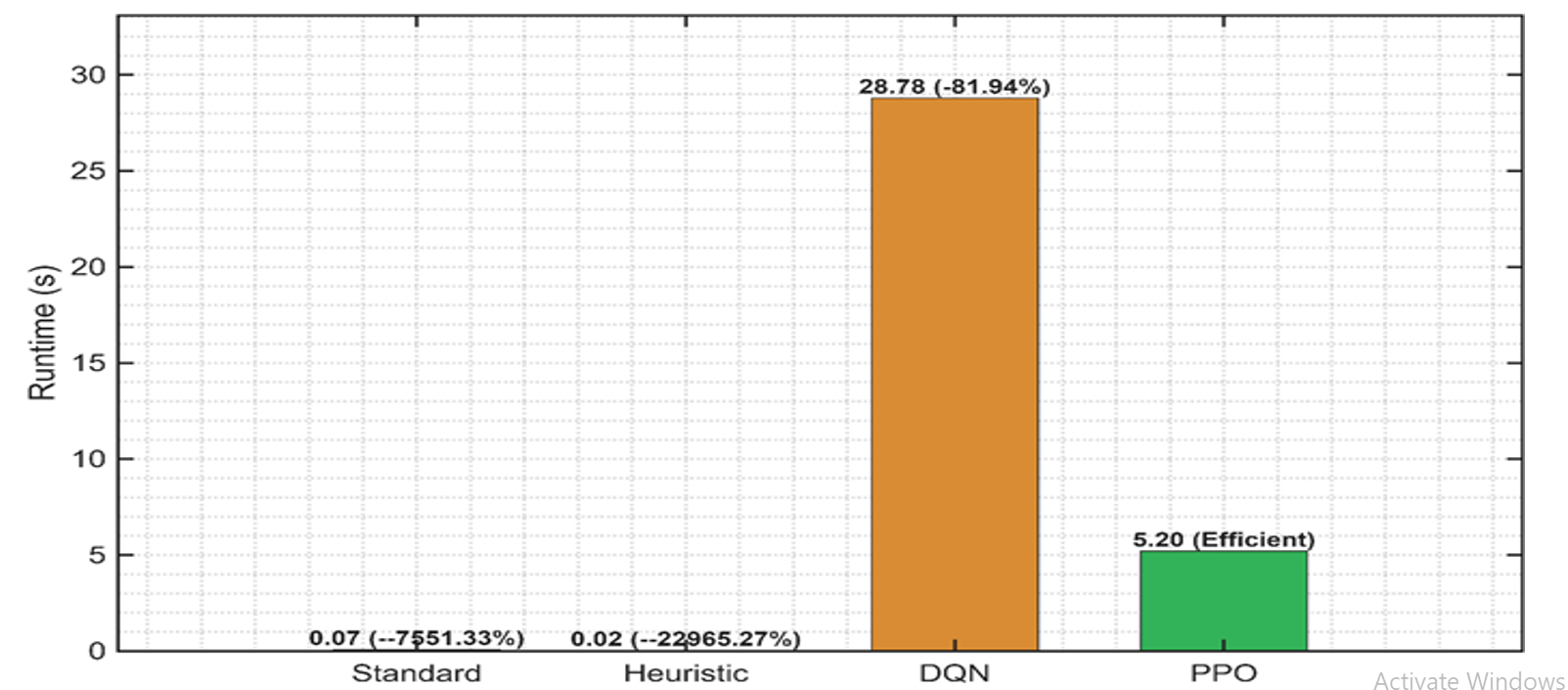
Low Power Wide Area Networks (LPWANs), particularly LoRaWAN, are increasingly being deployed in mobile Internet of Things (IoT) applications. In these applications, adaptive data rate (ADR) control is essential for maintaining reliable and energy-efficient communication under dynamic wireless conditions. However, ADR performance remains constrained when channel state information (CSI) is imperfect. Although reinforcement learning (RL)-based ADR methods have demonstrated notable improvement over conventional approaches, their effectiveness under imperfect CSI deployment scenarios remains insufficiently explored. In this paper, we investigate the robustness of RL-based ADR approaches with imperfect CSI for mobile LoRaWAN networks using a mobility-aware simulation framework. Standard ADR, heuristic ADR, Deep Q-Network (DQN)-based ADR, and Proximal Policy Optimisation (PPO)-based ADR are evaluated across varying mobility patterns, network layouts, and channel dynamics. Key performance metrics include packet delivery ratio, latency, runtime efficiency, and retention of baseline capability are evaluated. The Results show that PPO achieves the best performance under imperfect CSI conditions, attaining a mean packet delivery ratio of 0.9954, outperforming standard ADR, heuristic ADR, and DQN by 29.49%, 19.12%, and 1.55%, respectively. In addition, PPO reduced latency by 53.12% and runtime by 81.94% compare to DQN while preserving over 99% of baseline communication reliability under scenario variation. These findings demonstrate that policy-gradient learning provides better transferability, robustness, and deployment readiness compared with conventional and value-based ADR approaches. The study highlights the importance of evaluating intelligent wireless controllers not only for optimisation performance, but also for cross-scenario generalisation before real-world deployment in mobile LPWAN systems.
References
Adelantado, F., Vilajosana, X., Tuset-Peiro, P., Martinez, B., Melia-Segui, J., & Watteyne, T. (2017). Understanding the limits of LoRaWAN. IEEE Communications Magazine, 55(9), 34–40.
Alliance, L. (2015). Lorawan specification. LoRa Alliance, 1–82.
Azizi, F., Teymuri, B., Aslani, R., Rasti, M., Tolvaneny, J., & Nardelli, P. H. J. (2022a). MIX-MAB: Reinforcement learning-based resource allocation algorithm for LoRaWAN. 2022 IEEE 95th Vehicular Technology Conference :( VTC2022-Spring), 1–6.
Bor, M. C., Vidler, J. E., & Roedig, U. (2016). LoRa for the Internet of Things. Ewsn, 16, 361–366.
Centenaro, M., Vangelista, L., Zanella, A., & Zorzi, M. (2016). Long-range communications in unlicensed bands: The rising stars in the IoT and smart city scenarios. IEEE Wireless Communications, 23(5), 60–67.
Farhad, A., & Pyun, J.-Y. (2022). HADR: A hybrid adaptive data rate in LoRaWAN for Internet of Things. ICT Express, 8(2), 283–289.
Gbadamosi, A. S. (2020). Cloud-based IoT monitoring system for poultry farming in Nigeria. Arid Zone Journal of Engineering, Technology and Environment, 16(1), 100–108.
Lodhi, M. A., Wang, L., Farhad, A., Qureshi, K. I., Chen, J., Mahmood, K., & Das, A. K. (2025). A Contextual Aware Enhanced LoRaWAN Adaptive Data Rate for mobile IoT applications. Computer Communications, 232, 108042.
Mnih, V., Kavukcuoglu, K., Silver, D., Rusu, A. A., Veness, J., Bellemare, M. G., Graves, A., Riedmiller, M., Fidjeland, A. K., & Ostrovski, G. (2015). Human-level control through deep reinforcement learning. Nature, 518(7540), 529–533.
Nouar, A., Abbes, M. T., Boumerdassi, S., & Chaib, M. (2024). Impact of mobility model on LoRaWAN performance. Journal of Communications, 7–18.
Sarmento Neto, G. A., da Silva, T. A. R., de Abreu, P. F. F., Veloso, A. F. da S., Mendes, L. H. de O., Soares, A. C. B., & Junior, J. V. dos R. (2025). Evaluating a mobility-aware ADR scheme in urban and suburban LoRaWAN environments. Annals of Telecommunications, 1–14.
Schulman, J., Wolski, F., Dhariwal, P., Radford, A., & Klimov, O. (2017). Proximal policy optimization algorithms. ArXiv Preprint ArXiv: 1707.06347.
Teymuri, B., Serati, R., Anagnostopoulos, N. A., & Rasti, M. (2023a). Lp-mab: Improving the energy efficiency of lorawan using a reinforcement-learning-based adaptive configuration algorithm. Sensors, 23(4), 2363.
Van Hasselt, H., Guez, A., & Silver, D. (2016). Deep reinforcement learning with double q-learning. Proceedings of the AAAI Conference on Artificial Intelligence, 30(1).
Yazid, Y., Guerrero-González, A., Ez-Zazi, I., El Oualkadi, A., & Arioua, M. (2022). A reinforcement learning based transmission parameter selection and energy management for long range internet of things. Sensors, 22(15), 5662.
Zholamanov, B., Bolatbek, A., Saymbetov, A., Nurgaliyev, M., Yershov, E., Kopbay, K., Orynbassar, S., Dosymbetova, G., Kapparova, A., & Kuttybay, N. (2024). Enhanced Reinforcement Learning Algorithm Based-Transmission Parameter Selection for Optimization of Energy Consumption and Packet Delivery Ratio in LoRa Wireless Networks. Journal of Sensor and Actuator Networks, 13(6), 89.
Downloads
Published
Issue
Section
Categories
License
Copyright (c) 2026 Simon Nelson Boyi, Umar Suleiman Dauda, Safiu Abiodun Gbadamosi, Umar Zangina, James Garba Ambafi

This work is licensed under a Creative Commons Attribution 4.0 International License.