
A Systematic Review of Chronic Kidney Disease Prediction in Nigeria using Machine Learning Techniques
DOI:
https://doi.org/10.33003/fjs-2026-1014-5701Keywords:
Machine learning, Prediction models, early diagnosis, artificial intelligence, Nigeria, Chronic kidney diseaseAbstract
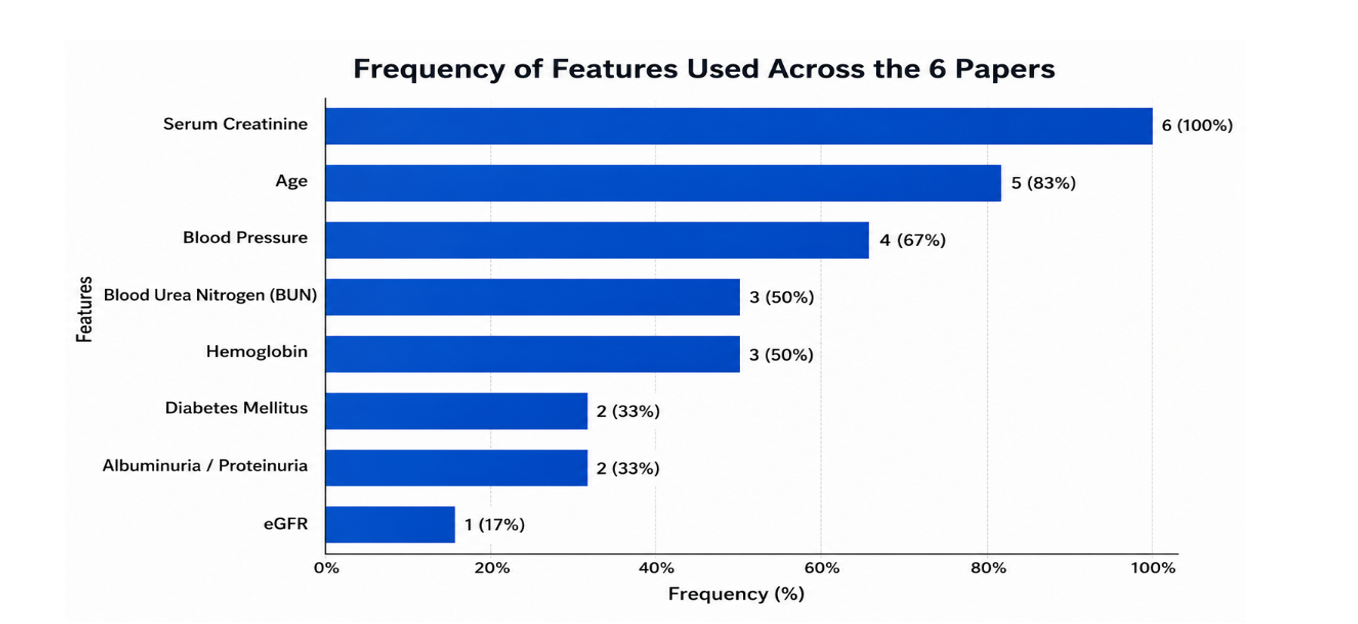
Chronic kidney disease (CKD) is a major public health problem in Nigeria, where delayed presentation, limited diagnostic capacity and low awareness contribute to under-diagnosis. Early identification of individuals at risk may help delay progression to end-stage renal disease. Machine learning (ML) provides an opportunity to improve risk stratification using routinely collected clinical data. This systematic review synthesized studies that used Nigerian clinical data to develop supervised ML models for CKD prediction or diagnosis. A systematic search of PubMed, Scopus, IEEE Xplore, Google Scholar and African Journals Online was conducted according to the Preferred Reporting Items for Systematic Reviews and Meta-Analyses (PRISMA) 2020 guidelines for studies published between January 2010 and April 2025. Methodological quality and risk of bias were assessed using the Prediction Model Risk of Bias Assessment Tool (PROBAST). Six empirical studies met the eligibility criteria. Reported model accuracy ranged from 81.3% to 99.4%, with Random Forest, Gradient Boosting, Deep Neural Networks and hybrid approaches among the methods used. Serum creatinine, age, blood pressure, blood urea nitrogen and haemoglobin were frequently reported predictors. Major limitations included small and heterogeneous datasets, limited interpretability, inadequate external validation and limited translation of models into routine clinical practice. Future research should prioritize multicentre prospective datasets, transparent reporting, external validation and explainable ML approaches to support clinically useful and equitable CKD prediction in Nigeria.
References
Adunni, O. O., Olusayo, O. E., Olatunde, O. S., Segun, S. O., & Aina, S. (2022). ACO-KNN predictive model for diagnosis of chronic kidney disease. International Journal of Research and Innovation in Applied Science.
Aliyu, A. M., Mumin, K. A., Abubakar, A. B., Abba, A. S., & Ibrahim, A. (2025). Performance evaluation of machine learning algorithm using chronic kidney disease (CKD) dataset. FUDMA Journal of Sciences, 9(12), 72–80. https://doi.org/10.33003/fjs-2025-0912-4025
Apiyanteide, F., Eu, N., Cc, O., & Digban, K. (2023). Systematic review and meta-analysis of the epidemiology of chronic kidney disease in Nigeria, 11(12), 690–709.
Bagbe, A., Akomolafe, A. A., & Bagbe, A. S. (2025). Development and evaluation of a machine learning model for predicting terminal diseases. Asian Journal of Probability and Statistics, 27(4), 157–165. https://doi.org/10.9734/ajpas/2025/v27i4747
Bakare, O., Agaba, E., Gimba, Z., Abene, E., Imoh, L., & Maji, J. (2025). Assessing renal function in chronic kidney disease: A comparative evaluation of glomerular filtration rate prediction equations in the North-Central Region of Nigeria. Cureus, 17. https://doi.org/10.7759/cureus.84577
Barrera-García, J., Cisternas-Caneo, F., Crawford, B., Gómez Sánchez, M., & Soto, R. (2024). Feature selection problem and metaheuristics: A systematic literature review about its formulation, evaluation and applications. Biomimetics, 9(1). https://doi.org/10.3390/biomimetics9010009
Bikbov, B., Purcell, C. A., Levey, A. S., et al. (2020). Global, regional, and national burden of chronic kidney disease, 1990–2017: A systematic analysis for the Global Burden of Disease Study 2017. The Lancet, 395(10225), 709–733. https://doi.org/10.1016/S0140-6736(20)30045-3
Chawla, N. V., Bowyer, K. W., & Hall, L. O. (2002). SMOTE: Synthetic minority over-sampling technique. Journal of Artificial Intelligence Research, 16, 321–357.
Delrue, C., De Bruyne, S., & Speeckaert, M. M. (2024). Application of machine learning in chronic kidney disease: Current status and future prospects. Biomedicines, 12(3). https://doi.org/10.3390/biomedicines12030568
Ibrahim Iliyas, I., Rambo, S. I., Dauda, A. B., & Tasiu, S. (2021a). Prediction of chronic kidney disease using deep neural network. FUDMA Journal of Sciences, 4(4), 34–41. https://doi.org/10.33003/fjs-2020-0404-309
Iftikhar, H., Hashem, A. F., Qureshi, M., & Rodrigues, P. C. (2025). Clinical application of machine learning models for early-stage chronic kidney disease detection. Diagnostics, 15(20). https://doi.org/10.3390/diagnostics15202610
Iliyas, I. I., Boukari, S., & Ya, A. (2025). Recent trends in prediction of chronic kidney disease using different learning approaches: A systematic literature review. Journal of Medical Artificial Intelligence. https://doi.org/10.21037/jmai-24-256
Iliyas, I. I., Isah, R. S., Ali, B. D., & Andra, U. (2021b). Comparative analysis of some prominent machine learning algorithms for the prediction of chronic kidney disease. Academy Journal of Science and Engineering, 15(1).
Islam, M. A., Majumder, M. Z. H., & Hussein, M. A. (2023). Chronic kidney disease prediction based on machine learning algorithms. Journal of Pathology Informatics, 14, 100189. https://doi.org/10.1016/j.jpi.2023.100189
Khalid, F., Alsadoun, L., Khilji, F., et al. (2024). Predicting the progression of chronic kidney disease: A systematic review of artificial intelligence and machine learning approaches. Cureus, 16(5), e60145. https://doi.org/10.7759/cureus.60145
Mbunge, E., & Batani, J. (2023). Application of deep learning and machine learning models to improve healthcare in sub-Saharan Africa: Emerging opportunities, trends and implications. Telematics and Informatics Reports, 11, 100097. https://doi.org/10.1016/j.teler.2023.100097
Olanrewaju, T. O., Aderibigbe, A., Popoola, A. A., et al. (2020). Prevalence of chronic kidney disease and risk factors in North-Central Nigeria: A population-based survey. BMC Nephrology, 21(1), 467. https://doi.org/10.1186/s12882-020-02126-8
Osofisan, A. O., Adeyemo, O. O., Sawyerr, B. A., & Eweje, O. (2011). Prediction of kidney failure using artificial neural networks. European Journal of Scientific Research, 61(4), 487–492.
Owoyemi, A., Owoyemi, J., Osiyemi, A., & Boyd, A. (2020). Artificial intelligence for healthcare in Africa. Frontiers in Digital Health, 2, 6. https://doi.org/10.3389/fdgth.2020.00006
Page, M. J., McKenzie, J. E., Bossuyt, P. M., et al. (2021). The PRISMA 2020 statement: An updated guideline for reporting systematic reviews. BMJ, 372, n71. https://doi.org/10.1136/bmj.n71
Rashed-Al-Mahfuz, M., Haque, A., Azad, A., et al. (2021). Clinically applicable machine learning approaches to identify attributes of chronic kidney disease (CKD) for use in low-cost diagnostic screening. IEEE Journal of Translational Engineering in Health and Medicine, 9, 4900511. https://doi.org/10.1109/JTEHM.2021.3073629
Wolff, R. F., Moons, K. G. M., Riley, R. D., et al. (2019). PROBAST: A tool to assess the risk of bias and applicability of prediction model studies. Annals of Internal Medicine, 170(1), 51–58. https://doi.org/10.7326/M18-1376
Zheng, J.-X., Li, X., Zhu, J., et al. (2024). Interpretable machine learning for predicting chronic kidney disease progression risk. DIGITAL HEALTH, 10, 20552076231224224. https://doi.org/10.1177/20552076231224225
Downloads
Published
Issue
Section
Categories
License
Copyright (c) 2026 Hauwa Ahmad Amshi, Saratu Yusuf Ilu, Usman Muhammad Kadai

This work is licensed under a Creative Commons Attribution 4.0 International License.


