
Reliability Assessment and Failure Analysis of Solar Photovoltaic Systems in the Northern Region of Adamawa State, Nigeria
DOI:
https://doi.org/10.33003/fjs-2026-1012-5697Keywords:
Solar Photovoltaic, Failure Analysis, Reliability, MTBF, Infant Mortality, Adamawa State, NigeriaAbstract
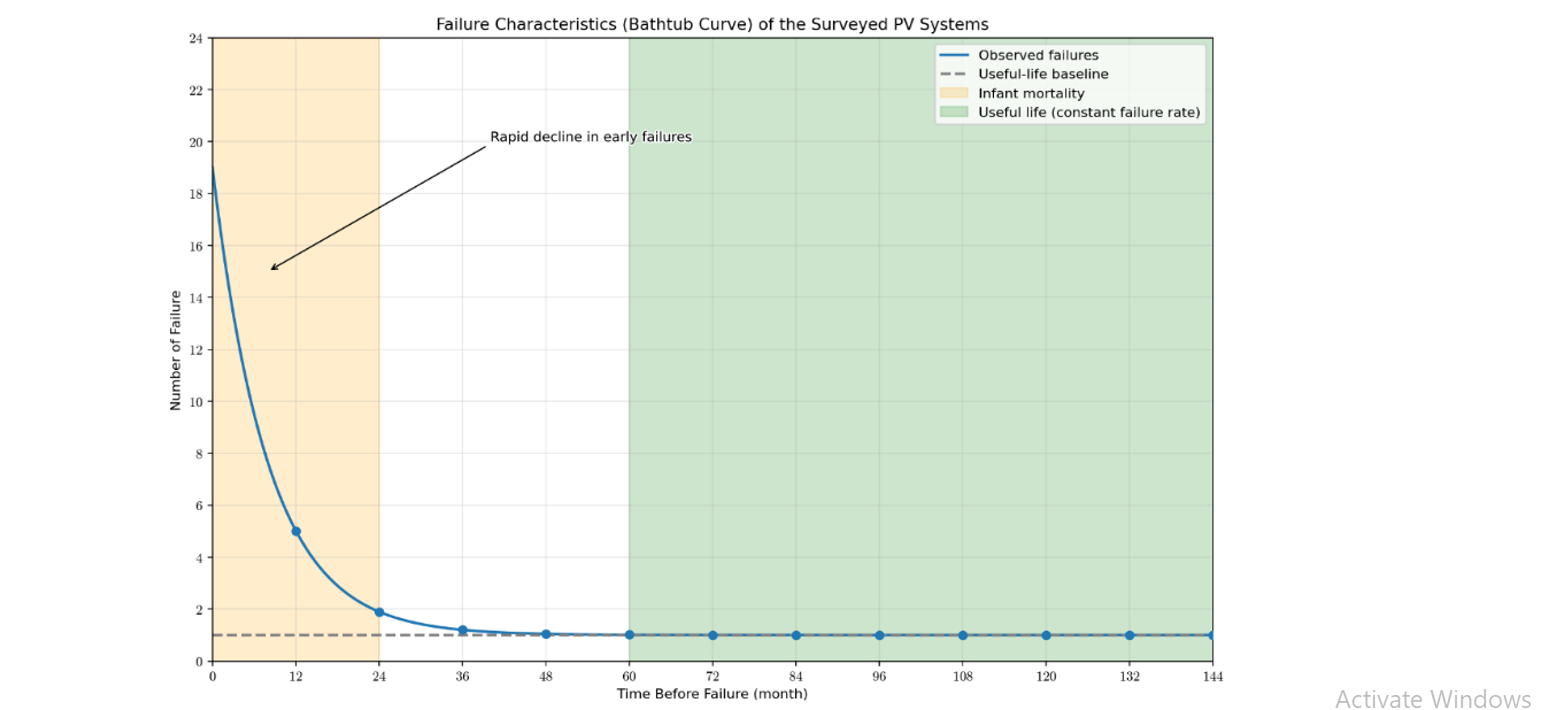
The deployment of solar photovoltaic (PV) systems in Northern Nigeria is crucial for addressing energy poverty. However, long-term success is often hindered by high failure rates. This study provides a detailed assessment of failures and reliability for solar PV systems installed in the Adamawa Northern Region from 2009 to 2022. Data were collected from 38 solar PV systems, comprising 12 Solar Street Lights (SSLs), 19 Solar Clinic Systems (SCSs), and 7 Solar Home Systems (SHSs), using field inspections, structured interviews, and component reliability analysis. The findings reveal a troubling infant mortality rate, with 52.63% of failures occurring within the first year of operation. The overall system failure rate (λ) was 0.2278 per month, with a Mean Time Between Failures (MTBF) of 3.16 months and an overall system reliability of 76% during the observation period. Major causes of failure included poor installation practices, the use of non-deep-cycle batteries, inadequate system design, and a lack of proper post-installation maintenance. Our reliability models indicate that parallel system configurations can improve system reliability from 76.0% to 94.24%, representing approximately 24% improvement over conventional series configurations. The study concludes by highlighting the importance of establishing improved technical standards, rigorous quality control during procurement and installation, and organized maintenance protocols to extend the lifespan and boost the reliability of solar PV systems in the region.
References
Adebayo, A. A. (2004). Climate I: Sunshine, temperature, evaporation, and relative humidity. In A. A. Adebayo and A. L. Tukur (Eds.), Adamawa State in maps. Paraclete Publishers.
Adelaja, A. O. (2021). Solar energy deployment in Nigerian schools: Challenges and prospects. Energy for Sustainable Development, 62, 1–10.
Batzelis, E., Gupta, N., Garg, R., and Kumar, P. (2007). Sensitivity and reliability models of a photovoltaic system connected to the grid.Renewable and Sustainable Energy Reviews, 69, 188–196.
International Electrotechnical Commission. (2016). IEC 62446-1:2016 Photovoltaic (PV) systems—Requirements for testing, documentation and maintenance. International Electrotechnical Commission.
International Energy Agency. (2002). Reliability study of grid-connected PV systems: Field experience and recommended design practice. International Energy Agency.
Kuitche, J. M., Tamizh-Mani, G., and Pan, R. (2011). Failure modes, effects and criticality analysis (FMECA) approach to the crystalline silicon photovoltaic module reliability assessment.Proceedings of SPIE (Vol.8112, Article 81120L).SPIE. https://doi.org/1
Meyer, E. L., and Van Dyk, E.E. (2004).Assessing the reliability and degradation of photovoltaic module performance parameters. IEEE Transactions on Reliability, 53(1), 83–92. https://doi.org/10.1109/TR.2004.824831
Olayinka, A. S., and Olaolu, T. A. (2019). Performance evaluation of solar photovoltaic systems in northern Nigeria. Journal of Renewable Energy, 15(2), 45–56.
Shaaban, M., and Petinrin, J. O. (2014). Renewable energy potentials in Nigeria: Meeting rural energy needs. Renewable and Sustainable Energy Reviews, 29, 72–84. https://doi.org/10.1016/j.rser.2013.08.078
Stephen, O. O., Li, Y., Zhang, W., Zhang, F., and Sun, H. (2012). Reliability analysis of switched stand-alone hybrid PV–diesel generation power systems for rural electrification in Nigeria.International Journal on Electrical Engineering and Informatics, 4(4), 663–676.
Tekwa, I. J., and Usman, B. H. (2006). Effects of land degradation on soil resources in the Sudano–Sahelian zone of Nigeria. Journal of Arid Environments, 64(1), 1–14.
Downloads
Published
Issue
Section
Categories
License
Copyright (c) 2026 Ibrahim Buba

This work is licensed under a Creative Commons Attribution 4.0 International License.


