
Investigation On Hygiene Indicator Analysis (Total Coliforms, E. coli) of Kunun Aya Sold By Different Vendors Along Zoo Road, Kano Municipal, Kano State, Nigeria
DOI:
https://doi.org/10.33003/fjs-2026-1012-5695Keywords:
Kunun Aya, total coliforms, Escherichia coli, hygiene indicator organisms, MPN, foodAbstract
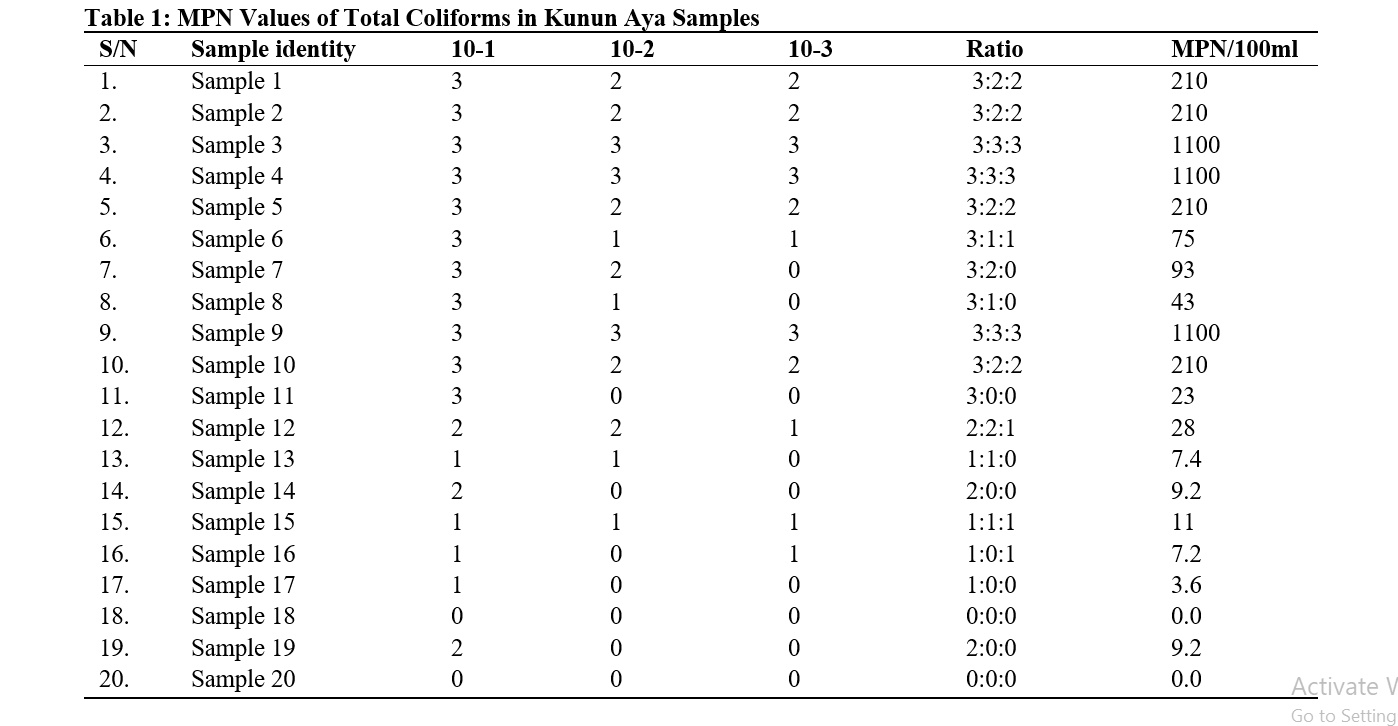
Kunun Aya is a common non-alcoholic beverage that is widely consumed in Nigeria owing to its high nutritional value and low cost. Poor hygiene during the production, packaging, storage, and sales of the beverage may expose it to microbiological contamination. This work evaluated the microbiological quality of Kunun Aya beverages sold by various vendors in Zoo Road, Kano Municipal Area, Nigeria, using total coliforms and Escherichia coli as indicators of hygiene. Twenty (20) Kunun Aya samples were collected aseptically and subjected to standard microbiological procedures. Total coliforms were determined by the MPN technique, while Escherichia coli was identified by isolation on EMB and confirmed through Gram staining. The results indicated a coliform count range of 0 to 1100 MPN/100 mL. Eighteen (90%) samples tested positive for total coliforms, but only two (10%) of the samples conformed to the accepted standard. Isolation of E. coli was positive in 8 (40%) samples, suggesting the potential presence of feces. Comparative analysis with WHO and NAFDAC standards revealed that most of the samples did not meet the standards. This study indicates that a considerable amount of Kunun Aya produced in the studied area presents various hazards to public health. Hygienic improvement, consumption of clean drinking water, microbial monitoring, and stringent regulation are therefore required for ensuring the microbiological safety of locally produced drinks.
References
Adeleye, A. O., Yusuf, M. A., Sadiq, M. B. (2024). Detection of bacterial contaminants in ready-to-drink Zobo beverage sold within a university environment. International Journal of Scientific Research, 13(2): 45–52.
Asante-Poku, A., Owusu, M., & Addo, K. K. (2024). Microbiological quality assessment of Sobolo and other traditional beverages sold in urban communities in Ghana. Journal of Food Safety and Hygiene, 9(1), 12–21. https://www.scirp.org/journal/paperinformation.aspx?paperid=136884
Eruteya, O. C., Mmonu, J. C., & Jonathan, F. C. (2024). Assessment of the nutritional and microbiological quality of vended tiger nut (Cyperus esculentus) drink in Choba, Rivers State, Nigeria. FUDMA Journal of Sciences, 8(2), 23–28. https://doi.org/10.33003/fjs-2024-0802-2327
Ezemba, C. C., Obinabo, C. C., Archibong, E. J., & Mbah, O. M. (2021). Microbial assessment of kunu sold in Awka Metropolis. Microbiology Research Journal International, 31(11), 18–25. https://doi.org/10.9734/MRJI/2021/v31i1130355
National Agency for Food and Drug Administration and Control. (2020). Guidelines for microbiological quality of foods and ready-to-eat products in Nigeria. National Agency for Food and Drug Administration and Control.
Okwelle, A. A. (2020). Assessment of the microbiological quality of tiger nut (Cyperus esculentus) drink sold in Ignatius Ajuru University of Education, Port Harcourt, Nigeria. Zenodo. https://doi.org/10.5281/zenodo.4430210
Sadiq, A., & Atteh, B. O. (2023). Impact of ingredients formulation and processing parameters on the nutritional quality of foam-mat dried Kunun-zaki powder (A Nigerian fermented cereal beverage). Journal of Agricultural and Food Chemical Engineering, 3, 1–13. https://doi.org/10.58612/jafce351
Tersoo-Abiem, J., & Orinya, I. A. (2024). Microbial quality of home-made street-vended beverages sold in Makurdi Metropolis, Nigeria. European Journal of Nutrition & Food Safety, 16(2), 112–121. https://journalejnfs.com/index.php/EJNFS/article/view/1516
World Health Organization. (2022). Guidelines for drinking-water quality (4th ed.). World Health Organization. https://www.who.int/publications/i/item/9789240049954
Downloads
Published
Issue
Section
Categories
License
Copyright (c) 2026 Hadiza Ali, Muhammad Abba Husaini Na’abba, Zainab Gobir

This work is licensed under a Creative Commons Attribution 4.0 International License.


