
Comparative Review of Intelligent Flood Monitoring and Risk Assessment Systems: An IoT–Random Forest Perspective
DOI:
https://doi.org/10.33003/fjs-2026-1016-5687Keywords:
Early warning systems, Flood monitoring, Internet of Things (IoT), Machine learning, Random ForestAbstract
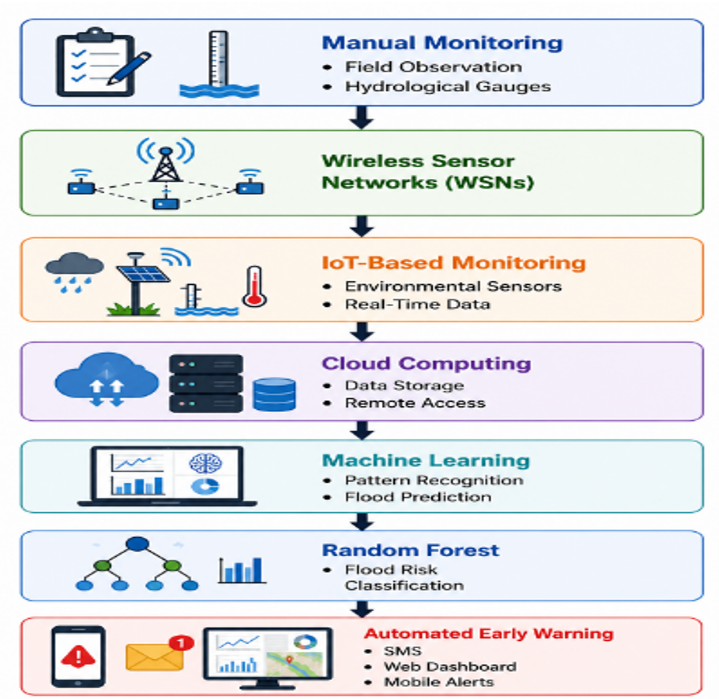
Flooding remains one of the most destructive natural hazards worldwide, causing significant loss of life, damage to infrastructure, and socioeconomic disruption. Recent advances in the Internet of Things (IoT), wireless communication, and machine learning have enabled the development of intelligent flood monitoring systems capable of supporting real-time environmental monitoring and timely decision-making. This study presents a comparative review of recent intelligent flood monitoring systems with the objective of evaluating current technological approaches and identifying effective design strategies for flood risk assessment. The review systematically compares existing studies based on key criteria, including environmental sensing parameters, IoT architectures, wireless communication technologies, machine learning techniques, flood prediction capabilities, web-based monitoring platforms, and automated early warning mechanisms. Particular attention is given to an integrated framework that combines IoT-based environmental sensing with the Random Forest machine learning algorithm and its relative strengths when compared with other reported approaches. The comparative evaluation indicates that integrating multiple environmental sensors with Random Forest models generally provide improved predictive reliability, greater robustness to heterogeneous environmental data, reduced susceptibility to overfitting, and enhanced support for real-time flood risk classification. Furthermore, the incorporation of web-based monitoring interfaces and automated alert mechanisms contributes to more efficient dissemination of flood information and improved emergency preparedness. The findings provide a comprehensive overview of recent technological developments and highlight the value of integrating IoT sensing and Random Forest-based analytics as a practical direction for developing reliable, scalable, and intelligent flood monitoring and risk assessment systems.
References
Abdulridha, H. M., Al-Hilo, A. A., & Jasim, A. N. (2022). Internet of Things based flood monitoring and early warning systems: A review. International Journal of Electrical and Computer Engineering, 12(5), 5280–5292.
Arabameri, A., Costache, R., Pham, Q. B., Blaschke, T., Bui, D. T., & Chen, W. (2023). Flood susceptibility assessment using ensemble machine learning models: A systematic review. Science of the Total Environment, 858, 159769.
Breiman, L. (2001). Random forests. Machine Learning, 45(1), 5–32. https://doi.org/10.1023/A:1010933404324
Géron, A. (2023). Hands-on machine learning with Scikit-Learn, Keras, and TensorFlow (3rd ed.). O'Reilly Media.
Intergovernmental Panel on Climate Change. (2023). Climate change 2023: Synthesis report. IPCC. https://www.ipcc.ch/report/ar6/syr/
United Nations Office for Disaster Risk Reduction. (2022). Global assessment report on disaster risk reduction 2022: Our world at risk. UNDRR. https://www.undrr.org/gar2022
World Meteorological Organization. (2023). State of the global climate 2023. WMO. https://wmo.int/publication-series/state-of-global-climate-2023
Yaseen, Z. M., Sulaiman, S. O., Deo, R. C., & Chau, K. W. (2022). Internet of Things and machine learning for flood prediction and smart water resources management: A review. Environmental Science and Pollution Research, 29(37), 55516–55539.
Downloads
Published
Issue
Section
Categories
License
Copyright (c) 2026 Idayana Alabere, Epelle Bright Curthbert

This work is licensed under a Creative Commons Attribution 4.0 International License.


