
Bioherbicidal Activity of Endophytic Aspergillus niger Crude Extract Against Major Weeds of Rice Crops for Sustainable Agriculture
DOI:
https://doi.org/10.33003/fjs-2026-1013-5683Keywords:
Endophytic Fungus, Extract, Bioherbicidal Activity, GC-MS, WeedsAbstract
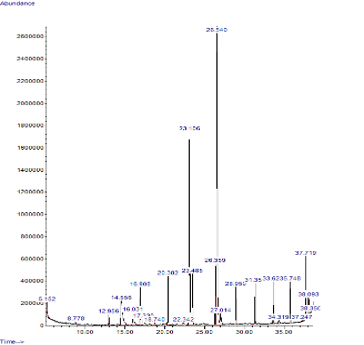
Rice (Oryza sativa) is one of the most stable foods in Nigeria, but efficient production is limited by weeds attack. This study assessed the bioherbicidal activity of endophytic Aspergillus niger extract against Echinochiola crus-galli, Cyperus iria, and I. rugosum weeds. A fungus was isolated from healthy Vitellaria paradoxa leaves and molecularly identified as Aspergillus niger (MIK1) strain with accession number AM270408.1 recorded in the NCBI GenBank. PDA Pure mycelial culture of the fungus was grown in 250mLErlenmeyer flasks containing 100mL PDB medium on a shaker at 120 rpm and 28°C for 12days.The broth culture was extracted using ethyl acetate and yielded 4.57g of crude extract. GC–MS analysis detected 26 compounds in the extract. Bioherbicidal activity at varying concentration of 0.125, 0.25, 0.5 1.0μg/mL indicated that the extract inhibited seed germination of E. crus-galli (17.4 %), shoot length (6.3%), and radicle length (9.4 %) at the highest concentration(1.0 μg/mL). Screen house test showed a reduction of shoot fresh and dry weights of both weeds with over 80 % at 1.0 μg/mL. ANOVA test showed that germinations, seedling growths, and biomass reduction of both weeds were not significantly different (p˃ 0.05). These findings reveal that endophytic Aspergillus niger crude extract from Nigeria V.paradoxa possessed bioactive compounds with bioherbicidal activity against the test weeds. Further investigations for practical applications in the field to manage other weeds is suggested for sustainable agriculture.
References
Ahmad Y, Ahmad MN, Zia A, Alam SS, Khan RA and Riaz M. (2020). Bio control of economically important weed species through endophytic fungi isolated from Parthenium hysteropho (Family: Asteraceae). Egypt. J. Biol. Pest. Control, 30 (1), 1- 8. https://doi.org/10.1186/s41938-020-00295-0.
Alshallash KS. (2018.Germination of weed species (Avena fatua, Bromus catharticus, Chenopodium album and Phalaris minor) with implications for their dispersal and control. Ann Agric Sci 63(1): 91-97. https://doi.org/10.1016/j.aoas.2018.05.003.
Ashraf M, Ahmad MSA, Öztürk M, Aksoy A. (2021). Crop improvement through different means: Challenges and prospects. In Crop Production for Agricultural Improvement; Ashraf, M., Öztürk M, Ahmad M, Aksoy A, Eds. Springer: The Netherlands.
Bhardwaj A, Sharma D, Agrawal PK. (2015). Isolation and characterization of endophytic fungi from spikes of Pinus roxburghii growing in Himalayan region. World J Pharm Res 3(9):568–579
Bisht R., Sharma D and Agrawal PK. (2016). Antagonistic and antibacterial activity of endophytic fungi isolated from needle of Cupressus torulosa D.Don. Asian J Pharm Clin,, Res 9(3):282–288.
Fawole OB and Yahaya JU. (2017). Bio-control potentials of crude extracts of soil fungi on Amaranthus hybridus and Phyllanthus amarus. Journal of Agricultural Sciences, 62(1): 41-49.
Gharde Y, Singh PK, Dubey RP, and Gupta PK. (2018). Assessment of yield and economic losses in agriculture due to weeds in India. Journal of Crop Protection 107, 12–18. https://doi.org/10.1016/j.cropro.2018.01.007.
Gnanavel I. (2015. Eco-Friendly Weed Control Options for Sustainable Agriculture. Science Alert. Available at: https://scialert.net/fulltext/?doi=sciintl.37.47, (accessed 30 March 2021).
Gul HI, Tugrak M and Sakagami H. (2017). Synthesis and bioactivity studies on new 4-(3-(4 substitutedphenyl)-3a, 4-dihydro-3Hindeno[1,2-c]pyrazol-2-yl) benzenesulfonamides. J Enzyme Inhib Med Chem;, 31.
Hamzah TN, Lee SY, Hidayat A. Terhem R. (2018). Faridah-Hanum I., Mohamed R., Diversity and characterization of endophytic fungi isolated from the tropical mangrove species, Rhizophora mucronata, and identification of potential antagonists against the soil-borne fungus, Fusarium solani. Front Microbiol, 9: 1707. https://doi.org/10.3389/fmicb.2018.01707.
Hashem AH, Abu-Elreesh G, El-Sheikh HH and Suleiman WB. (2022). Isolation, identification, and statistical optimization of a psychrotolerant Mucor racemosus for sustainable lipid production. Biomass Conversion and Biorefinery, https://doi.org/10.1007/s13399-022-02390-8.
Kaul S, Gupta S, Ahmed M and Dhar MK. (2012). Endophytic fungi from medicinal plants: a treasure hunt for bioactive metabolites. Phytochem Rev, 11:487–505.
Kumar S, Stecher G, Li M, Knyaz C and Tamura K. (2018). MEGA X: Molecular evolutionary genetics analysis across computing platforms. Molecular Biology and Evolution, , 35(6), 1547-1549. https://doi.org/10.1093/molbev/msy096.
Kusari S, Pandey SP, and Spiteller M. (2013). Untapped mutualistic paradigms linking host plant and endophytic fungal production of similar bioactive secondary metabolites. Phytochemistry. 91:81–87.
Lahlali R, Hijri M. (2010). Screening, identification and evaluation of potential biocontro l fungalendophytes against Rhizoctonia solani AG3 on potato plants. FEMS Microbiol. Lett., 311, 152–159.
Marcias-Rubalcava M.L.Ruiz-Velasco SM.E and Melendez- Gonzalez C, Hernandez-Ortega S. (2014). Naphthoquinone spiroketals and organic extracts from the endophytic fungus Edenia gomezpompae as potential herbicides. J. Agric. Food Chem., 62, 3553- 3562. https://doi.org/10.1021/jf500965k.
Mohammed AM., Umar, K.M., Abdullahi, IL., and Terhem, R. (2025). Antifungal activity of endophytic fungi extracts isolated from Vitellaria paradoxa against phytopathogenic fungi in cucumber crops. Journal of Scientific Agriculture, 9, 110–121.
Nia R, Mia M, Oktapiana K. (2017). Antibacterial Activity Test of Endophytic Fungus from Mangrove Plant (Rhizophora apiculata L) and (Bruguiera gymnorrizha (L.) Lamk) Against Klebsiella pneumoniae ATCC 700603. In: 2nd International Conference on Sustainable Agriculture and Food Security: A Comprehensive Approach. Dubai: KnE Life Sciences, pp. 146-157. https://doi.org/10.18502/kls.v2i6.1031.
Padhi S, Tayung K. (2015). In vitro antimicrobial potentials of endolichenic fungi isolated from thalli of Parmelia lichen against some human pathogens. Beni-Suef. Univ. J. Basic. Appl. Sci. 4, 299-306. https://doi.org/10.1016/j.bjbas.11.006
Prihanto AA, Firdaus M, Nurdiani R. (2011). Endophytic fungi isolated from mangrove (Rhyzopora mucronata) and its antibacterial activity on Staphylococcus aureus and Escherichia coli. J. Food Sci. 1, 386-389.
Rana K L, Kour D, Sheikh I, Yadav N, Yadav A N, Kumar V, Singh B P, Dhaliwal HS and Saxena A K. (2019). Biodiversity of endophytic fungi from diverse niches and their biotechnological applications. In B. P. Singh (Ed.), Advances in Endophytic Fungal Research (pp. 105-144) Cham, Switzerland: Springer, https://doi.org/10.1007/978-3-030- 03589-1_6.
Rukachaisirikul V, Rodglin A, Sukpondma Y, Pongpaichit S, Buatong J, Sakayaroj J. (2012). Phthalide and isocoumarin derivatives produced by an Acremonium sp. isolated from a mangrove R. apiculata. J. Nat. Prod. 75, 853-858. https://doi.org/10.1021/np200885e
Sharma M, Tarafdar A, Ghosh R and Gopalakrishanan S. (2017). Biological control as a tool for eco-friendly management of plant pathogens. In: Adhya TK, Lal B, Mohapatra B, Paul D, Das S. (Eds.), Advances in Soil Microbiology: Recent Trends and Future Prospects, Springer, Singapore, Pp. 153–188.
Strobel GA. (2018). The emergence of endophytic microbes and their biological promise. J. Fungi, 2018, 4, 57.
Sun X, Guo LD, Endophytic fungal diversity. (2012). Review of traditional and molecular techniques. Mycology, 3, 65–76.
Talla E, Nyemb JN, Tiabou, AT, Djou SG, Biyanzi P, Sophie L, & Tanyi JM. (2016). Antioxidant Activity and a New Ursane-type Triterpene from Vitellaria paradoxa (Sapotaceae) Stem Barks. European Journal of Medicinal Plants, 16(3), 1–20. https://doi.org/10.9734/EJMP/2016/28847.
Tilley N. (2019). What is a weed: Weed info and control methods in gardens? gardening know how. Available at: https://www.gardeningknowhow.com/plant-problems/weeds/what-is-a-weed.html, (Accessed on March 30, 2021).
Torretta V, Katsoyiannis IA, Viotti Pand Rada EC. (2018). Critical review of the effects of glyphosate exposure to the environment and humans through the food supply chain. Sustainability, 10, 950. https://doi.org/10.3390/su10040950.
Uzma F, Konappa NM and Chowdappa S. (2016). Diversity and extracellular enzyme activities of fungal endophytes isolated from medicinal plants of Western Ghats, Karnataka. EJBAS, 3, 335-342. https://doi.org/10.1016/j.ejbas.08.007
Watanabe T. (2002.).Pictorial Atlas of Soil and Seed Fungi: Morphologies of Cultured Fungi and Key to Species, 2nd ed.; CRC Press: Washington. DC, USA.
White TJ,Bruns T, Lee S. (1990).Taylor J.Amplification and Direct Sequencing of Fungal Ribosomal rNA Genes for Phylogenetics. In PCR Protocols. A Guide to Methods and Applications; Innis, M.A., Gelfand, D.H., Sninsky, J.J., White, T.J., Eds.; Academic Press: San Diego, CA, USA, pp. 315–322.
Zhao J, Zhou L, Wang J, Shan T, Zhong L, Liu X and Gao X. (2010). Endophytic fungi for producing bioactive compounds originally from their host plants. in: Méndez-Vilas, A. (Eds.), Current Research, Technology and Education Topics in Applied Microbiology and Microbial Biotechnology, First ed. Badajoz: Formatex Research Center, pp. 567-576.
Downloads
Published
Issue
Section
Categories
License
Copyright (c) 2026 Abdullahi Mairiga Mohammed, Kabir Mustapha Umar

This work is licensed under a Creative Commons Attribution 4.0 International License.