
Qualitative and Quantitative Phytochemical Profiling of Hibiscus sabdariffa L. Seeds: Secondary Metabolite Characterization and Implications for Nutraceutical and Therapeutic Applications
DOI:
https://doi.org/10.33003/fjs-2026-1015-5678Keywords:
Hibiscus sabdariffa, Roselle seeds, Phytochemical screening, Secondary metabolites, AlkaloidsAbstract
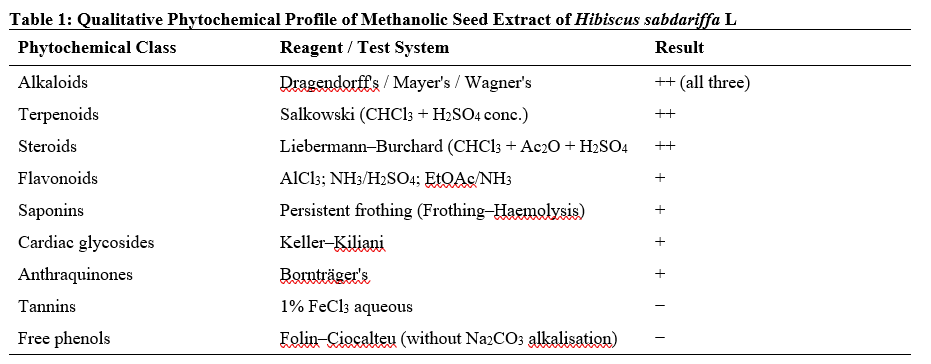
Hibiscus sabdariffa L. (Malvaceae), commonly known as roselle, is a widely cultivated multipurpose plant of considerable ethnopharmacological relevance across tropical and subtropical regions of Africa, Asia, and the Americas. Despite sustained global interest in the phytochemistry of its calyces and leaves, systematic characterisation of the seed fraction remains comparatively underexplored. This study reports a parallel qualitative and quantitative phytochemical analysis of methanolic extracts of H. sabdariffa seeds sourced from the Onigambari Research Station, Ibadan, Nigeria. Qualitative screening conducted according to Harborne (1973) and Evans (2009) detected seven of nine secondary metabolite classes tested. Alkaloids, terpenoids, and steroids were recorded as abundantly present (++), while flavonoids, saponins, cardiac glycosides, and anthraquinones were present (+). Tannins and free phenols were absent (−). Gravimetric quantification yielded alkaloids at 1.55 ± 0.002% (w/w), terpenoids at 1.30 ± 0.001% (w/w), and saponins at 0.45 ± 0.002% (w/w). Spectrophotometric analyses, performed in triplicate against validated calibration curves (R² ≥ 0.99), gave: total tannin content (TTC) of 1.05 ± 0.007% (w/w) gallic acid equivalents (GAE); total flavonoid content (TFC) of 0.28 ± 0.249% (w/w) quercetin equivalents (QE); and total phenolic content (TPC) of 0.83 ± 0.001% (w/w) GAE. The detected phytochemical assemblage is consistent with reported antioxidant, anti-inflammatory, antimicrobial, and cardioprotective activities of the species. These findings provide an empirical basis for the seed's continued evaluation as a nutraceutical ingredient and herbal medicine resource.
References
Ali, B. H., Al-Wabel, N. A., & Blunden, G. (2005). Phytochemical, pharmacological and toxicological aspects of Hibiscus sabdariffa L.: A review. Phytotherapy Research, 19(5), 369–375. https://doi.org/10.1002/ptr.1628
Awad, A. B., & Fink, C. S. (2000). Phytosterols as anticancer dietary components: Evidence and mechanism of action. Journal of Nutrition, 130(9), 2127–2130. https://doi.org/10.1093/jn/130.9.2127
Chukwu, C. N., Ogunka-Nnoka, C. U., & Akaninwor, J. O. (2019). Phytochemical composition, anti-nutrient properties and antioxidant potentials of raw Hibiscus sabdariffa seeds. Archives of Current Research International, 17(3), 1–10. https://doi.org/10.9734/acri/2019/v17i330113
Da-Costa-Rocha, I., Bonnlaender, B., Sievers, H., Pischel, I., & Heinrich, M. (2014). Hibiscus sabdariffa L.—a phytochemical and pharmacological review. Food Chemistry, 165, 424–443. https://doi.org/10.1016/j.foodchem.2014.05.002
Evans, W. C. (2009). Trease and Evans' pharmacognosy (16th ed.). Saunders/Elsevier.
Hagr, T., & Adam, I. (2020). Phytochemical analysis, antibacterial and antioxidant activities of essential oil from Hibiscus sabdariffa (L.) seeds (Sudanese Karkadi). Progress in Chemical and Biochemical Research, 3(2), 194–201. https://doi.org/10.33945/SAMI/PCBR.2020.3.2
Hamrita, B., Ben Gara, A., & Braiek, O. B. (2022). Comparison of qualitative and quantitative phytochemical methods and their implications in standardisation of plant extracts. Plant Science Today, 9(1), 1–9. https://doi.org/10.14719/pst.1569
Harborne, J. B. (1973). Phytochemical methods: A guide to modern techniques of plant analysis. Chapman and Hall.
Hopkins, A. L., Lamm, M. G., Funk, J. L., & Ritenbaugh, C. (2013). Hibiscus sabdariffa L. in the treatment of hypertension and hyperlipidemia: A comprehensive review of animal and human studies. Fitoterapia, 85, 84–94. https://doi.org/10.1016/j.fitote.2013.01.003
Middleton, E., Jr., Kandaswami, C., & Theoharides, T. C. (2000). The effects of plant flavonoids on mammalian cells: Implications for inflammation, heart disease, and cancer. Pharmacological Reviews, 52(4), 673–751.
Mohamed, I. M., Alrasheid, A. A., & Ayoub, S. M. H. (2024). Phytochemical screening, assessment of biological activity and nutritional value of Sudanese Hibiscus sabdariffa L. seeds. Plant Science Today. https://doi.org/10.14719/pst.2934
Montalvo-González, E., Sánchez-González, E. L., Torres-García, G., Velázquez-Estrada, J. L., González-Torres, S., Gutiérrez-Martino, A., Isiordia-Espinoza, M. A., & González-Silva, N. (2022). Biological activities of Hibiscus sabdariffa L. (roselle) and its constituents: Review of recent research advances. Food & Function, 13(13), 6669–6690. https://doi.org/10.1039/D2FO00714B
Nogueira da Cruz, R., & Khiatah, B. (2022). Importance of quantitative versus qualitative phytochemical analysis in drug standardisation. Journal of Traditional and Complementary Medicine, 12(1), 1–10. https://doi.org/10.1016/j.jtcme.2021.06.003
Oakenfull, D. (1981). Saponins in food—a review. Food Chemistry, 6(1), 19.
Obadoni, B. O., & Ochuko, P. O. (2001). Phytochemical studies and comparative efficacy of the crude extracts of some homeostatic plants in Edo and Delta States of Nigeria. Global Journal of Pure and Applied Sciences, 8(2), 203–208.
Ojokoh, A. O., Gabriel, M. O., & Lawal, R. T. (2019). A review of chemical constituents and pharmacological properties of Hibiscus sabdariffa L. Journal of Pharmacognosy and Phytochemistry, 8(3), 2014–2024.
Onyeukwu, C. C., & Dibie, O. A. (2023). Phytochemical and nutritional evaluation of Hibiscus sabdariffa calyces obtained from different agro-ecological zones of Nigeria. Scientific African, 19, e01563. https://doi.org/10.1016/j.sciaf.2023.e01563
Plat, J., & Mensink, R. P. (2005). Plant stanol and sterol esters in the control of blood cholesterol levels: Mechanism and safety aspects. American Journal of Cardiology, 96(1), 15D–22D. https://doi.org/10.1016/j.amjcard.2005.06.006
Serban, C., Sahebkar, A., Ursoniu, S., Andrica, F., & Banach, M. (2015). Effect of sour tea (Hibiscus sabdariffa L.) on arterial hypertension: A systematic review and meta-analysis of randomized controlled trials. Journal of Hypertension, 33(6), 1119–1127. https://doi.org/10.1097/HJH.0000000000000585
Tsai, P.-J., McIntosh, J., Pearce, P., Camden, B., & Jordan, B. R. (2002). Anthocyanin and antioxidant capacity in roselle (Hibiscus sabdariffa L.) extract. Food Research International, 35(4), 351–356. https://doi.org/10.1016/S0963-9969(01)00129-6
Umeoguaju, F. U., & Ephraim-Emmanuel, B. C. (2021). Pharmacological and nutraceutical potential of Hibiscus sabdariffa: Comprehensive review. Journal of Herbal Medicine, 28, 100449. https://doi.org/10.1016/j.hermed.2021.100449
van Gorkom, B. A. P., de Vries, E. G. E., Karrenbeld, A., & Kleibeuker, J. H. (1999). Review article: Anthranoid laxatives and their potential carcinogenic effects. Alimentary Pharmacology & Therapeutics, 13(4), 443–452. https://doi.org/10.1046
Downloads
Published
Issue
Section
Categories
License
Copyright (c) 2026 Olabisi Ayeni, Murtala Muniru, Olubukola Oyediji, Ayomikun Ayeni, Ayanniyi Aremu, Johnson Oguntoye, Oluwaseun Oyediran

This work is licensed under a Creative Commons Attribution 4.0 International License.