
Chemical Profiling of Piper nigrum L. Leaves: Vitamin Quantification, Phytochemical Screening, and HPLC Identification of Major Flavonoids
DOI:
https://doi.org/10.33003/fjs-2026-1014-5674Keywords:
Polyherbal Formulation, Antidiabetic, Syrup, LD50, GC-MS, Diabetes MellitusAbstract
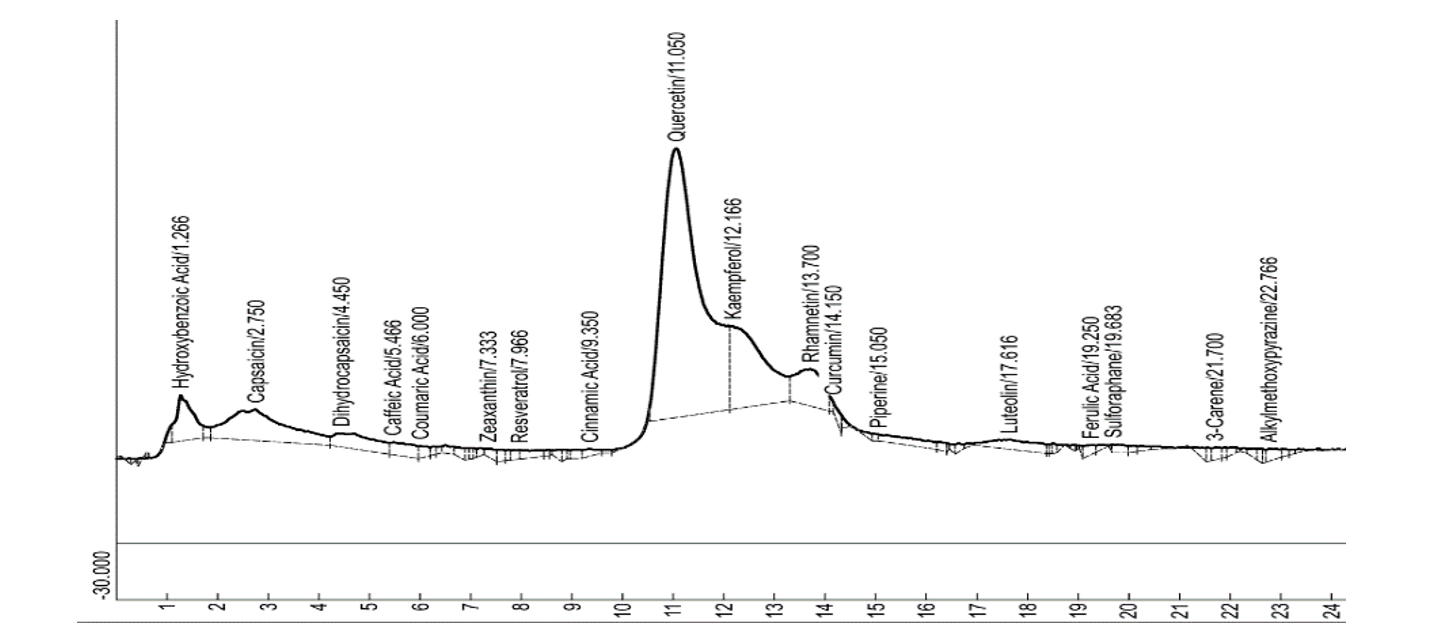
2500 g of powdered P. nigrum leaves were extracted by cold maceration using methanol. The crude methanol extract was subjected to fractionation by vacuum liquid chromatography, and the hexane-ethyl acetate fraction was characterized using HPLC. Phytochemical screening was carried out on the fraction, and the result revealed the presence of alkaloids, flavonoids, eugenols, steroids. Vitamin analysis was carried out on the crude extract and the result revealed Vitamin A (0.019 mg/100g), Vitamin C (15.181 mg/100g), Vitamin D (0.001 mg/100g), Vitamin E (1.355 mg/100g), Vitamin B1 (0.163 mg/100g), Vitamin B2 (0.360 mg/100g), Vitamin B3 (1.250), Vitamin B5 (2.155), Vitamin B6 (0.361), Vitamin B9 (0.025). HPLC analysis revealed eighteen chromatographic peaks, which were tentatively assigned to various phytochemical constituents, with quercetin (Rt. 11.050; 46.51%), as the predominant compound, followed by kaempferol (Rt. 12.166; 13.98%), with a relative low concentration of piperine (Rt 15.050; 2.80%).
References
Banjarnahor, S.D.S. and Artanti, N. (2014). ‘Antioxidant properties of flavonoids’. Medical Journal of Indonesia. 23(4): 239-244.
Barman, P., Hazarika, S., Roy, K., Rawal, R.K. and Konwar, R. (2025). ‘Phytochemical analysis of leaf extract of Piper nigrum and investigation of its biological activities’. Inflammopharmacology. 33(6): 3255-3277. https://doi.org/10.1007/s10787-025-01701-5
Biswas, P., Anand, U., Saha, S.C., Kant, N., Mishra, T., Masih, H., Bar, A., Pandey, D.K., Jha, N.K., Majumder, M., Das, N., Gadekar, V.S., Shekhawat, M.S., Kumar, M., Radha, Proćków, J., Pérez de la Lastra, J.M. and Dey, A. (2022). ‘Betelvine (Piper betle L.): A comprehensive insight into its ethnopharmacology, phytochemistry, and pharmacological, biomedical and therapeutic attributes’, Journal of Cellular and Molecular Medicine. 26(11): 3083-3119. https://doi.org/10.1111/jcmm.17323
Ding, L., Fei, T., Xiao, J. and Wang, L. (2026). ‘Unveiling the multifaceted potential of Piper nigrum: A comprehensive review of its chemical components, health benefits, safety assessment and industrial application’, Journal of Agricultural and Food Chemistry. 74(4): 3353-3376.
https://doi.org/10.1021/acs.jafc.5c15160
Iyekowa, O., Oviawe, P.A., Igbinumwen, O., Atapia, M.I., Oluyide, J.A., Odigie, A.J., Omoregbee, G.O., Ogbonwan, O.G., Asiriuwa, D.O. and Anokhaoya, S.P. (2024). ‘Mineral composition and chemical characterization of the oil constituents of Hibiscus sabdariffa calyxes (Zobo calyxes) by gas chromatography-mass spectrometry (GC-MS)’. Benin Journal of Physical Sciences, 1(2): 48-49.
Mballa, D.L.E., Yadang, F.S.A., Tchamgoue, A.D., Mba, J.R., Tchokouaha, L.R.Y., Biang, E.M., Tchinda, A.T., Djomeni Dzeufiet, D.P. and Agbor, G.A. (2021). ‘Cafeteria diet-induced metabolic and cardiovascular changes in rats: The role of Piper nigrum leaf extract’. Evidence-Based Complementary and Alternative Medicine. 55:85. https://doi.org/10.1155/2021/5585650
Nwofia, G.E., Kelechukwu, C. and Nwofia, B.K. (2013). ‘Nutritional composition of some Piper nigrum (L.) accessions from Nigeria’. International Journal of Medicinal and Aromatic Plants. 3(2): 247-254.
Odeja, O.O., Okpala, E.O., Ibok, M.G., Igata, D.F. and Onocha, P.A. (2026). ‘Phytochemical Screening and Antioxidant Activity of Piper nigrum and Aframomum melegueta Seeds Extracts’. FUDMA Journal of Sciences. 10(10): 105-110.
Peters, D.E., Baradum, S.R. and Ohiri, R.C. (2022). ‘Nutrient composition of Piper umbellatum Linn leaves’. Journal of Advances in Food Science & Technology. 9(2): 38-44. https://doi.org/10.56557/JAFSAT/2022/v9i27812
Saini, S., Nanda, S. and Dhiman, A. (2020). ‘GCMS analysis of bioactives of Piper betle Linn. leaf’. Current Bioactive Compounds. 16(1). https://doi.org/10.2174/1573407215666190417153613
Takooree, H., Aumeeruddy, M.Z., Rengasamy, K.R.R., Venugopala, K.N., Jeewon, R., Zengin, G. and Mahomoodally, M.F. (2019). ‘A systematic review on black pepper (Piper nigrum L.): From folk uses to pharmacological applications’. Critical Reviews in Food Science and Nutrition, 59: 210-243. https://doi.org/10.1080/10408398.2019.1565489
Tian, C., Liu, X., Chang, Y., Wang, R., Lv, T., Cui, C. and Liu, M. (2021). ‘Investigation of the anti-inflammatory and antioxidant activities of luteolin, kaempferol, apigenin and quercetin’. South African Journal of Botany, 137: 257-264.
Yu, L., Hu, X., Xu, R., Ba, Y., Chen, X., Wang, X., Cao, B. and Wu, X. (2022). ‘Amide alkaloids characterization and neuroprotective properties of Piper nigrum L.: A comparative study with fruits, pericarp, stalks and leaves’. Food Chemistry. 368: 130. https://doi.org/10.1016/j.foodchem.2021.130832
Downloads
Published
Issue
Section
Categories
License
Copyright (c) 2026 Victory Omozejele Okodugha, Julius Iyasele, Osaro Iyekowa, Silvanus Innih

This work is licensed under a Creative Commons Attribution 4.0 International License.


