
Phytochemical, Nutritional, Metal Composition, Haematological and Antimalarial Evaluation of the Leaf Extract of Morinda Citrifolia L. (Noni)
DOI:
https://doi.org/10.33003/fjs-2026-1014-5645Keywords:
Morinda citrifolia, antimalarial activity, mineral composition, phytochemicals, haematological parametersAbstract
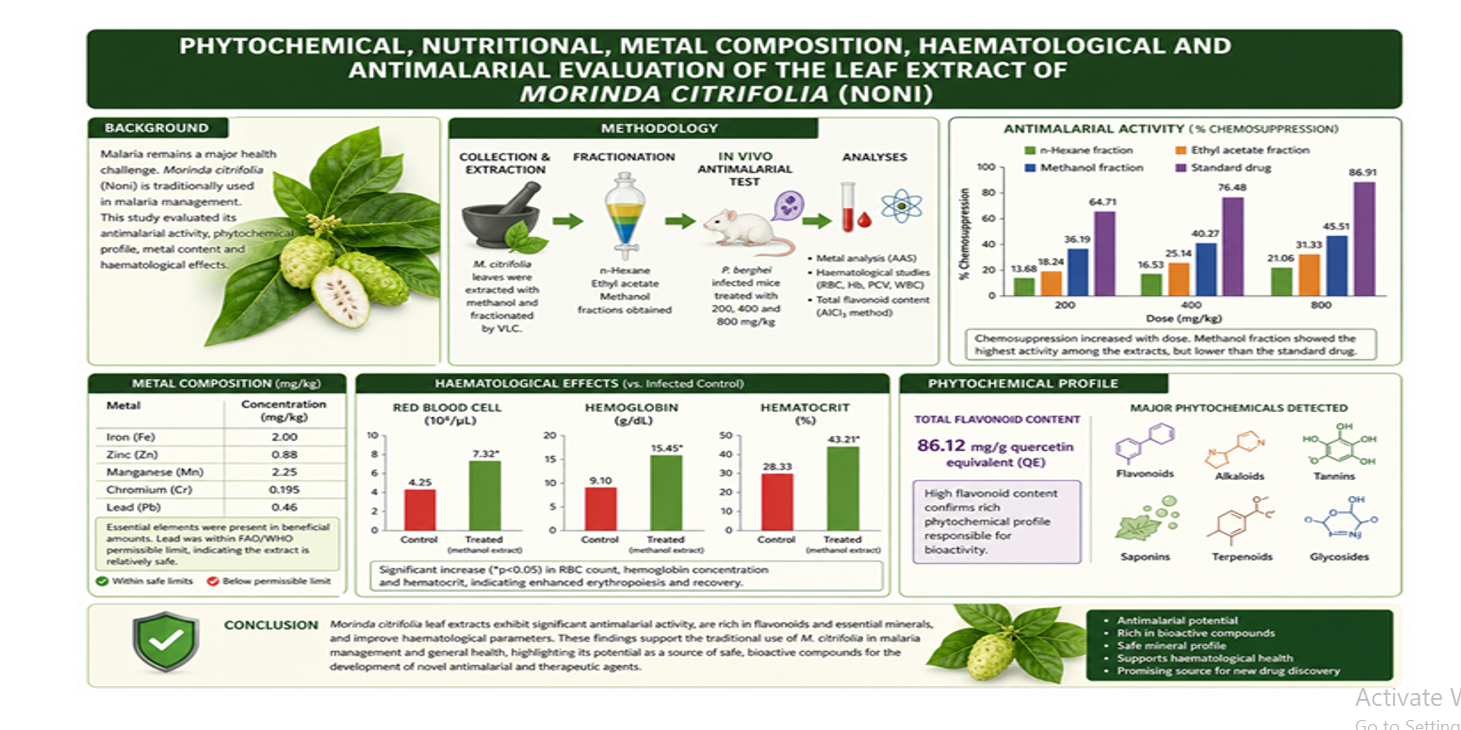
Malaria remains one of the most devastating tropical diseases, responsible for significant morbidity and mortality, particularly in developing countries. This study aimed to evaluate the antimalarial activity, phytochemical composition, metal content, and haematological effects of Morinda citrifolia leaf extracts in order to establish their therapeutic potential and safety profile. Leaf extracts were fractionated using vacuum liquid chromatography, and n-hexane, ethyl acetate, and methanol fractions were assessed for in vivo antiplasmodial activity against Plasmodium berghei in infected mice at doses of 200, 400, and 800 mg/kg. Additionally, metal analysis, haematological studies on red and white blood cells, and total flavonoid content determination were carried out using standard analytical methods The antimalarial evaluation revealed dose-dependent chemosuppression, with values increasing from 13.68–36.19% at 200 mg/kg to 21.06–45.51% at 800 mg/kg across the extracts, indicating significant antiplasmodial activity, although lower than that of the standard drug. Metal analysis showed the presence of essential elements such as iron (2.00 mg/kg), zinc (0.88 mg/kg), manganese (2.25 mg/kg), and chromium (0.195 mg/kg), with lead (0.46 mg/kg) remaining within FAO/WHO permissible limits, suggesting the extract is relatively safe. Haematological studies demonstrated significant increases in red blood cell count, hemoglobin concentration, and hematocrit levels in treated rats, indicating positive effect on erythropoiesis. The methanol leaf extract exhibited high total flavonoid content of 86.12 mg/g quercetin equivalent, confirming the plant’s rich phytochemical profile.
References
Amato, R., Pearson, R. D., Almagro-Garcia, J., Amaratunga, C., Lim, P., Suon, S., & Fairhurst, R. M. (2018). Origins of the current outbreak of multidrug-resistant malaria. Nature Genetics, 50(9), 1231–1237. https://doi.org/10.1038/s41588-018-0171-8
AOAC International. (2019). Official methods of analysis (21st ed.). AOAC International.
Cowman, A. F., Healer, J., Marapana, D., & Marsh, K. (2016). Malaria: Biology and disease. Cell, 167(3), 610–624. https://doi.org/10.1016/j.cell.2016.07.055
Dixon, R. A., & Siva, D. (2019). Ethnobotany of Morinda citrifolia (Rubiaceae) in Polynesia. In V. S. Ramachandran & C. Rodrigues (Eds.), Ethnobotany and the search for new drugs (pp. 230–236).
Ebrahimzadeh, M. A., Nabavi, S. M., Nabavi, S. F., Bahramian, F., & Bekhradnia, A. R. (2008). Antioxidant and free radical scavenging activity of medicinal plants. Pakistan Journal of Pharmaceutical Sciences, 21(3), 291–295.
Elkins, R. (2018). Hawaiian noni (Morinda citrifolia): Prize herb of Hawaii and the South Pacific. Woodland Publishing.
Fagbohun, E. D., Lawal, O. U., & Ore, M. E. (2012). Chemical composition and antimicrobial activities of Urena lobata L. Journal of Medicinal Plants Research, 6(12), 2256–2259. https://doi.org/10.5897/JMPR09.233
Hirazumi, A., & Furusawa, E. (1999). Immunomodulatory polysaccharide-rich substance from Morinda citrifolia fruit juice with antitumour activity. Phytotherapy Research, 13(5), 380–387.
Jahurul, M. H. A., Zaidul, I. S. M., Norazlina, M. R., Sahena, F., Jinap, S., Azmir, J., & Amid, A. (2021). Functional and nutritional properties of noni (Morinda citrifolia) seed and its oil. Food Bioscience, 41, 101000. https://doi.org/10.1016/j.fbio.2021.101000
Krauss, B. H. (2019). Plants in Hawaiian culture. University of Hawaii Press.
Mandukhail, S. U. R., Aziz, N., & Gilani, A. H. (2010). Antidyslipidemic effects of Morinda citrifolia. Lipids in Health and Disease, 9, 88. https://doi.org/10.1186/1476-511X-9-88
Nerurkar, P. V., Hwang, P. W., & Saksa, E. (2015). Anti-diabetic potential of noni: The yin and the yang. Molecules, 20(10), 17684–17719. https://doi.org/10.3390/molecules201017684
Nielsen, S. S. (2017). Food analysis (5th ed.). Springer.
Ogbeide, O. K., Omono, E. D., Ehizojie, P. O., Aiwonegbe, A. E., & Uadia, J. O. (2022). Phytochemical investigation, anti-inflammatory and analgesic activities of ethyl acetate extract of pride of Barbados pod (Caesalpinia pulcherrima). Tanzania Journal of Science, 48(3), 548–558. https://doi.org/10.4314/tjs.v48i3.12
Olugbue, V. U., Ogundapo, S. S., Obasi, S. E., Vining-Ogu, I. C., Igara, C. E., Suleman, J. B., Danladi, G. J., Ngobidi, K. C., Nkama, O. J., Uchendu, D., Nsude, F. I., & Kalu, C. (2026). Phytochemical Profile, Antibacterial Activity and Effect of Infusions from Polyherbal Tea on Gut Microbiota of Albino Rats. FUDMA Journal of Sciences, 10(11), 343-352. https://doi.org/10.33003/fjs-2026-1011-5268
Potterat, O., & Hamburger, M. (2007). Morinda citrifolia (noni) fruit—phytochemistry and pharmacology. Planta Medica, 73(3), 191–199. https://doi.org/10.1055/s-2007-967115
Singleton, V. L., Orthofer, R., & Lamuela-Raventós, R. M. (1999). Analysis of total phenols and oxidation substrates by Folin–Ciocalteu reagent. Methods in Enzymology, 299, 152–178. https://doi.org/10.1016/S0076-6879(99)99017-1
Skoog, D. A., Holler, F. J., & Crouch, S. R. (2021). Principles of instrumental analysis (7th ed.). Cengage Learning.
Skoog, D. A., West, D. M., Holler, F. J., & Crouch, S. R. (2014). Fundamentals of analytical chemistry (9th ed.).
Talapko, J., Škrlec, I., Alebić, T., Jukić, M., & Včev, A. (2019). Malaria: The past and the present. Microorganisms, 7(6), 179. https://doi.org/10.3390/microorganisms7060179
Wang, M. Y., West, B. J., Jensen, C. J., Nowicki, D., Chen, S., Palu, A. K., & Anderson, G. (2019). Morinda citrifolia (noni): A comprehensive review of its pharmacology and therapeutic effects. Journal of Food Science, 84(6), 1327–1338. https://doi.org/10.1111/1750-3841.14635
White, N. J., Pukrittayakamee, S., Hien, T. T., Faiz, M. A., Mokuolu, O. A., & Dondorp, A. M. (2014). Malaria. The Lancet, 383(9918), 723–735. https://doi.org/10.1016/S0140-6736(13)60024-0
World Health Organization. (2023). World malaria report 2023. World Health Organization.
Downloads
Published
Issue
Section
Categories
License
Copyright (c) 2026 Matthew Edekin Oni, Emmanuel Ovwero, Kennedy Osahon Ogbeide

This work is licensed under a Creative Commons Attribution 4.0 International License.


