
Predicting Community Willingness for Sustainable Mountain Tourism in Idanre Hills, Nigeria
DOI:
https://doi.org/10.33003/fjs-2026-1014-5643Keywords:
Resident Participation, Conservation Attitudes, Cultural Heritage, Livelihood-Sensitive PlanningAbstract
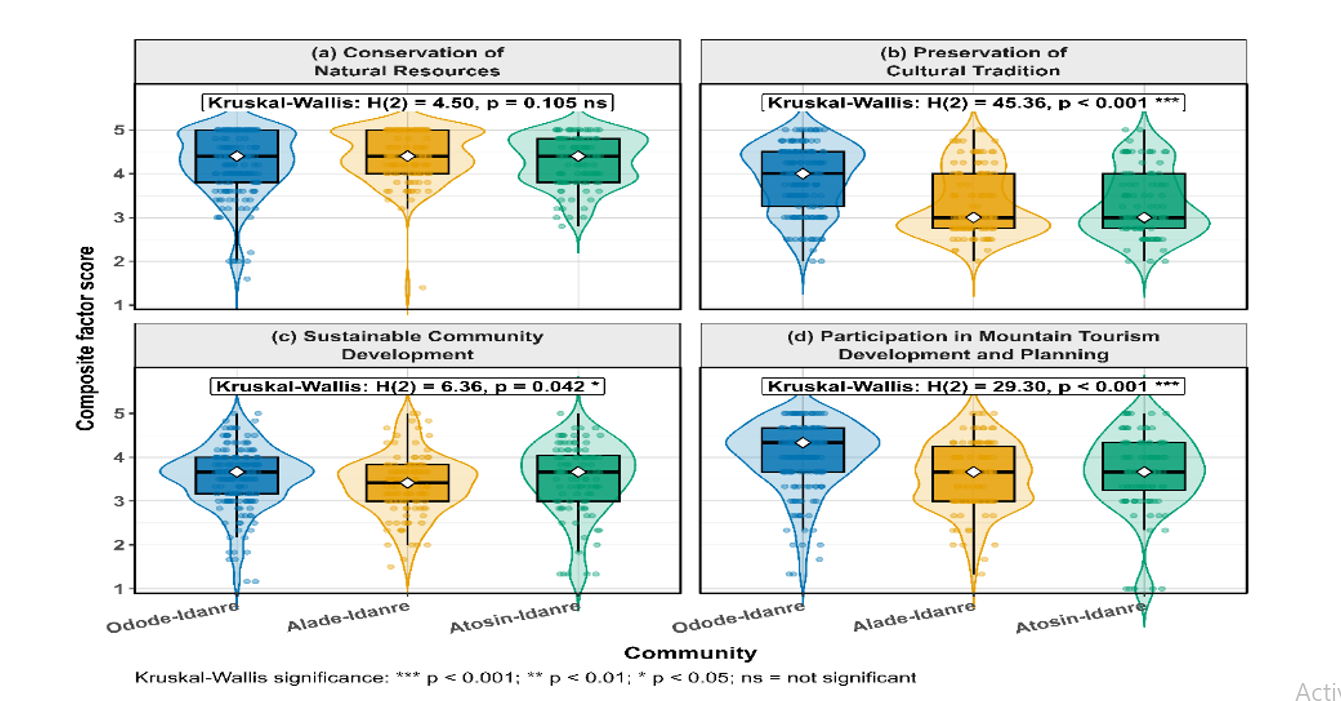
Sustainable mountain tourism relies on residents' willingness for conservation, cultural interpretation and destination planning. This study identified socio-demographic predictors that affect residents' willingness to participate in mountain tourism development in Idanre Hills, Nigeria. An exploratory descriptive survey was conducted in Odo-Ode Idanre, Alade Idanre and Atosin Idanre using a multistage sampling procedure, with 380 households completing structured questionnaires. The analyses carried out included mean willingness scores, Kruskal-Wallis tests, and ordinal logistic regression. Most respondents were male (63.90%), married (56.50%), at the secondary school level, Christian (86.40%), and in the monthly income range of ₦21,000–₦40,000 (54.20%). Conservation of natural resources ranked highest amongst the index's willing indicators (4.28 ± 0.03), closely followed by participation in eco-tourism planning and management (3.79 ± 0.04), preservation of cultural values (3.58 ± 0.04), and then sustainable development of the community (3.48 ± 0.04). In addition, support without a limit on the number of tourists was rated highest (4.52 ± 0.05), while agreement with the negative impact was rated lowest (2.31 ± 0.07). Gender, education, occupation, family size, religion and income influenced overall willingness to support Idanre tourism development. To support community-based, conservation-sensitive tourism that considers the livelihood needs of community dwellers, we recommended that tourism planning recognize residents' willingness and that it be inclusive, conservation-based, and livelihood-sensitive for Idanre Hills.
References
Adebayo, A. (2017). Sustainable tourism and cultural landscape management: the case of Idanre Hill, Ondo State, Nigeria. Tourism Today, 16(16/17), 43-55.
Adigun, F. O., Abolade, F., & Adegboye, D. I. (2016). Patronage pattern of Idanre Hills as eco-tourism centre. Research on Humanities and Social Sciences, 6(12), 35-42.
Agboola, M., Olowo, R. O., & Kevin-Israel, O. C. (2021). Evaluation of Impact of Tourism on the Quality of Life of the Host Community Resident in Idanre, Ondo State Nigeria. Journal of Tourism & Hospitality, 10(1000469), 1-7.
Arabomen, O. J., & Babalola, F. D. (2025). Evaluation of the tourism potential of Erin Ijesha (Olumirin) Waterfalls, Osun State, Nigeria. FUDMA Journal of Sciences, 9(11), 32-40.
Arowosafe, F. C., & Omopariola, D. J. (2014). Factors Affecting Tourists’ Experience at Idanre Hills, Ondo State, Nigeria. A Publication of the School of Agriculture Technology, The Federal University of Technology, Akure, Applied Tropical Agriculture, Nigeria, 69-73.
Cronbach, L. J. (1951). Coefficient alpha and the internal structure of tests. psychometrika, 16(3), 297-334.
Duglio, S., & Beltramo, R. (2017). Estimating the economic impacts of a small-scale sport tourism event: The case of the Italo-Swiss mountain trail CollonTrek. Sustainability, 9(3), 343.
Duglio, S., Bonadonna, A., Letey, M., Peira, G., Zavattaro, L., & Lombardi, G. (2019). Tourism development in inner mountain areas—The local stakeholders’ point of view through a mixed method approach. Sustainability, 11(21), 5997.
Hanafiah, M. H., Jamaluddin, M. R., & Zulkifly, M. I. (2013). Local community attitude and support towards tourism development in Tioman Island, Malaysia. Procedia-Social and Behavioral Sciences, 105, 792-800.
Harilal, V., & Tichaawa, T. M. (2020). Community perceptions of the economic impacts of ecotourism in Cameroon. African Journal of Hospitality, Tourism and Leisure, 9(6), 959-978.
Ivanovic, M., & Saayman, M. (2013). South Africa calling cultural tourists. African Journal for Physical Health Education, Recreation and Dance, 2013(sup2. 1), 138-154.
Kruskal, W. H., & Wallis, W. A. (1952). Use of ranks in one-criterion variance analysis. Journal of the American statistical Association, 47(260), 583-621.
Kumar, J. (2017). Community-based tourism: A tool for sustainable development. International Journal of Applied Research, 3(7), 540–544.
Lai, P. H., & Nepal, S. K. (2006). Local perspectives of ecotourism development in Tawushan Nature Reserve, Taiwan. Tourism Management, 27(6), 1117-1129.
Li, Q. (2018). Shinrin-Yoku: The art and science of forest bathing. Penguin UK.
Liao, C. C., Lin, Y. X., & Hsieh, H. H. (2019). Satisfaction of indigenous tourism from residents’ perspective: A case study in Nantou county, Taiwan. Sustainability, 11(1), 276.
Likert, R. (1932). A technique for the measurement of attitudes. Archives of Psychology, 22(140), 1–55.
Luo, Y., & Deng, J. (2008). The New Environmental Paradigm and nature-based tourism motivation. Journal of Travel research, 46(4), 392-402.
Makoni, L., & Tichaawa, T. M. (2017). Residents’ perceptions and attitudes towards urban tourism product offerings in Harare, Zimbabwe. African Journal of Hospitality, Tourism and Leisure, 6(4), 1-15.
Manyara, G., & Jones, E. (2007). Community-based tourism enterprises development in Kenya: An exploration of their potential as avenues of poverty reduction. Journal of sustainable tourism, 15(6), 628-644.
Marzuki, A., Hay, I., & James, J. (2012). Public participation shortcomings in tourism planning: The case of the Langkawi Islands, Malaysia. Journal of sustainable tourism, 20(4), 585-602.
Meyer, D. (2007). Pro-poor tourism: From leakages to linkages. A conceptual framework for creating linkages between the accommodation sector and ‘poor’neighbouring communities. Current issues in tourism, 10(6), 558-583.
Oladeji, S. O., Awolala, D. O., & Alabi, O. I. (2022). Evaluation of sustainable ecotourism practices in oke-idanre hills, ondo-state, Nigeria. Environment, Development and Sustainability, 24(2), 2656-2684.
Olaniyi, O.E., Akinsorotan, O.A., Agboola, O.P., Ajayi, G. and Ogunjemite, B.G. (2020). Degree and socio-demographic predictors of residents’ willingness to participate in the mountain tourism development of Ado-Awaye Suspended Lake, Nigeria. African Journal of Hospitality, Tourism and Leisure, 9(3), 183 – 198.
Río-Rama, M., Maldonado-Erazo, C., Durán-Sánchez, A., & Álvarez-García, J. (2019). Mountain tourism research. A review. European Journal of Tourism Research, 22(2019), 130-150.
Shaibu, A. H., Ogunjinmi, A. A., & Adeyemo, A. I. (2018). Assessment of Residents’ Awareness and Participation in Sustainable Rural Tourism Development in Selected Tourist Destinations in Southwest Nigeria. Journal of Tourism and Heritage Studies, 7(2), 123-136.
Sinclair-Maragh, G., Gursoy, D., & Vieregge, M. (2015). Residents׳ perceptions toward tourism development: A factor-cluster approach. Journal of Destination Marketing & Management, 4(1), 36-45.
United Nations World Tourism Organization. (2019). Walking tourism: Promoting regional development. UNWTO.
Downloads
Published
Issue
Section
Categories
License
Copyright (c) 2026 Oluwatobi Emmanuel Olaniyi, Opeyemi Ayomide Bamikole

This work is licensed under a Creative Commons Attribution 4.0 International License.


