
Influence of Cement Brand on the Fresh, Mechanical, and Durability Properties of Concrete
DOI:
https://doi.org/10.33003/fjs-2026-1014-5642Keywords:
Portland cement, cement brand, compressive strength, fresh concrete properties, water absorption, analysis of varianceAbstract
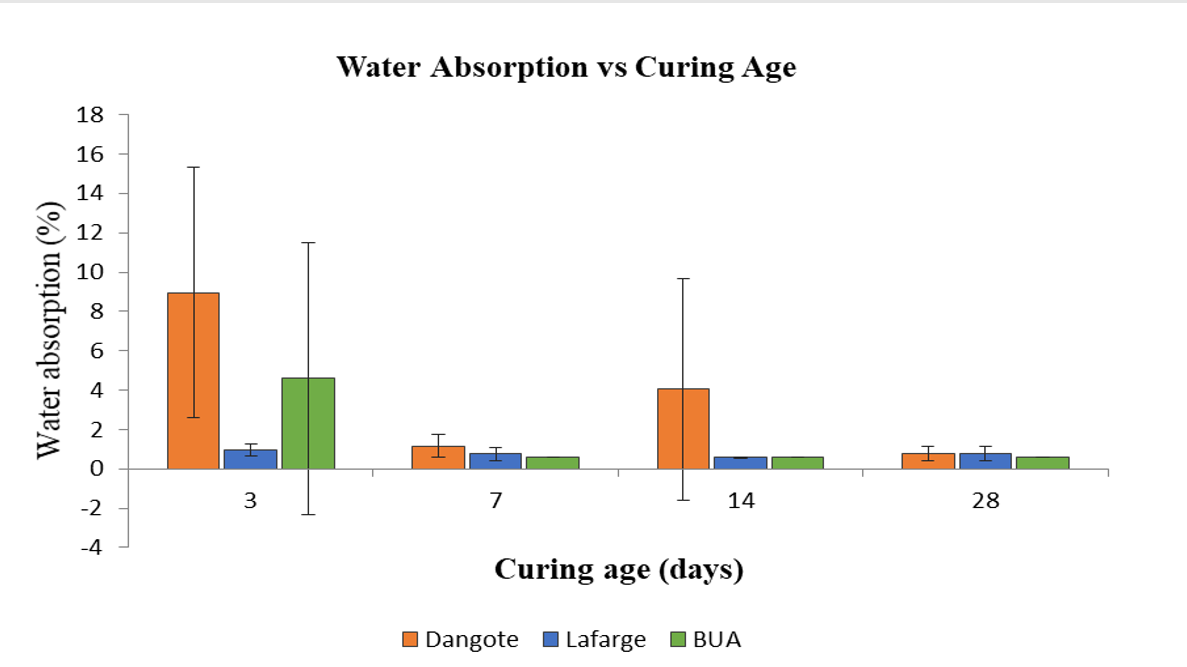
This study evaluated the influence of three commercially available Portland cement brands in Nigeria (Dangote, Lafarge, and BUA) on the fresh, mechanical, and durability properties of 1:2:4 concrete at a constant water-cement ratio of 0.5. Concrete cubes (150 × 150 × 150 mm) were cast and cured for 3, 7, 14, and 28 days, after which slump, setting time, compressive strength, and water absorption were determined. Two-way analysis of variance (ANOVA) showed that both cement brand (F(2,24) = 15.73, p < 0.001) and curing age (F(3,24) = 28.70, p < 0.001) significantly influenced compressive strength, whereas their interaction was not significant (p = 0.13). One-way ANOVA revealed significant differences among brands at 3 and 7 days (p < 0.01), but not at 14 or 28 days (p > 0.05). Although BUA recorded the highest mean 28-day compressive strength (28.22 ± 2.14 N/mm²), followed by Lafarge (26.44 ± 3.74 N/mm²) and Dangote (23.78 ± 0.22 N/mm²), Tukey's HSD test found no significant pairwise differences. The cement brand did not significantly affect water absorption (p = 0.08), whereas curing age did (p = 0.04). Lafarge produced the highest slump (45 mm) and shortest setting time (5-6 hours), while BUA produced the lowest slump (25 mm) and longest setting time (8-9 hours). These findings indicate that the cement brand primarily influences fresh properties and early-age strength, supporting project-specific testing when selecting cement.
References
ACI Committee 211. (2009). Standard practice for selecting proportions for normal, heavyweight, and mass concrete (ACI 211.1-91) (Reapproved 2009). American Concrete Institute.
ASTM International. (2018). Standard test methods for time of setting of hydraulic cement by Vicat needle (ASTM C191-08). ASTM International.
ASTM International. (2019a). Standard specification for Portland cement (ASTM C150/C150M-19a). ASTM International.
ASTM International. (2019b). Standard test method for electrical indication of concrete's ability to resist chloride ion penetration (ASTM C1202-19). ASTM International.
ASTM International. (2021). Standard test method for density, absorption, and voids in hardened concrete (ASTM C642-21). ASTM International.
Awoyemi, T. J., Ibedu, K. E., Kaura, J. M., & Lawan, A. (2023). Strength-durability properties and microstructural analysis of concrete containing cow bone ash and bentonite. FUDMA Journal of Sciences, 7(5), 39–49. https://doi.org/10.33003/fjs-2023-0705-1900
Bamigboye, G. O., Ede, A. N., Egwuatu, C., Jolayemi, J., Olowu, O. A., & Odewumi, T. (2015). Assessment of compressive strength of concrete produced from different brands of Portland cement. Civil and Environmental Research, 7(8), 31–38. https://www.iiste.org/Journals/index.php/CER/article/view/24638
Barbhuiya, S., Kanavaris, F., Das, B. B., & Idrees, M. (2024). Decarbonising cement and concrete production: Strategies, challenges and pathways for sustainable development. Journal of Building Engineering, 86, Article 108861. https://doi.org/10.1016/j.jobe.2024.108861
British Standards Institution. (2005). Admixtures for concrete, mortar and grout -Test methods - Part 5: Determination of capillary absorption (BS EN 480-5:2005). BSI.
British Standards Institution. (2011). Cement - Composition, specifications and conformity criteria for common cements (BS EN 197-1:2011). BSI.
British Standards Institution. (2016a). Methods of testing cement - Part 1: Determination of strength (BS EN 196-1:2016). BSI.
British Standards Institution. (2016b). Methods of testing cement - Determination of setting times and soundness (BS EN 196-3:2016). BSI.
Cheng, D., Reiner, D. M., Yang, F., Cui, C., Meng, J., Shan, Y., Liu, Y., Tao, S., & Guan, D. (2023). Projecting future carbon emissions from cement production in developing countries. Nature Communications, 14, Article 8213. https://doi.org/10.1038/s41467-023-43660-x
Falade, F., Ikponmwosa, E., & Fapohunda, C. (2018). Influence of cement brands on the mechanical properties of laterized concrete. International Journal of Sustainable Construction Engineering and Technology, 9(2), 33–45.
Gana, A. J., Atoyebi, O. D., & Ichagba, R. B. (2020). Effect of different brands of Nigerian cement on the properties of pervious concrete. IOP Conference Series: Earth and Environmental Science, 445, Article 012029. https://doi.org/10.1088/1755-1315/445/1/012029
Hewlett, P., & Liska, M. (Eds.). (2019). Lea's chemistry of cement and concrete (5th ed.). Butterworth-Heinemann.
Mehta, P. K., & Monteiro, P. J. M. (2014). Concrete: Microstructure, properties, and materials (4th ed.). McGraw-Hill Education.
Mindess, S., Young, J. F., & Darwin, D. (2003). Concrete (2nd ed.). Prentice Hall.
Neville, A. M. (2011). Properties of concrete (5th ed.). Pearson Education Limited.
Neville, A. M., & Brooks, J. J. (2010). Concrete technology (2nd ed.). Pearson Education Limited.
Olonade, K. A., Balogun, I. O., & Abiodun, Y. O. (2020). Sulphate attack resistance of selected cement brands in Nigeria. Journal of Engineering Research, 25(3), 19–33. https://jer.unilag.edu.ng/article/view/1104
Sultan, M. A., Jawad, M., Iqbal, M. M., Ghafoor, M. I., Farooq, U., & Mushtaq, A. (2023). A comparative study: Effects of fineness of cement on consistency and compressive strength of different branded cements in Pakistan. Journal of Applied Engineering Sciences, 13(26), 9–16. https://doi.org/10.2478/jaes-2023-0002
Downloads
Published
Issue
Section
Categories
License
Copyright (c) 2026 Akuha Simon Iorshagher, Manasseh Tyogo, Innocent Makoji Bala

This work is licensed under a Creative Commons Attribution 4.0 International License.