
Experimental Study and Optimization of lathe Machining Parameters
DOI:
https://doi.org/10.33003/fjs-2026-1018-5634Keywords:
Optimization, Material removal rate, Response surface methodology, Central composite design, Turning operationAbstract
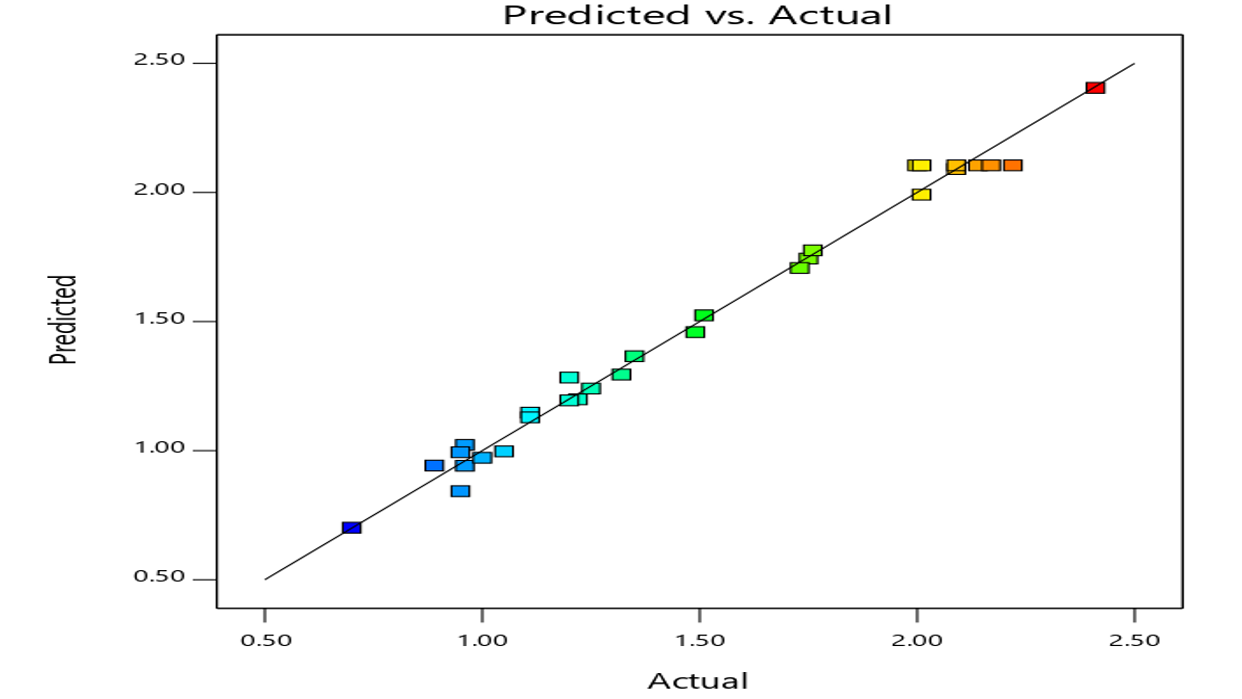
In modern manufacturing, optimizing machining parameters is crucial for enhancing productivity, reducing costs, and improving surface quality. Turning, a widely used metal cutting process, often suffers from inefficiencies due to poor parameter selection, leading to increased tool wear and energy use. This study investigated how machining variables like cutting speed, feed rate, depth of cut, and spindle speed affect the Material Removal Rate (MRR), aiming to determine the optimal combination for maximum efficiency. Central Composite Design (CCD) of Response Surface Methodology (RSM) was used to model and optimize the machining process. Thirty experimental runs were conducted on a conventional lathe, varying the selected parameters within practical limits. MRR was calculated for each run, and regression modeling was applied to develop a predictive quadratic model. Analysis of Variance (ANOVA) confirmed the statistical significance of the model and highlighted the contribution of each parameter. Findings showed that feed rate and depth of cut had the most significant influence on MRR, followed by cutting speed, with spindle speed having a moderate effect. The optimal machining conditions were identified as: cutting speed of 170.89 m/min, feed rate of 0.49 mm/rev, depth of cut of 1.14 mm, and spindle speed of 751.13 rpm, achieving a maximum MRR of 2.46%. The developed model can serve as a predictive tool to set machining parameters, reducing guesswork and improving efficiency. Future research could extend this approach to include other factors such as surface roughness, tool wear, for comprehensive process optimization.
References
Amiebenomo, S., Ighodalo, O., & Ozigi, O. A. (2023). Optimization of machining parameters in mild steel turning operation by response surface methodology. International Journal of Innovative Research and Development, 12(1), 69–83
Awasare, A. (2025). Optimization and performance analysis of lathe machine for precision machining. Research and Reviews: Journal of Mechanical Engineering, 1(1), 35–39.
Bagaber, S. A., & Yusoff, A. R. (2017). Effect of cutting parameters on sustainable machining performance of coated carbide tool in dry turning process of stainless steel 316. AIP Conference Proceedings, 1828, 020013. https://doi.org/10.1063/1.4979384
Bello, Y., Yakubu, S. O., Agov, T. E., & Soretire, L. K. (2024). Comparative study of different cutting fluids on tool-work interface temperature during turning operation on 6061 aluminum alloy. FUDMA Journal of Sciences, 8(5), 143–151. https://doi.org/10.33003/fjs-2024-0805-2781
Dhanalakshmi, S., & Rameshbabu, T. (2020). Multi-aspects optimization of process parameters in CNC turning of LM 25 alloy using the Taguchi-Grey approach. Metals, 10(4), 453.
Geleso, G., Debena, Z., & Demeke, N. (2025). Optimization of machining parameters for C45 steel in vertical machining centers using response surface methodology: A study on surface roughness and material removal rate. https://doi.org/10.21203/rs.3.rs-6540425/v1
Jain, D., & Bose, A. (2022). Advancements in lathe machining: A review of CNC and AI-based optimization techniques. International Journal of Mechanical Engineering, 67(1), 95–108.
Miller, C., & Robinson, J. (2017). Effect of cutting fluids on tool wear and surface finish in precision turning operations. Journal of Machine Tools and Manufacture, 23(5), 311–326.
Mohanraj, T., Sakthivel, G., & Pramanik, S. (2024). Use of RSM desirability approach to optimize WEDM of mild steel. Physica Scripta, 99(10), 105976. https://doi.org/10.1088/1402-4896/ad7707
Nguyen, T. (2024). Comparing Taguchi-based RSM and ANN for shredder blade geometrical parameter optimization. Journal of Mechanical Engineering, 21(2), 1–21. https://doi.org/10.24191/jmeche.v21i2.26247
Nur, R., Suyuti, M. A., & Susanto, T. A. (2017). Optimizing cutting conditions on sustainable machining of aluminum alloy to minimize power consumption. AIP Conference Proceedings, 1855, 020002-1–020002-7.
Patel, V., & Sharma, P. (2019). Application of Taguchi method for optimization in lathe machining. Journal of Manufacturing Processes, 32, 85–94.
Rao, M., & Venkaiah, N. (2015). Parametric optimization in machining of Nimonic-263 alloy using RSM and particle swarm optimization. Procedia Materials Science, 10, 70–79. https://doi.org/10.1016/j.mspro.2015.06.027
Saha, S., Mondal, A. K., Čep, R., Joardar, H., Haldar, B., Kumar, A., Alsalah, N. A., & Ataya, S. (2024). Multi-Response Optimization of Electrochemical Machining Parameters for Inconel 718 via RSM and MOGA-ANN. Machines, 12(5), 335. https://doi.org/10.3390/machines12050335
Salgar, V. H., Patil, M. M., Nitin, S., Nikam, A. S., & Dhawan, A. P. (2019). Optimization of cutting parameters during turning of AISI 1018 using Taguchi method. International Research Journal of Engineering and Technology, 6(4), 994–1002.
Singh, L., Choudhary, R., & Juneja, D. K. (2017). Optimization of cutting parameters based on Taguchi method of AISI 316 using CNC lathe machine. International Research Journal of Engineering and Technology, 4(7), 3197–3203.
Suresh, P., Kumar, R., & Sharma, A. (2020). Optimization of cutting parameters in lathe machining for surface finish improvement. International Journal of Advanced Manufacturing, 45(3), 215–230.
Downloads
Published
Issue
Section
Categories
License
Copyright (c) 2026 Samuel Ayodeji Omotehinse, Esiri Amagre Monday, Precious Osayomwanbor, Kelvin Siakpere

This work is licensed under a Creative Commons Attribution 4.0 International License.


