
Biochemical Characterization of the Antioxidant and α-Amylase Inhibitory Activities of Mucuna pruriens Leaf Extract: Insights from Enzyme Kinetic Analysis
DOI:
https://doi.org/10.33003/fjs-2026-1013-5621Keywords:
Mucuna pruriens, α-Amylase Inhibition, Antioxidant Activity, Enzyme Kinetics, Mixed Inhibition, Type 2 Diabetes MellitusAbstract
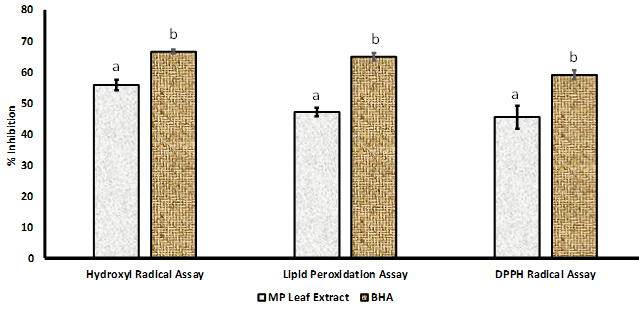
The increasing prevalence of type 2 diabetes mellitus has intensified the search for plant-derived therapeutics capable of simultaneously attenuating oxidative stress and regulating carbohydrate metabolism. Although Mucuna pruriens is recognized for its medicinal properties, the antioxidant potential and enzyme inhibitory mechanism of its leaf extract remain poorly understood. This study investigated the in vitro antioxidant activity, α-amylase inhibitory potential, and inhibition kinetics of ethanolic leaf extract of M. pruriens. Antioxidant capacity was evaluated using hydroxyl radical, lipid peroxidation, and 2,2-diphenyl-1-picrylhydrazyl (DPPH) radical scavenging assays with butylated hydroxyanisole (BHA) as the reference antioxidant. α-Amylase inhibitory activity was determined across different extract concentrations, while Lineweaver–Burk kinetic analysis was employed to elucidate the mode of enzyme inhibition. The extract exhibited appreciable antioxidant activity in all assay models, demonstrating hydroxyl radical, lipid peroxidation, and DPPH scavenging activities of 55.77 ± 1.66%, 47.00 ± 1.40%, and 45.34 ± 3.72%, respectively, although significantly lower than BHA (P < 0.05). The extract inhibited α-amylase in a concentration-dependent manner, increasing from 45.83 ± 1.55% at 1.10 mg/mL to 59.24 ± 1.11% at 2.30 mg/mL, surpassing acarbose (56.24 ± 0.82%) at the highest concentration tested, with an IC₅₀ of 1.40 mg/mL. Kinetic analysis revealed a reduction in apparent Vmax (0.27 mM min⁻¹) accompanied by an altered Km (0.39%), indicating a mixed mode of α-amylase inhibition. These findings demonstrate that M. pruriens leaf extract possesses dual antioxidant and antihyperglycaemic activities through free radical scavenging and modulation of α-amylase activity, highlighting its potential for future antidiabetic drug development.
References
Alam, S., Sarker, M. M. R., Sultana, T. N., Chowdhury, M. N. R., Rashid, M. A., Chaity, N. I., Zhao, C., Xiao, J., Hafez, E. E., Khan, S. A., & Mohamed, I. N. (2022). Antidiabetic phytochemicals from medicinal plants: Prospective candidates for new drug discovery and development. Frontiers in Endocrinology, 13, 800714. https://doi.org/10.3389/fendo.2022.800714
Ali, H., Houghton, P.J., & Soumyanath, A. (2006). -Amylase inhibitory activity of some Malaysian plants used to treat diabetes; with particular reference to Phyllanthus amarus. Journal of Ethnopharmacology, 107 (3): 449455. https://doi.org/10.1016/j.jep.2006.04.004
American Diabetes Association. (2024). Standards of medical care in diabetes. Diabetes Care.47 (Suppl. 1), S1S154. https://doi.org/10.2337/dc24-S001
Bashev, Z., Karcheva-Bahchevanska, D., Ardasheva, R., & Ivanova, S. (2026). A comprehensive review of the therapeutic potential of Mucuna pruriens. Molecules, 31(5), 868. https://doi.org/10.3390/molecules31050868
Bharadwaj, R. P., Raju, N. G., & Chandrashekharaiah, K. S. (2018). Purification and characterization of -amylase inhibitor from the seeds of underutilized legume, Mucuna pruriens. Journal of Food Biochemistry, 42(7), e12686. https://doi.org/10.1111/jfbc.12686
orkovi, I., Gao-Soka, D., Pichler, A., imunovi, J., & Kopjar, M. (2022). Dietary Polyphenols as Natural Inhibitors of -Amylase and -Glucosidase. Life, 12(11), 1692. https://doi.org/10.3390/life12111692
Dyatlova, N., Tobarran, N. V., Kannan, L., North, R., & Wills, B. K. (2023). Metformin-associated lactic acidosis (MALA). In StatPearls. StatPearls Publishing. https://www.ncbi.nlm.nih.gov/books/NBK580485/
Ekor, M. (2014). The growing use of herbal medicines: Issues relating to adverse reactions and challenges in monitoring safety. Frontiers in Pharmacology, 4(177). https://doi.org/10.3389/fphar.2013.00177
International Diabetes Federation. (2025). IDF Diabetes Atlas (11th ed.). Brussels: IDF. Retrieved from: https://idf.org/about-diabetes/what-is-diabetes/
Karakaya, S., Gzc, S., Gvenalp, Z., zbek, H., Yuca, H., Dursunolu, B., Kazaz, C., & Kl, C. S. (2018). The -amylase and -glucosidase inhibitory activities of the dichloromethane extracts and constituents of Ferulago bracteata roots. Pharmaceutical Biology, 56(1), 1824. https://doi.org/10.1080/13880209.2017.1414857
Lam, T. P., Tran, N. V., Pham, L. H. D., et al. (2024). Flavonoids as dual-target inhibitors against -glucosidase and -amylase: A systematic review of in vitro studies. Natural Products and Bioprospecting, 14, 4. https://doi.org/10.1007/s13659-023-00424-w
Manzoor, M.F., Arif, Z., Kabir, A., Mehmood, I., Munir, D., Razzaq, A., Ali, A., Goksen, G., Coier, V., Ahmad, N., Ali, M & Rusu, A. (2022). Oxidative stress and metabolic diseases: Relevance and therapeutic strategies. Frontiers in Nutrition. 9:994309. https://doi.org/10.3389/fnut.2022.994309
Modak, M., Dixit, P., Londhe, J., Ghaskadbi, S., & Devasagayam, T. P. A. (2007). Indian herbs and herbal drugs used for the treatment of diabetes. Journal of Clinical Biochemistry and Nutrition, 40(3), 163173. https://doi.org/10.3164/jcbn.40.163
Mukherjee, B., Hoque, A. A., Hota, S. H., Gope, S., Ray, M., Barman, M., Bhattacharya, S., Chakraborty, S., & Das, L. (2025). Antioxidants and their physiological role in free radical scavenging. In Dietary Supplements and Nutraceuticals (pp. 397440). Springer. https://doi.org/10.1007/978-981-96-2375-6_14
Nelson, D. L., Cox, M. M., & Hoskins, A. A. (2021). Lehninger principles of biochemistry (8th ed.). W. H. Freeman.
Pangestiningsih, T.W., Nuraini, D.M., Andityas, M., & Ariana, A. (2025). Histological response and blood glucose level in a diabetic animal model after the oral administration of Mucuna pruriens: A systematic review and meta-analysis. Vet World. 2025 May; 18(5):1377-1388. https://doi.org/10.14202/vetworld.2025.1377-1388
Pathania, R., Chawla, P., Khan, H., Kaushik, R., & Khan, M.A. (2020). An assessment of potential nutritive and medicinal properties of Mucuna pruriens: a natural food legume. 3 Biotech 10, 261 (2020). https://doi.org/10.1007/s13205-020-02253-x
Sales, P. M., Souza, P. M., Simeoni, L. A., & Silveira, D. (2012). -Amylase inhibitors: A review of raw material and isolated compounds from plant source. Journal of Pharmacy & Pharmaceutical Sciences, 15(1), 141183. https://doi.org/10.18433/J35S3K
World Health Organization (2024). Health topics: Diabetes. https://www.who.int/health-topics/diabetes#tab=tab_1 . Accessed June 3, 2026.
Yadav, J. P., Pathak, P., Yadav, S., Singh, A., Palei, N. N., & Verma, A. (2024). In-vitro evaluation of antidiabetic, antioxidant, and anti-inflammatory activities in Mucuna pruriens seed extract. Clinical Phytoscience, 10, 21. https://doi.org/10.1186/s40816-024-00381-y
Gulcin, ., & Alwasel, S. H. (2023). DPPH Radical Scavenging Assay. Processes, 11(8), 2248. https://doi.org/10.3390/pr11082248
Shahidi, F., & Samarasinghe, A. (2025). How to assess antioxidant activity? Advances, limitations, and applications of in vitro, in vivo, and ex vivo approaches. Food Prod Process and Nutr 7, 50. https://doi.org/10.1186/s43014-025-00326-z
Bello Mada, S., Paul Ugwu, C., Musa Abarshi, M. ., & Saliu, M. A. (2020). Renin-Inhibitory Bioactive Peptides With Antihypertensive Property: A Review . Fudma Journal OF Sciences, 4(2), 478-489. https://doi.org/10.33003/fjs-2020-0402-140
Downloads
Published
Issue
Section
Categories
License
Copyright (c) 2026 Chizoba Paul Ugwu, Samuel Chukwuemeka Meludu, Chidiebere Emmanuel Ugwu

This work is licensed under a Creative Commons Attribution 4.0 International License.


