
Technical Efficiency of Cassava Producers in Odogbolu Local Government Area of Ogun State
DOI:
https://doi.org/10.33003/js-2026-1012-5604Keywords:
Cassava Production, Technical Efficiency, Stochastic, Frontier Analysis, Profitability, Gross MarginAbstract
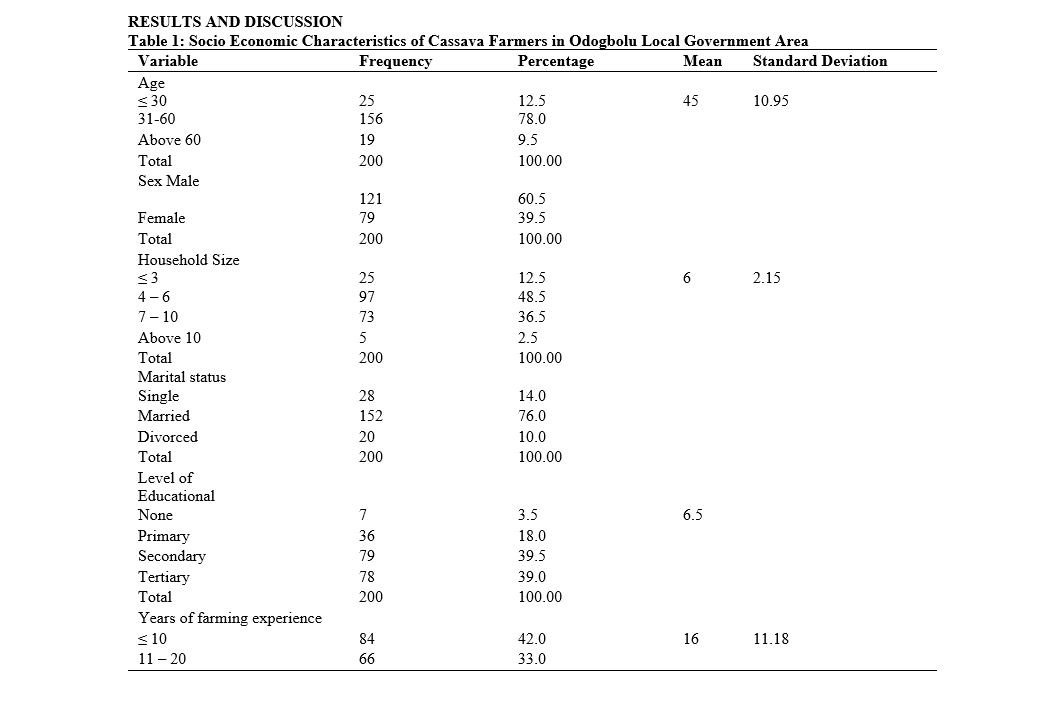
This study assessed the technical efficiency and profitability of cassava production in Odogbolu Local Government Area of Ogun State, Nigeria. Specifically, it described the socio-economic characteristics of cassava farmers, estimated their technical efficiency, identified the determinants of technical inefficiency, and examined the costs and returns of cassava production. Primary data were collected from 200 cassava farmers selected through a simple proportionate random sampling technique using a structured questionnaire. Data were analyzed using descriptive statistics, gross margin analysis, and the Cobb–Douglas stochastic frontier production function. The results showed that the mean age of the farmers was 45 years, with an average farming experience of 16 years. The mean technical efficiency was 0.88, indicating that farmers realized about 88% of their potential output, leaving a 12% scope for improvement. Farm size (β = 0.655; p < 0.01), fertilizer (β = 0.116; p < 0.05), and herbicide (β = 0.366; p < 0.01) significantly increased cassava output, while age, household size, farming experience, extension contact, and access to credit significantly reduced technical inefficiency. Cost and return analysis revealed a total revenue of ₦765,892.00, a total production cost of ₦549,990.00, and a gross margin of ₦317,771.00, confirming that cassava farming is profitable in the study area. The study concludes that cassava farmers are highly technically efficient and that improving access to extension services, affordable credit, improved inputs, and farmer cooperatives will further enhance productivity, efficiency, and profitability. It recommends strengthening agricultural extension services, improving farmers' access to credit, promoting cooperative membership.
References
Adeagbo, O. A., Ayinde, I. A., Adekunle, C. P., & Akinbile, L. A. (2023). The level of adoption of multiple climate change adaptation strategies among farmers in Southwest Nigeria. Scientific African, 22, e01971.
Adebayo, K., & Okuneye, P. A. (2019). Agricultural development and rural livelihoods Ogun State, Nigeria. Nigerian Journal of Rural Sociology, 19(2), 45–56.
Adeniji, A.A., Ega, M.O., Akoroda, A.A. Adeniyi, B.O. Ugwu & A. Balogun (2003). Cassava development in Nigeria. IFAD. 1-87.
Adepoju, A. A., & Salman, K. K. (2013). Technical efficiency of cassava farmers in Nigeria: A stochastic frontier approach. Journal of Agricultural Economics and Development, 2(1), 1–8.
Aigner, D., Lovell, C. A. K., & Schmidt, P. (1977). Formulation and estimation of stochastic frontier production function models. Journal of Econometrics, 6(1), 21–37.
Amaza, P. S., & Maurice, D. C. (2005). Identification of factors that influence technical efficiency in rice-based production systems in Nigeria. Food, Agriculture and Environment, 3(2), 196–201.
Ayeni, M. D., Aremu, C., & Olufemi, A. A. (2023). Stochastic frontier analysis of technical efficiency and profitability of dry season okra production in Nigeria. SAGE Open, 13(2), 1–9. https://doi.org/10.1177/21582440231181589.
Battese, G. E., & Coelli, T. J. (1995). A model for technical inefficiency effects in a stochastic frontier production function for panel data. Empirical Economics, 20(2), 325–332.
Chinaka, C.C. Omeke J.O., Onu R.O., & Okoro, B.O. (2013) Production, Processing and Utilization of Cassava. An extension bulletin No 224, sponsored by WAAP-Nigeria. Agricultural Transformation Agenda of the Federal Ministry of Agriculture and Rural Development. Produced and distributed by National Agricultural Extension and Research Liaison Services (NAERLS) Ahmadu Bello University. 4(3), 1-30.
Dossou, B. F. (2024) Type and Technical, Allocative and Economic Efficiencies in Agricultural Production: The case of Women Market Gardeners in Oueme Valley in Southern Benin. American Academic Scientific Research Journal for Engineering, Technology, and Sciences. 1-19.
Federal Ministry of Agriculture and Food Security (FMAFS). (2024). Agricultural sector progress report. Abuja, Nigeria: FMAFS.
Food and Agriculture Organization (FAO). (2024). Nigeria agricultural sector review. Rome, Italy: FAO.
Food and Agriculture Organization. (2023). The status of women in agrifood systems. Rome: FAO.
Food and Agriculture Organization. (2022). Fertilizer and sustainable crop production in Africa. Rome: FAO.
International Institute of Tropical Agriculture. (2024). Cassava value chain development in Nigeria. Ibadan, Nigeria: IITA.
International Institute of Tropical Agriculture. (2021). Cassava agronomy and weed management practices in West Africa. Ibadan, Nigeria: IITA.
Joseph, M., Hamidu, K., & Tidy, A. S. (2024). Socio-economic determinants of technical efficiency among dry season crop farmers in Gombe State, Nigeria. Journal of Agricultural Economics, Environment and Social Sciences, 10(1), 79–91.
Mairabo, A., J. S., Audu, H., Salihu, M. Y. & Elisha, Y. (2023). Technical efficiency of soybean production in Niger State, Nigeria. Fudma Journal of Sciences (Fjs), 7(1) 201 – 206.
National Planning Commission (NPC)[Nigeria] (2006). 2006 Nigeria demographic and Health Survey Summary Report. Abuja, Nigeria.
National Planning Commission (NPC)[Nigeria] (2026). 2025 Nigeria Demographic and Health Survey Summary Report. Abuja, Nigeria.
Ogun State Agricultural Development Programme (OGADEP). (2023). Extension service and agricultural development report. Abeokuta, Nigeria: OGADEP.
Omoluabi, J.E., & S.J. Ibitoye (2024) Cassava production and agricultural growth in Nigeria; Analysis of effects and forecast. GSC Advanced Research and Reviews. 37-46
Osun, I., Ogundijo, M., & Bolariwa, E. (2014). Determinants of Technical Inefficiency of Farm Production: Tobit Analysis Approach to the NDE Farmers in Ondo State, Nigeria. International Journal of Agriculture and Biology, 6(2), 355-358.
Downloads
Published
Issue
Section
Categories
License
Copyright (c) 2026 Alaba Akinsulu, Olaniyi Adegoke Odusina, Happiness Temitayo Ebofin

This work is licensed under a Creative Commons Attribution 4.0 International License.


