
Assessment of Heavy Metals and Polycyclic Aromatic Hydrocarbons in Nanoparticulate Banknote Dust from Selected Commercial Banks in Benin Metropolis, Nigeria
DOI:
https://doi.org/10.33003/fjs-2026-1013-5596Keywords:
Heavy metals, Particulate, Banknote Dust (BND), PAHs, GC-FID, DLS, Heavy metals, Particulate, Banknote Dust (BND), PAHs, GC-FID, DLSAbstract
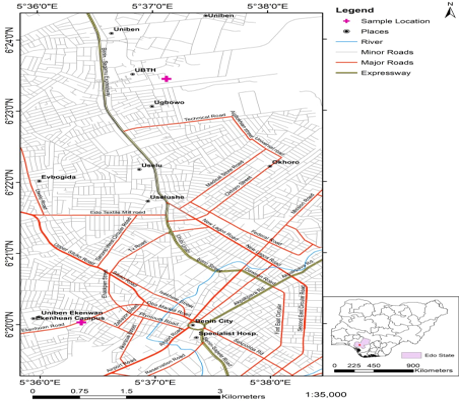
The improper handling of banknotes can accumulate dust that carries pollutants, posing health risks. This study assesses the potential health risk of particulate banknote dust (BND) in two commercial banks (A and B) in Benin Metropolis, Nigeria. About 10 g of BND were collected twice from each bank's tables and equipment with a soft brush and stored in airtight bags. The samples were analyzed for heavy metals using atomic absorption spectrophotometry (AAS), and polycyclic aromatic hydrocarbons (PAHs) using gas chromatography with a flame ionization detector (GC-FID), and the particle size was measured via dynamic light scattering (DLS). The results obtained for particle size ranged from 36.57 to 48.48 nm, indicating a nano-sized nature. The results of heavy metal concentration showed that iron had the highest, at 2,055.00 ± 70.06 mg/kg for location A and 1,934.53 ± 68.64 mg/kg for location B; however, both locations were below WHO/USEPA limits of 10000 mg/kg. Cadmium was recorded as the lowest in locations A (1.82 ± 0.03 mg/kg) and B (0.95 ± 0.15 mg/kg), exceeding permissible limits of 0.8 mg/kg. All 16 EPA priority PAHs were detected in the BND, with location A showing the highest concentration at 4.278 µg/kg, dominated by pyrene, and location B having more phenanthrene. These findings suggest possible health risks for staff and customers from long-term exposure. Therefore, implementing cashless payments and use of personal protective equipment (PPE) for bank staff is recommended.
References
Abdullahi, M., Auwal, Y., and Usman, A.H. (2022). Determination of heavy metals (Co, Cu, Cd, Fe, Pb, Zn) in some edible insects and fingerlings in Dutsin-ma town, Fudma Journal of Sciences, 6(04),6–11. https://doi.org/10.33003/fjs-2022-0604-1035
Adami, G., Barbieri, P., Piselli, S., Predonzani, S. and Reisenhofer, E., (2000). Detecting and characterizing source of persistent organic pollutants (PAHs and PCBs) in surface sediment of an industrialized area (Harbour of Trieste, Northan Ariatic sea). Journal of environmental monitoring 2:261-265 http://doi:101039/b0009950.
Alemu, A. (2014). Microbial contamination of currency notes and coins in circulation: A potential public health hazard, Biomedicine and Biotechnology, vol. 2(03): 46-53. https://doi.org/10.12691/bb-2-3-2
Anaam, J.A. (2019). A literature review on microbial contamination of paper currency, International Journal of Environmental Chemistry, 5(01): 18–22p. https://www.researchgate.net/publication/334120379
ATSDR, (2008). Chromium Toxicity, Atlanta, Georgia. https://www.atsdr.cdc.gov/csem/ (Accessed 13 August 2025).
Awe, S., Eniola, K.I.T., Ojo, F. T., and Sani, A. (2010). Bacteriological quality of some Nigerian currencies in circulation. African Journal of Microbiological Research 4(21):2231–2234
Boström, C.-E., Gerde, P., Hanberg, A., Jernström, B., Johansson, C., Kyrklund, T., Rannug, A., Törnqvist, M., Victorin, K., & Westerholm, R. (2002). Cancer risk assessment, indicators, and guidelines for polycyclic aromatic hydrocarbons in the ambient air. Environmental Health Perspectives, 110(Suppl 3), 451–488.
Brady, D. H. and Kelly, M.O. (2000). Pathogens associated with currencies, retrospective study of private diagnostic laboratories. University press. 2000.
Burchiel, S.W. and Luster, M.L. (2001). Signaling by Environmental PAHs in Human Lymphocytes. Journal of Clinical Immunology, 98:2 http;//doi101006/jclim2000.
California Environmental Protection Agency (Cal-EPA) (1994). Memorandum, to Cal/EPA Departments, Boards, and Offices from Standards and Criteria work Group, Office of Environmental Health Hazard Assessment. Subject: California Cancer Potency Factors: 134.
Cecchi, T., Giuliani, A. and Catini, C. (2025) ‘Green analysis of illicit drugs on banknote dust’, Green Analytical Chemistry, 12, p. 100218. https://doi.org/10.1016/j.greeac.2025.100218.
Cecchi, T., & Santoni, E. (2022). First liquid chromatography–high resolution mass spectrometry method for the determination of cocaine on banknote dust. Forensic Toxicology. 40 (2), 357–365 https://doi.org/10.1007/s11419-022-00627-9
Envoh, C.E. (2020). Bioavailability, average daily does and risk of heavy metals in soils from Children playground within Owerri, Imo State, Nigeria. Chemistry Africa, 3:427-438.
Envoh, C.E. and Isiuku, B.O. (2020). Determination and human health risk assessment of heavy metals in food basin soil in Owerri Southeastern Nigeria. Chemistry Africa, 3:1059, 1071 29.Verla Environmental, AW.
Genchi, G., Carocci, A., Lauria, G., Sinicropi, M. S., and Catalano, A. (2020). Nickel: Human Health and Environmental Toxicology. International Journal of Environmental Research and Public Health, 17(3), 679.
Goldman, R., Enewold, L., Pellizari, E., Beach, J.B., Bowman, E.D., Krishman, S.S., Shield. P. G. (2021). Smoking increases carcinogenic PAHs in Human Lung tissue. Cancer research 61, 6367-6371
Gorny, R.L., Golofit-Szymcak, M., Wojcik-Fatta, A., Cyprowski, M., Stobnicka-Kuplec, A., Lawniczek-Waezyk, A. (2021). Microbial Contamination of money sorting facilities. Annals of Agricultural and Environmental Medicine, 28(1):61-71. https://doi.org/10.26444/aaem/132321
IARC (2012) “International Agency for Research on Cancer: Chemical Agents and Related Occupations- A Review of Human Carcinigens.” Monograph on the Evaluation of Carcinogenic Risks to Humans 100(5),233-240
Igiebor, F. A., Amengialue, O. O., Ugwoke, G., Edogun, P. I., Ogboye, P. O., Obueh, H. O., Egharevba, P. A., Aishuehien, I. I., Ochoyama H., & Uwuigiaren N. J. (2025). Role of microplastics in the global plastics pollution crisis with respect to one health in post covid-19 era. Emerging Contaminants and One Health Approach. 1, CRC press, 103-134 https://doi.org/10.1201/9781032623801-6
Laden, F., Joel, S., Frank, E., Douglas, W. (2000). Reduction in fine particulate pollution and mortality. American journal of respiratory and critical care medicine. 19; 173(6):667-672.
Letelier, P., Saldias, R., Loren, P., Riquelme, I., and Guzman, N. (2023). MicroRNAs as Potential Biomarkers of Environmental Exposure to Polycyclic Aromatic Hydrocarbons and Their Link with Inflamatiom and Lung Cancer, international Journal of Molecular Sciences, 24. https://doi.org/10.3390/ijms242316984.
Moghtaderi, M.M., Ashraf, M.M., Moghtaderi, T.T., Teshnizi, S.H., and Nabavizadeh, S.H. (2020). Heavy metal concentration in classroom dust samples and its relationship with childhood asthma: a study from Islamic Republic of Iran, Eastern Mediterranean Health Journal/Eastern Mediterranean Health Journal, 26(05),594–601. https://doi.org/10.26719/emhj.19.072.
Ofoedu, C.E., Jude, O.I., Ijeoma, M A., Perpetual, Z.O., Charles Odilichukwu, R.O., and Małgorzata, K. (2021). Bacterial contamination of Nigerian currency notes: A comparative analysis of different denominations recovered from local food vendors, PeerJ, 9, p. e10795. https://doi.org/10.7717/peerj.10795
Paiko, Y.B., Nkeruwem, O.N., Tsado, M.T., Dagaci., M.Z. (2015). Proximate, mineral and anti-nutritional composition of the outer peel and seed coat of chrysophyllum albidum (African star apple) obtained from Minna, Niger state, Nigeria. Jewel Journal of scientific research.3(1): 1-6
Sayaan Bhattacharyya. (2020). Microbial Flora in Currency note: an area of concern. IP Internal Journal of Medical Microbiology and Topical Diseases, 6(2):90-91.
Sulaiman, M., Usman, U. L., Mudassir, B., & Salisu, A. A. (2026). Assessment of Microplastic Pollution, Seasonal Dynamic and Polymer Composition in Water, Sediment, and Fish from Mairuwa Reservoir, Funtua, Katsina Northwestern Nigeria. FUDMA JOURNAL OF SCIENCES, 10(12), 109-119. https://doi.org/10.33003/fjs-2026-1012-5639
Urrutia-Pereira, M., Rizzo, L.V., Staffeld, P.L., Chong-Neto, H.J., Viegi, G., and Sole, D. (2021). Dust from the Sahara to the American Continent: Health impacts, Allergol. Immunopath., 49, 187–194
Villeneuve, D.L., Khim, J.S., Kannan, K., Giesy J.P.(2002). Relative potencies of individual polycyclic aromatic hydrocarbons to induce dioxin‑like and estrogenic responses in three cell lines. Environmental Toxicology. 2002;17(2):128–137. doi: https://doi.org/10.1002/tox.10041
Wani, A.L., Ara, A., Usmani, J.A. (2015). Lead toxicity: a review. Interdisciplinary Toxicology. 2015;8(2):55–64.
Wang, G., Liu, H., Gong, Y., Wei, Y., Miso, A., Yang, L. and Zhang, H. (2017). Risk assessment of metals in Urban Soils from a typical Industrial City, Suzhou, Eastern China. International Journal of Environmental Research and Public Health. 14(1025):1-7
World Health Organization (WHO) (2019). Exposure to Cadmium: A major health concern. Chemical Safety and Health Unit (CHE), https://www.who.int/publications/i/item/WHO-CED-PHE-EPE-19-4-3 (Accessed 24 July 2025).
Zhuo, S., Shen, G., Zhu, Y., Du, W., Pan, X., Li, T., Hau, Y., Lin, J., Cheng, H., Xing, B., Tao, S. (2017). Source-orientation risk assessment of inhalation exposure to ambient polycyclic aromatic hydrocarbons and contributions to non-priority isomers in urban Najig, a megacity located in Yangtze River, China. Environmental pollution 224(10): 796-809.
Downloads
Published
Issue
Section
Categories
License
Copyright (c) 2026 Osagie Ferdinand Amayo, Philip Idemudia Edogun, Justina Ebehirieme Ukpebor

This work is licensed under a Creative Commons Attribution 4.0 International License.


