
Availability, Accessibility, and Barriers to Low Vision Devices in Edo State, Nigeria: A Cross-Sectional Study of Low Vision Care Providers
DOI:
https://doi.org/10.33003/fjs-2026-1013-5587Keywords:
Low Vision, Low Vision Devices, Accessibility, Availability, Vision RehabilitationAbstract
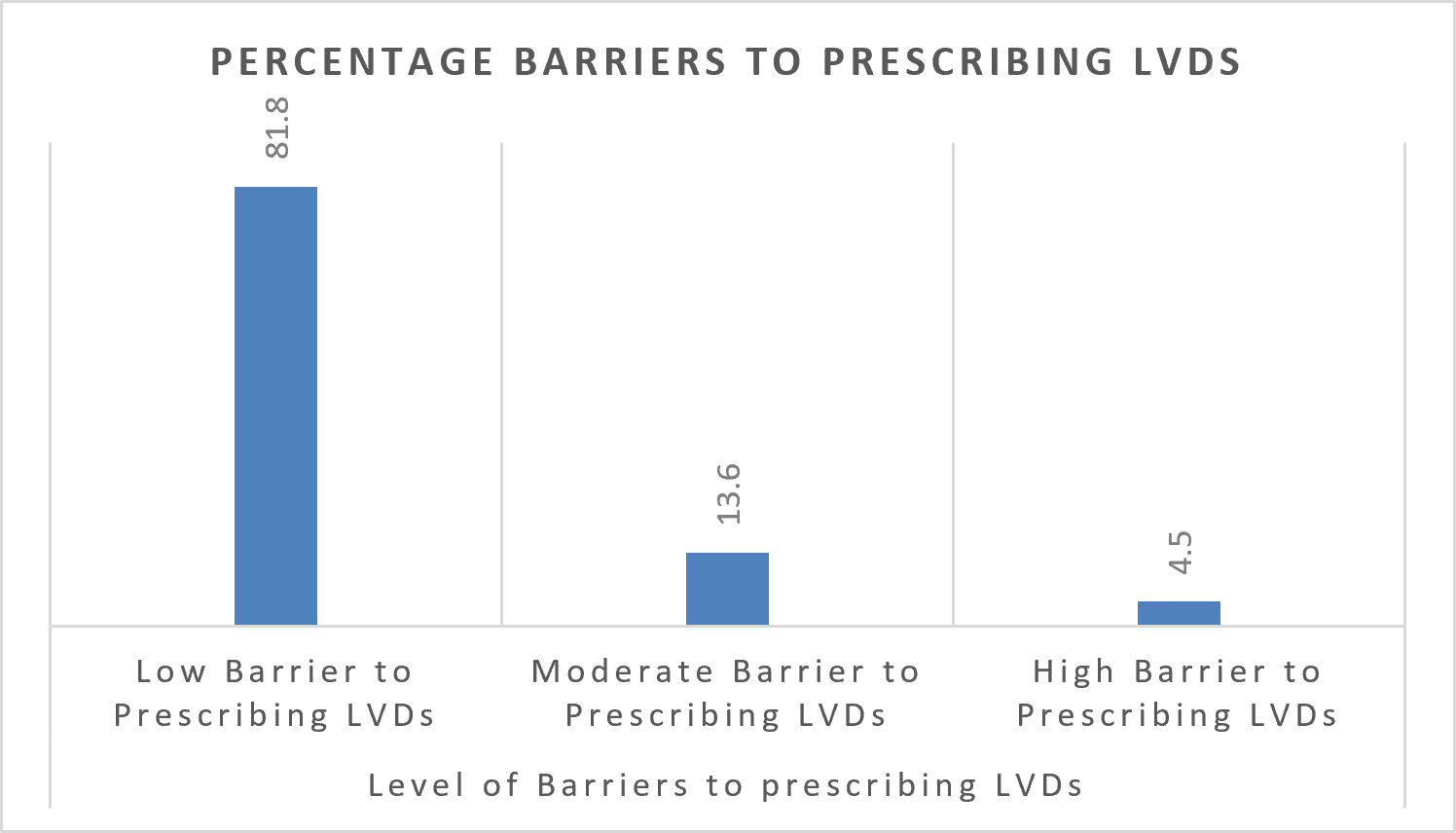
Low vision (LV) rehabilitation improves functional vision and quality of life among people living with irreversible visual loss. However, effective rehabilitation depends largely on the availability and accessibility of appropriate low vision devices (LVDs). This study evaluated factors influencing availability and accessibility of LVDs among low vision care providers in Edo State, Nigeria. We carried out descriptive cross-sectional survey among 22 optometrists providing LV care across the three senatorial districts of Edo State. Participants were purposively selected using predefined eligibility criteria. Participants completed a structured questionnaire independently, which was developed from National Eye Institute Visual Function Questionnaire and modified for low vision service delivery. We processed and evaluated all information using SPSS version 23. On average, the participants were 38.18 ± 6.41 years old, and 63.6% were females. Nearly all providers (95.5%) reported poor availability of low vision devices, while 45.5% reported poor accessibility and 50.0% reported moderate accessibility. Most respondents indicated inadequate availability of electronic LVDs, poor access through local suppliers, limited institutional support, and high importation costs as major barriers. Despite these systemic challenges, most providers perceived relatively low barriers to prescribing devices, suggesting adaptation to longstanding resource limitations. Low vision rehabilitation services in Edo State are constrained primarily by inadequate availability and accessibility of LVDs, insufficient institutional support, and financial barriers. Strengthening procurement systems, improving government investment, expanding local distribution networks, and integrating low vision services into national eye health programmes are essential to improve equitable access to vision rehabilitation.
References
Abraham, CH., Diane, VS., and Nishanee, R. (2025). A Qualitative Assessment of Low Vision Care Among Optometric Practitioners in Sub-Saharan Africa Using a Health Systems Framework. Health Services Insights, 18, 11786329251399780. https://doi.org/10.1177/11786329251399779.
Acheampong, E., Kasore, V., Kponyo, BA., Owusu-Ansah, RY., Owusu-Ansah, JK., Ansah, O., et al. (2025). Barriers to Assistive Technology Uptake among Persons with Disabilities in Selected Urban Districts in Ghana. Scientific Reports, 16(1), 1838. https://doi.org/10.1038/s41598-025-31466-4.
Akuffo, KO., Kyeremeh, S., Agyekum, S., Osei, I., Duah, J., Ampong, J., et al. (2026). Low Vision Services in Sub- Saharan Africa : A Systematic Review. Frontiers in Health Services, 6(6), 1839924. https://doi.org/10.3389/frhs.2026.1839924.
Alsaqr, AM. (2021). Barriers to Low Vision Services among Optometrists in Saudi Arabia. Open Ophthalmology Journal, 15, 178–188.
Dendea, SG., Ababor, JK., Daba, KT., and Molla, JM. (2023). Reported Perceived Barriers to Low Vision Rehabilitation Services among Ophthalmic Personnel in Ethiopia. Advanced Techniques in Biology & Medicine, 11(1000400), 1–8.: https://doi.org/10.35248/2379-1764.23.11.400.
Federal Ministry of Health & Social Welfare. (2023). National Eye Health Strategic Development Plan (2024-2028).
Garba, H. (2026). Availability and Accessibility of Rehabilitation Services for Children with Disabilities in Kano Metropolis. FUDMA Journal of Sciences, 10(9), 79–83. https://doi.org/10.33003/fjs-2026-1009-5308.
Jose, J., Thomas, J., Bhakat, P., and Krithica, S. (2016). Awareness, Knowledge, and Barriers to Low Vision Services among Eye Care Practitioners. Oman Journal of Ophthalmology, 9(1), 37–43. https://doi.org/10.4103/0974-620X.176099.
Kyeremeh, S., and Mashige, KP. (2021). Availability of Low Vision Services and Barriers to Their Provision and Uptake in Ghana: Practitioners’ Perspectives. African Health Sciences, 21(2), 896–903. https://doi.org/10.4314/ahs.v21i2.51.
Monye, HI, Kyari, F., and Momoh, RO. (2020). A Situational Report on Low Vision Services in Tertiary Hospitals in South‑East Nigeria. Nigerian Journal of Clinical Practice, 23, 919–27. https://doi.org/10.4103/njcp.njcp.
Moyegbone, JE., Okpoghono, J., Osaiyuwu, AB., Oronsaye, EE., Fregene, FA., Ogbomo, IN., et al. (2025). Impairment of Depth Perception and Risk Factors among Commercial Motor-Vehicle Drivers. Transportation Research Interdisciplinary Perspectives, 31, 101444. https://doi.org/10.1016/j.trip.2025.101444.
National Eye Institute. (2000). Visual Functioning Questionnaire - 25 (VFQ-25). PB/IA 1–16.
National Eye Institute. (2025). Low Vision. Available at https://www.nei.nih.gov/eye-health-information/eye-conditions-and-diseases/low-vision
NPC. (2023). Demographic Statistics Bulletin 2022. Available at Https://Www.Nigerianstat.Gov.Ng/Pdfuploads/DEMOGRAPHIC_BULLETIN_2022_FINAL.Pdf.
Oikonomidis, K., Almpanidou, S., Talimtzi, P., Kakavouti-doudou, A., Metaxas, SM., and Karampatakis, V. (2023). Compliance With the Use of Low-Vision Aids in a Greek Population : An Explorative Study. Cureus 15(7), e42730. https://doi.org/10.7759/cureus.42730.
Okasheh-otoom, A. (2026). Barriers to Adoption of Electronic Low Vision Aids Among Eye Care Professionals in Jordan: Descriptive Cross- Sectional Study. JMIR Rehabilitation and Assistive Technologies, 13, e87685. https://doi.org/10.2196/87685.
Okoye, RS., Bell, L., and Papadopoulos, I. (2018). Barriers to Accessing Good Eye Care Services in Nigeria : A Focus. Journal of the Nigerian Optometric Association, 20(1), 30–37.
Okwudishu, IA., Ugalahi, MO., Olusanya, BA., and Bekibele, CO. (2023). Prevalence of Low Vision and Barriers to Uptake of Low Vision Services in an Adult Population of Southwest Nigeria. Nigerian Journal of Ophthalmology, 31(1), 19–24. https://doi.org//10.4103/njo.njo_14_22.
Oldfrey, B., Holloway, C., Walker, J., Mccormack, S., Kenney, L., Ssekitoleko, R., et al. (2024). Repair Strategies for Assistive Technology in Low Resource Settings. Disability and Rehabilitation: Assistive Technology, 19(5), 1945–1955. https://doi.org/10.1080/17483107.2023.2236142.
Virgili, G., Acosta, R., Bentley, SA., Giacomelli, G., Allcock, C., and Evans, JR. (2018). Reading Aids for Adults with Low Vision. Cochrane Library Cochrane Database of Systematic Reviews, (4), CD003303. https://doi.org/10.1002/14651858.CD003303.pub4.
WHO. (2026a).Blindness and Vision Impairment. Available at https://www.who.int/news-room/fact-sheets/detail/blindness-and-visual-impairment.
WHO. (2026b). Eye Care, Vision Impairment and Blindness. World Health Organization. Available at https://www.who.int/health-topics/blindness-and-vision-loss#tab=tab_1
Downloads
Published
Issue
Section
Categories
License
Copyright (c) 2026 John Esimaje Moyegbone, Oforbuike Onyebuchi Ike, Nnaemeka Alvand Onwukwe

This work is licensed under a Creative Commons Attribution 4.0 International License.


