
Isolation and Antibiotic Susceptibility Patterns of Airborne Bacteria from the In-Patient and Out-Patient Sections of Selected Primary Health Care Centers
DOI:
https://doi.org/10.33003/fjs-2026-1020-5574Keywords:
Airborne bacteria, Healthcare-associated infection, Primary health care, In-patient, Out-patient, Antibiotic resistanceAbstract
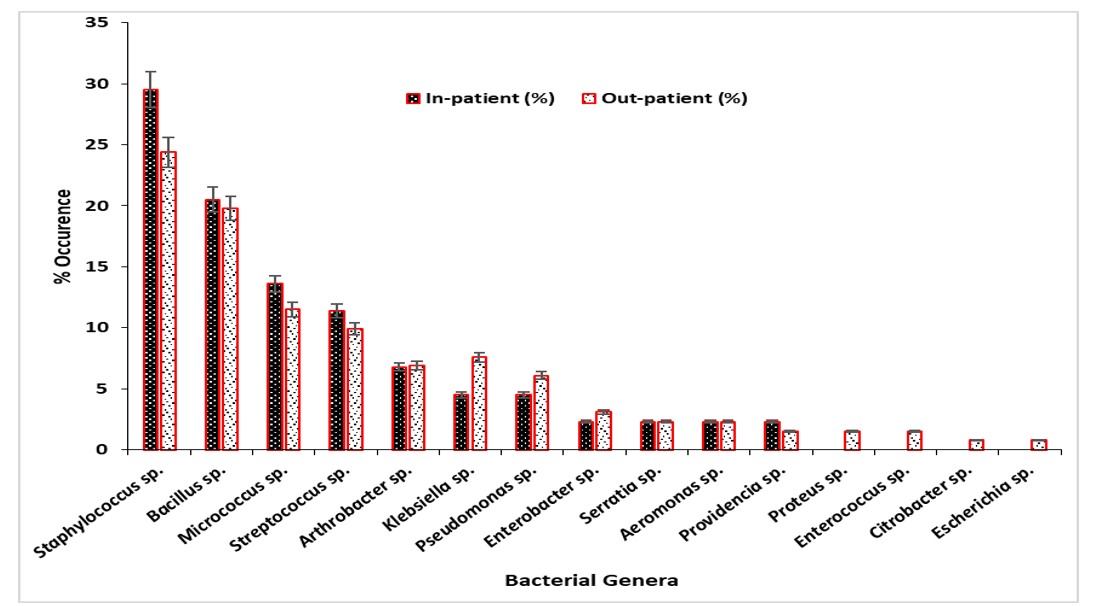
Airborne bacteria constitute an important source of environmental contamination in healthcare facilities and may contribute to healthcare-associated infections. This study assessed the load, diversity and antibiotic susceptibility of settled airborne bacteria in the in-patient (IP) and out-patient (OP) sections of six primary health care centres (three government-owned and three private-owned) in Obafemi-Owode LGA, Ogun State, Nigeria. Settle plates (Nutrient and MacConkey agar) were exposed in triplicate at 150 cm for 10-, 20- and 30-min during morning clinics across four wet-season visits (June 2025). OP loads were significantly higher than IP loads (one-way ANOVA, P < 0.05), with overall means of 21.1±4.58 and 65.2±7.06 CFU/plate, respectively (grand mean 43.1±7.77). After 48 h, IP counts ranged from 8±0.63 – 22±2.71 (10 min), 11±0.91 – 52±4.16 (20 min) and 16±1.31 – 57±2.36 CFU/plate (30 min); OP counts were 22±0.71 – 54±2.76, 36±2.46 – 104±3.89 and 82±2.23 – 144±5.16. The highest OP means were at IHC (86.7±17.28) and OHC (82.7±17.92); the lowest was at MHC (39.3±10.39). Several government-owned centres showed higher contamination than the private-owned. Gram-positive bacteria predominated, including Staphylococcus spp., Streptococcus spp. and Bacillus spp., alongside Gram-negative genera including Escherichia coli, Klebsiella spp., Pseudomonas spp. and Serratia spp. Mean panel resistance was about 52% (Gram-positive) and 48% (Gram-negative), especially to ampicillin, amoxicillin–clavulanate and erythromycin; while ciprofloxacin and gentamicin showed the best activity. The data indicate substantial settled airborne contamination that may increase healthcare-associated infection risk and underscore the need for routine microbiological surveillance, improved ventilation, and stringent infection-prevention protocols
References
Adekanmbi, A. O., Ishola, L. T., Ogunsakin, E. B., Ajamu, T. A., & Lawal, F. T. (2026). Antibiotic resistance profiles and co-occurrence of ESBL and AmpC β-lactamase genes in ESBL-producing Gram-negative bacteria of clinical origin. BMC Microbiology. https://doi.org/10.1186/s12866-026-05129-x
Ahmed, S. K., Hussein, S., Qurbani, K., Ibrahim, R. H., Fareeq, A., Mahmood, K. A., & Mohamed, M. G. (2024). Antimicrobial resistance: Impacts, challenges, and future prospects. Journal of Medicine Surgery and Public Health, 2, 100081. https://doi.org/10.1016/j.glmedi.2024.100081
Aleruchi, O., Robinson, V. K., Okpokiri, M., & Egedeye-Fubara, I. V. (2024). Assessment of Airborne Microbial Composition and Antibiotic Susceptibility Profiles in Dumpsite Environments within Rivers State University. Journal of Advances in Microbiology, 24(1), 19–29. https://doi.org/10.9734/jamb/2024/v24i1782
AlRayess, S., Sleiman, A., Alameddine, I., Fayad, A. A., Matar, G. M., & El-Fadel, M. (2022). Airborne bacterial and PM characterization in intensive care units: correlations with physical control parameters. Air Quality Atmosphere & Health, 15(10), 1869–1880. https://doi.org/10.1007/s11869-022-01222-y
Al-Shaarani, A. A., & Pecoraro, L. (2026). The influence of environmental factors on the diversity and structure of airborne fungal and bacterial communities. Mycology: an International Journal on Fungal Biology. https://doi.org/10.1080/21501203.2026.2627697
Al-Shaarani, A. Q. A., & Pecoraro, L. (2024). A review of pathogenic airborne fungi and bacteria: unveiling occurrence, sources, and profound human health implication. Frontiers in Microbiology, 15, 1428415. https://doi.org/10.3389/fmicb.2024.1428415
Ather B, Mirza TM, Edemekong PF. Airborne Precautions. [Updated 2023 Mar 13]. In: StatPearls [Internet]. Treasure Island (FL): StatPearls Publishing; 2026 Jan-. Available from: https://www.ncbi.nlm.nih.gov/books/NBK531468/
Chamseddine, A., Elzein, I. M., & Hassan, N. (2025). Indoor Air Quality in Critical Indoor Environments: A review paper. Water Air & Soil Pollution, 236(13). https://doi.org/10.1007/s11270-025-08512-y
Chen, L., Song, Z., Zhou, X., Yang, G., & Yu, G. (2023). Pathogenic bacteria and fungi in bioaerosols from specialized hospitals in Shandong province, East China. Environmental Pollution, 341, 122922. https://doi.org/10.1016/j.envpol.2023.122922
Clinical and Laboratory Standards Institute (CLSI), (2024). Performance standards for antimicrobial disk susceptibility tests (14th ed., CLSI standard M02). Clinical and Laboratory Standards Institute.
Clinical and Laboratory Standards Institute (CLSI), (2025). Performance standards for antimicrobial susceptibility testing (35th ed., CLSI supplement M100). Clinical and Laboratory Standards Institute.
Fernandez, M. O., Thomas, R. J., Garton, N. J., Hudson, A., Haddrell, A., & Reid, J. P. (2019). Assessing the airborne survival of bacteria in populations of aerosol droplets with a novel technology. Journal of the Royal Society Interface, 16(150), 20180779. https://doi.org/10.1098/rsif.2018.0779
Haddad, G., & Hallak, M. A. (2026). Microbial contamination in the indoor environment of Arabian Gulf: a review. Frontiers in Microbiology, 17, 1796861. https://doi.org/10.3389/fmicb.2026.1796861
Herfst, S., Böhringer, M., Karo, B., Lawrence, P., Lewis, N. S., Mina, M. J., Russell, C. J., Steel, J., De Swart, R. L., & Menge, C. (2016). Drivers of airborne human-to-human pathogen transmission. Current Opinion in Virology, 22, 22–29. https://doi.org/10.1016/j.coviro.2016.11.006
Jalili, D., Dehghani, M., Fadaei, A., & Alimohammadi, M. (2021). Assessment of airborne bacterial and fungal communities in Shahrekord Hospitals. Journal of Environmental and Public Health, 2021, 1–7. https://doi.org/10.1155/2021/8864051
Kim, K., Kabir, E., & Jahan, S. A. (2017). Airborne bioaerosols and their impact on human health. Journal of Environmental Sciences, 67, 23–35. https://doi.org/10.1016/j.jes.2017.08.027
Kuznetsova, M. V., Nesterova, L. Y., Mihailovskaya, V. S., Selivanova, P. A., Kochergina, D. A., Karipova, M. O., Valtsifer, I. V., Averkina, A. S., & Erjavec, M. S. (2025). Nosocomial Escherichia coli, Klebsiella pneumoniae, Pseudomonas aeruginosa, and Staphylococcus aureus: Sensitivity to Chlorhexidine-Based Biocides and Prevalence of Efflux Pump Genes. International Journal of Molecular Sciences, 26(1), 355. https://doi.org/10.3390/ijms26010355
Li, J., Cheng, F., Wei, X., Bai, Y., Wang, Q., Li, B., Zhou, Y., Zhai, B., Zhou, X., Wang, W., & Zhang, J. (2025). Methicillin-Resistant Staphylococcus aureus (MRSA): Resistance, Prevalence, and Coping Strategies. Antibiotics, 14(8), 771. https://doi.org/10.3390/antibiotics14080771
Lu, Z., Mclnnes, R. S., Allen, F., Gadar, K., & Van Schaik, W. (2025). Resistance to last-resort antibiotics in enterococci. FEMS Microbiology Reviews, 49. https://doi.org/10.1093/femsre/fuaf057
Mannan, M., & Al-Ghamdi, S. G. (2021). Indoor air quality in buildings: A comprehensive review on the factors influencing air pollution in residential and commercial structure. International Journal of Environmental Research and Public Health, 18(6), 3276. https://doi.org/10.3390/ijerph18063276
Mohamed, F. I., Ibrahim, M. A., Abdel-Latef, G. K., Abdel-Rahim, M. M., Shany, S. a. S., Mahmoud, R., Mahgoub, S. M., Othman, S. I., & Aziz, S. a. a. A. (2026). Enhanced nanoencapsulation of gentamicin, ciprofloxacin, and lysozyme in chitosan-MIL-53 metal–organic frameworks for a synergistic activity against drug-resistant Salmonella from poultry and human origins. RSC Advances, 16(22), 19991–20014. https://doi.org/10.1039/d5ra09975g
Monteiro, A., Almeida, B., Paciência, I., Rufo, J. C., Ribeiro, E., Carolino, E., Viegas, C., Uva, A. S., & Verde, S. C. (2021). Bacterial Contamination in Health Care Centers: Differences between Urban and Rural Settings. Atmosphere, 12(4), 450. https://doi.org/10.3390/atmos12040450
Nie, C., Qiu, Y., Pei, T., & Qin, Y. (2024). Specific sources exert influence on the community structures of bioaerosols. Aerobiology, 2(4), 72–84. https://doi.org/10.3390/aerobiology2040006
Odoom, A., & Donkor, E. S. (2025). Prevalence of Healthcare‐Acquired Infections among Adults in Intensive Care Units: A Systematic Review and Meta‐Analysis. Health Science Reports, 8(7), e70939. https://doi.org/10.1002/hsr2.70939
Odoyo, E., Matano, D., Tiria, F., Georges, M., Kyanya, C., Wahome, S., Mutai, W., & Musila, L. (2023). Environmental contamination across multiple hospital departments with multidrug-resistant bacteria pose an elevated risk of healthcare-associated infections in Kenyan hospitals. Antimicrobial Resistance and Infection Control, 12(1), 22. https://doi.org/10.1186/s13756-023-01227-x
Olutiola P. O., Famurewa, O., Sonntag, H. S. (2000). An Introduction to General Microbiology (A practical Approach). Measurement of Microbial Growth, pp. 101-111. https://www.sciepub.com/reference/231610
Othman, M., Latif, M. T., Hamid, H. H. A., Bakar, N. H. A., Mohamad, N. H., Haron, N. F., & Noraini, N. M. R. (2024). Variability and health impact of air pollutants and bioaerosols in multi-functional indoor environments with mechanical ventilation system. Journal of Building Engineering, 90, 109436. https://doi.org/10.1016/j.jobe.2024.109436
Roy, S., Barua, H. T., Sujan, M. J., Hossain, A., Paul, S. K., Nasreen, S. A., Ahmed, S., Haque, N., Habib, Z. H., Rahman, A., Rizvi, S. M. S., Hasnat, M. A., Kwon, S. Y., Stelling, J., Gautam, S., Shaw, A., Marks, F., & Poudyal, N. (2025). Trends and patterns of antimicrobial resistance in a tertiary care hospital in Bangladesh. Microbiology Research, 16(2), 30. https://doi.org/10.3390/microbiolres16020030
Sajjad, B., Hussain, S., Rasool, K., Hassan, M., & Almomani, F. (2023). Comprehensive insights into advances in ambient bioaerosols sampling, analysis and factors influencing bioaerosols composition. Environmental Pollution, 336, 122473. https://doi.org/10.1016/j.envpol.2023.122473
Singh, K. V., Puraswani, M., Ningombam, A., Ashita, A., Thomas, J. M., Ambashta, N. K., Deuri, R. R., Sam, S., Ranic, D., Victor, D., Gunjiyal, J., Farooque, K., & Mathur, P. (2025). Environmental sampling reveals reservoirs of antimicrobial resistance in a tertiary care Indian hospital: an observational study to strengthen infection control practices. IJID Regions, 17, 100782. https://doi.org/10.1016/j.ijregi.2025.100782
Szabó, S., Feier, B., Capatina, D., Tertis, M., Cristea, C., & Popa, A. (2022). An overview of healthcare associated infections and their detection methods caused by pathogen bacteria in Romania and Europe. Journal of Clinical Medicine, 11(11), 3204. https://doi.org/10.3390/jcm11113204
Tselebonis, A., Nena, E., Panopoulou, M., Kontogiorgis, C., Bezirtzoglou, E., & Constantinidis, T. (2020). Air contamination in different departments of a tertiary hospital. Assessment of microbial load and of antimicrobial susceptibility. Biomedicines, 8(6), 163. https://doi.org/10.3390/biomedicines8060163
World Health Organization: WHO. (2022, May 6). WHO launches first ever global report on infection prevention and control. WHO. https://www.who.int/news/item/06-05-2022-who-launches-first-ever-global-report-on-infection-prevention-and-control
Xhetani, M., Parllaku, B., Bakiri, F., Lugaj, A., Hamzaraj, E., Lika, M., Metaliaj, A., Beca, V., & Bennewitz, B. (2026). Optimizing Molecular Tools for Bioaerosol Monitoring: A Case Study of Staphylococcus aureus in a Crowded Workplace. Aerobiology, 4(1), 4. https://doi.org/10.3390/aerobiology4010004
Downloads
Published
Issue
Section
Categories
License
Copyright (c) 2026 Gboyega Adebami, Mojisola Maloma, Eniola Olaleye, Oluwadamilola Isinkaye, Opeyemi Joshua, Bolanle Opere

This work is licensed under a Creative Commons Attribution 4.0 International License.