
Studies on the Adsorption of Cd(II) and Pb(II) Metal ions using Magnetite (Fe3O4) Nanoadsorbent from Fertilizer Wastewater
DOI:
https://doi.org/10.33003/fjs-2026-1012-5571Keywords:
Green Synthesis, Nanoadsorbent, Magnetite, CharacterizationAbstract
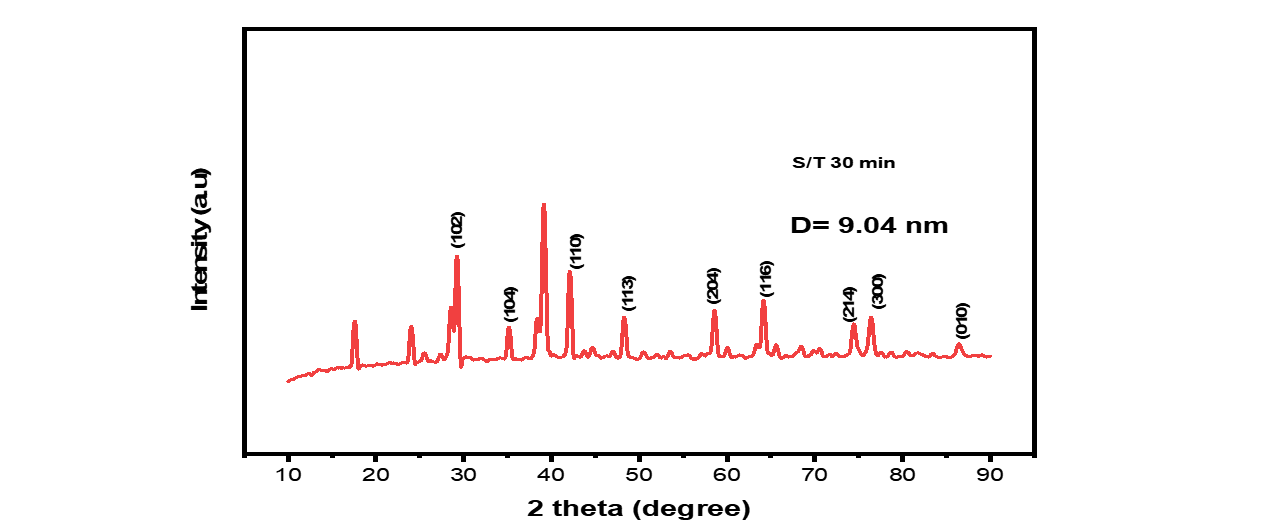
The green synthesized nanoadsorbent of magnetite (Fe3O4) was characterized for mineralogical phase structure, elemental composition, particles size and morphology. The XRD result showed distinct peaks at angles of 29.20, 33.33, 42.43, 48.22, 58.57, 64.33, 74.44, 76.42 and 86.44 degrees which is related to planes of (102), (104), (110), (113), (204), (116), (214), (300) and (010) with designated phase structure of cubic centered face and crystallite size of 9.04 nm. The elemental compositions also showed a separate peak of iron (Fe, 2.31 keV) and oxygen (O, 0.51 keV). While the surface morphology showed a well dispersed and slightly agglomerated with an average particle size distribution of 15.43 nm as well as dynamic light scattering particle size distribution of 45.76 nm and polydispersity index (PDI) of 0.287. The percentage removal efficiency of Cd(II) metal ions was the highest with 64.43 % when compared with Pb(II) metal ion with 53.43 % in contact time while in adsorbent dose and temperature Pb(II) metal ion had the highest with 68.67% and 65.78 % respectively, in the adsorption process. The kinetic adsorption data fitted well for the pseudo-second-order kinetic model due to the high number of R2 values of 0.9981and 0.9992 for Cd(II) and Pb(II) metal ions respectively, showing that chemisorption was the rate-determining step. The study demonstrated that magnetite (Fe3O4) nanoadsorbent can be utilized in wastewater treatment for the removal of metal ions due to its unique properties.
References
Abdulkareem, A. S., Hamzat, W. A., Tijani, J. O., Egbosiuba, T. C., Mustapha, S., Abubakre, O. K., Okafor, B. O., & Babayemi, A. K. (2023). Isotherm, kinetics, thermodynamics and mechanism of metal ions adsorption from electroplating wastewater using treated and functionalized carbon nanotubes. Journal of Environmental Chemical Engineering, 11(1), 109180.
Adeyemi, J. O., Oriola, A. O., Onwudiwe, D. C., & Oyedeji, A. O. (2022). Plant Extracts Mediated Metal-Based Nanoparticles: Synthesis and Biological Applications. Biomolecules, 12(5), 23–40.
Ahmed, S. F., Mofijur, M., Ahmed, B., Mehnaz, T., Mehejabin, F., Maliat, D., Hoang, A. T., & Shafiullah, G. M. (2022). Nanomaterials as a sustainable choice for treating wastewater. Environmental Research, 214(7).
Almeida-Naranjo, C. E., Guerrero, V. H., & Villamar-Ayala, C. A. (2023). Emerging Contaminants and Their Removal from Aqueous Media Using Conventional/Non-Conventional Adsorbents: A Glance at the Relationship between Materials, Processes, and Technologies. Water (Switzerland), 15(8), 1-7.
Alnasrawi, F. A., Mohammed, A. A., & Tariq, A. M. (2023). Synthesis and application of layered double hydroxides as a superior adsorbent for the removal of hazardous contaminants from aqueous solutions: a comprehensive review. Desalination and Water Treatment, 297, 26–74.
Aragaw, T. A., Bogale, F. M., & Aragaw, B. A. (2021). Iron-based nanoparticles in wastewater treatment: A review on synthesis methods, applications, and removal mechanisms. Journal of Saudi Chemical Society, 25(8), 101280.
Bhilkar, P. R., Bodhne, A. S., Yerpude, S. T., Madankar, R. S., Somkuwar, S. R., Daddemal-Chaudhary, A. R., Lambat, A. P., Desimone, M., Sharma, R., & Chaudhary, R. G. (2023). Phyto-derived metal nanoparticles: Prominent tool for biomedical applications. OpenNano, 14(6), 100192.
Dhar, P. K., Saha, P., Hasan, M. K., Amin, M. K., & Haque, M. R. (2021). Green synthesis of magnetite nanoparticles using Lathyrus sativus peel extract and evaluation of their catalytic activity. Cleaner Engineering and Technology, (3), 100117.
Diener, A., & Mudu, P. (2021). How can vegetation protect us from air pollution? A critical review on green spaces’ mitigation abilities for air-borne particles from a public health perspective - with implications for urban planning. Science of the Total Environment, (796) 148605.
Egbosiuba, T.C., Abdulkareem, A.S., Tijani, J.O., Ani, J.I., Krikstolaityte, V., Srinivasan, M., Veksha, A. & Lisak, G (2021). Taguchi optimization design of diameter-controlled synthesis of multi walled carbon nanotubes for the adsorption of Pb(II) and Ni(II) from chemical industry wastewater, Chemosphere, 12( 2), 89-93.
Harsha, L., Subramanian, A., Balakrishnan, N., & Prasad, A. (2022). Green Synthesis and Characterization of Titanium Dioxide Nanoparticle (Tio2) Synthesized Using the Leaf of Eucalyptus Globulus – An In Vitro Study. Journal of Complementary Medicine Research, 13(5), 115.
Joudeh, N., & Linke, D. (2022). Nanoparticle classification, physicochemical properties, characterization, and applications: a comprehensive review for biologists. Journal of Nanobiotechnology, 20(1), 1–29.
Kiwumulo, H. F., Muwonge, H., Ibingira, C., Lubwama, M., Kirabira, J. B., & Ssekitoleko, R. T. (2022). Green synthesis and characterization of iron-oxide nanoparticles using Moringa oleifera: a potential protocol for use in low and middle income countries. BMC Research Notes, 15(1), 1–8.
Mohamed, A., Atta, R. R., Kotp, A. A., Abo El-Ela, F. I., Abd El-Raheem, H., Farghali, A., Alkhalifah, D. H. M., Hozzein, W. N., & Mahmoud, R. (2023). Green synthesis and characterization of iron oxide nanoparticles for the removal of heavy metals (Cd2+ and Ni2+) from aqueous solutions with Antimicrobial Investigation. Scientific Reports, 13(1), 1–30.
NSDWQ (2023). Nigerian Standard Industrial. http://rivwarmis.ogunstate. gov.ng/assets/files/Nigerian Standard-for –Drinking Water-Quality-NIS-554-2023 pdf
Onyancha, R. B., Aigbe, U. O., Ukhurebor, K. E., Kusuma, H. S., Darmokoesoemo, H., Osibote, O. A., & Pal, K. (2022). Influence of magnetism-mediated potentialities of recyclable adsorbents for heavy metal ions removal from aqueous solutions – An organized review. Results in Chemistry, 4(4), 100452.
Qasem, N. A. A., Mohammed, R. H., & Lawal, D. U. (2021). Removal of heavy metal ions from wastewater: a comprehensive and critical review. Npj Clean Water, 4(1).
Qiu, M., Liu, L., Ling, Q., Cai, Y., Yu, S., Wang, S., Fu, D., Hu, B., & Wang, X. (2022). Biochar for the removal of contaminants from soil and water: a review. Biochar, 4(1), 1–25.
Sodzidzi, Z., Phiri, Z., Nure, J. F., Msagati, T. A. M., & de Kock, L. A. (2024). Adsorption of Toxic Metals Using Hydrous Ferric Oxide Nanoparticles Embedded in Hybrid Ion-Exchange Resins. Materials, 17(5).
Wen, J., Gao, F., Liu, H., Wang, J., Xiong, T., Yi, H., Zhou, Y., Yu, Q., Zhao, S., & Tang, X. (2024). Metallic nanoparticles synthesized by algae: Synthetic route, action mechanism, and the environmental catalytic applications. Journal of Environmental Chemical Engineering, 12(1), 111742.
WHO (2022). Guidelines for drinking-water quality: fourth edition incorporating the first and second addenda. https://www.who.int/publications/i/item/9789240045064.
Xu, W., Yang, T., Liu, S., Du, L., Chen, Q., Li, X., Dong, J., Zhang, Z., Lu, S., Gong, Y., Zhou, L., Liu, Y., & Tan, X. (2024). Insights into the Synthesis, types and application of iron Nanoparticles: The overlooked significance of environmental effects. Environment International, 15(8).1-8.
Yan, A., Wang, Y., Tan, S. N., Mohd Yusof, M. L., Ghosh, S., & Chen, Z. (2020). Phytoremediation: A Promising Approach for Revegetation of Heavy Metal-Polluted Land. Frontiers in Plant Science, 11(4), 1–15.
Zarei, Z., Razmjoue, D., & Karimi, J. (2020). Green Synthesis of Silver Nanoparticles from Caralluma tuberculata Extract and its Antibacterial Activity. Journal of Inorganic and Organometallic Polymers and Materials, 30(11), 4606–4614.
Zhu, Y., Yang, Q., Lu, T., Qi, W., Zhang, H., Wang, M., Qi, Z., & Chen, W. (2020). Effect of phosphate on the adsorption of antibiotics onto iron oxide minerals: Comparison between tetracycline and ciprofloxacin. Ecotoxicology and Environmental Safety, 205(5), 111345.
Downloads
Published
Issue
Section
Categories
License
Copyright (c) 2026 Yusuf James, Chima Nnachi, Dogara Kantoma

This work is licensed under a Creative Commons Attribution 4.0 International License.


