
Machine Learning-Assisted Numerical Integration for Predictive Mathematical Modelling
DOI:
https://doi.org/10.33003/fjs-2026-1012-5570Keywords:
Numerical integration, Predictive mathematical modeling, Machine learning, Adaptive Algorithms, Numerical StabilityAbstract
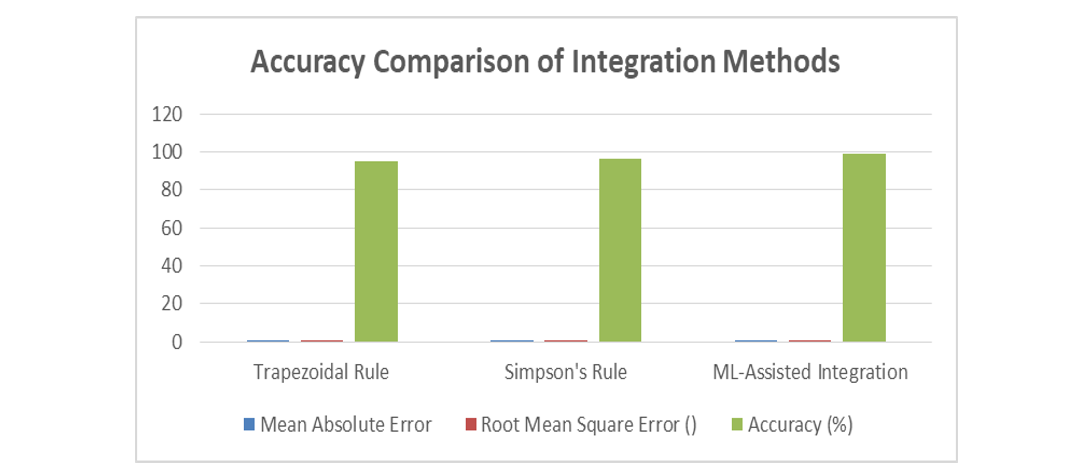
Accurate numerical integration remains a fundamental challenge in predictive mathematical modelling, particularly for nonlinear, high-dimensional, and data-driven systems. Conventional numerical integration techniques, including the Trapezoidal Rule, Simpson's Rule, and Gaussian Quadrature, are widely used to approximate integrals that cannot be solved analytically. However, their performance often depends on integration parameters, data quality, and computational resources, particularly for nonlinear, high-dimensional, and uncertain systems. This study proposes a hybrid system that integrates machine learning with numerical integration to enhance prediction accuracy, computational efficiency, and numerical robustness. The designed system uses numerical integration to model continuous system dynamics while machine learning algorithms learn from historical and simulated datasets to select suitable integration methods, optimize step sizes, and estimate numerical errors. Performance was evaluated using MAE, RMSE, MAPE, convergence rate, computational time, stability analysis, robustness analysis, and statistical significance testing. It reduced approximation errors by over 80%, improved predictive accuracy to approximately 99%, and maintained numerical stability across benchmark problems. The results demonstrate that machine learning-assisted numerical integration significantly improves computational efficiency and predictive performance while preserving the convergence and stability properties of classical numerical methods. The study develops a novel adaptive machine learning-assisted numerical integration algorithm that automatically selects numerical integration strategies while preserving theoretical convergence and stability across science, engineering, finance, and environmental systems.
References
Atajeromavwo, E. J., Okiemute, D. O., Rume, E. Y., Daniel, U., & Oyewale, M. A. (2024). Estimation of oil spillage and salvage revenue in Kokori Oil Field using numerical methods and Python algorithm. FUDMA Journal of Science. https://doi.org/10.33003/fjs-2024-0805-26863
Atkinson, K. E. (1989). An introduction to numerical analysis (2nd ed.). John Wiley & Sons.
Babuška, I., & Strouboulis, T. (2001). The finite element method and its reliability. Oxford University Press.
Banks, H. T., Hu, S., & Thompson, W. C. (2014). Modelling and inverse problems in the presence of uncertainty. CRC Press.
Biamonte, J., Wittek, P., Pancotti, N., Rebentrost, P., Wiebe, N., & Lloyd, S. (2017). Quantum machine learning. Nature, 549(7671), 195–202. https://doi.org/10.1038/nature23474
Bishop, C. M. (2006). Pattern recognition and machine learning. Springer.
Breiman, L. (2001). Random forests. Machine Learning, 45(1), 5–32. https://doi.org/10.1023/A:1010933404324
Brigo, D., & Mercurio, F. (2006). Interest rate models: Theory and practice (2nd ed.). Springer.
Brunton, S. L., Kutz, J. N., Aravkin, A. Y., & Johnson, J. (2022). Machine learning for data-driven science and engineering (2nd ed.). Cambridge University Press.
Brunton, S. L., Noack, B. R., & Koumoutsakos, P. (2020). Machine learning for fluid mechanics. Annual Review of Fluid Mechanics, 52, 477–508. https://doi.org/10.1146/annurev-fluid-010719-060214
Burden, R. L., & Faires, J. D. (2016). Numerical analysis (10th ed.). Cengage Learning.
Butcher, J. C. (2016). Numerical methods for ordinary differential equations (3rd ed.). Wiley.
Central Bank of Nigeria. (2024). Statistical bulletin. https://www.cbn.gov.ng
Chapra, S. C., & Canale, R. P. (2015). Numerical methods for engineers (7th ed.). McGraw-Hill Education.
Chen, T., & Guestrin, C. (2016). XGBoost: A scalable tree boosting system. In B. Krishnapuram et al. (Eds.), Proceedings of the 22nd ACM SIGKDD International Conference on Knowledge Discovery and Data Mining (pp. 785–794). ACM. https://doi.org/10.1145/2939672.2939785
Colton, J. (2024). Integrating machine learning with mathematical models: A new paradigm. Journal of Computer Science & Systems Biology, 17(4).
Cuomo, S., Di Cola, V. S., Giampaolo, F., Rozza, G., Raissi, M., & Piccialli, F. (2022). Scientific machine learning through physics-informed neural networks: Where we are and what’s next. Journal of Scientific Computing, 92(3), Article 88. https://doi.org/10.1007/s10915-022-01939-z
Forrester, A., & Keane, A. (2009). Recent advances in surrogate-based optimization. Progress in Aerospace Sciences, 45(1–3), 50–79. https://doi.org/10.1016/j.paerosci.2008.11.001
Forrester, A., Sobester, A., & Keane, A. (2008). Engineering design via surrogate modelling: A practical guide. Wiley.
Friedman, J. H. (2001). Greedy function approximation: A gradient boosting machine. The Annals of Statistics, 29(5), 1189–1232. https://doi.org/10.1214/aos/1013203451
Goodfellow, I., Bengio, Y., & Courville, A. (2016). Deep learning. MIT Press.
Han, J., Kamber, M., & Pei, J. (2012). Data mining: Concepts and techniques (3rd ed.). Morgan Kaufmann.
Hastie, T., Tibshirani, R., & Friedman, J. (2009). The elements of statistical learning: Data mining, inference, and prediction (2nd ed.). Springer.
Higham, D. J. (2004). An introduction to financial option valuation: Mathematics, stochastics and computation. Cambridge University Press.
Higham, D. J., & Higham, N. J. (2016). MATLAB guide (3rd ed.)—Society for Industrial and Applied Mathematics.
Hornik, K., Stinchcombe, M., & White, H. (1989). Multilayer feedforward networks are universal approximators. Neural Networks, 2(5), 359–366. https://doi.org/10.1016/0893-6080(89)90020-8
Hull, J. C. (2018). Options, futures, and other derivatives (10th ed.). Pearson.
Hull, J. C. (2022). Options, futures, and other derivatives (11th ed.). Pearson.
James, G., Witten, D., Hastie, T., & Tibshirani, R. (2021). An introduction to statistical learning: With applications in R (2nd ed.). Springer. https://doi.org/10.1007/978-1-0716-1418-1
Jordan, M. I., & Mitchell, T. M. (2015). Machine learning: Trends, perspectives, and prospects. Science, 349(6245), 255–260. https://doi.org/10.1126/science.aaa8415
Karniadakis, G. E., Kevrekidis, I. G., Lu, L., Perdikaris, P., Wang, S., & Yang, L. (2021). Physics-informed machine learning. Nature Reviews Physics, 3(6), 422–440. https://doi.org/10.1038/s42254-021-00314-5
Kennedy, M. C., & O’Hagan, A. (2001). Bayesian calibration of computer models. Journal of the Royal Statistical Society: Series B (Statistical Methodology), 63(3), 425–464. https://doi.org/10.1111/1467-9868.00294
Kovachki, N., Lanthaler, S., & Mishra, S. (2023). Neural operators: A review. Acta Numerica, 32, 421–548. https://doi.org/10.1017/S0962492923000039
LeCun, Y., Bengio, Y., & Hinton, G. (2015). Deep learning. Nature, 521(7553), 436–444. https://doi.org/10.1038/nature14539
LeVeque, R. J. (2007). Finite difference methods for ordinary and partial differential equations: Steady-state and time-dependent problems. Society for Industrial and Applied Mathematics.
Lu, L., Jin, P., Pang, G., Zhang, Z., & Karniadakis, G. E. (2021). Learning nonlinear operators via DeepONet. Nature Machine Intelligence, 3(3), 218–229. https://doi.org/10.1038/s42256-021-00302-5
Lu, L., Meng, X., Mao, Z., & Karniadakis, G. E. (2021). DeepXDE: A deep learning library for solving differential equations. SIAM Review, 63(1), 208–228. https://doi.org/10.1137/19M1274067
Mitchell, T. M. (1997). Machine learning. McGraw-Hill.
Molnar, C. (2024). Interpretable machine learning (3rd ed.). Leanpub.
Murphy, K. P. (2023). Probabilistic machine learning: Advanced topics. MIT Press.
O’Hagan, A. (1991). Bayes–Hermite quadrature. Journal of Statistical Planning and Inference, 29(3), 245–260. https://doi.org/10.1016/0378-3758(91)90002-V
Owen, A. B. (2023). Monte Carlo theory, methods and examples (Rev. ed.). Stanford University.
Pang, G., Shen, C., Cao, L., & Van Den Hengel, A. (2021). Deep learning for anomaly detection: A review. ACM Computing Surveys, 54(2), 1–38. https://doi.org/10.1145/3439950
Peherstorfer, B., Willcox, K., & Gunzburger, M. (2018). Survey of multifidelity methods in uncertainty propagation, inference, and optimization. SIAM Review, 60(3), 550–591. https://doi.org/10.1137/16M1082469
Press, W. H., Teukolsky, S. A., Vetterling, W. T., & Flannery, B. P. (2007). Numerical recipes: The art of scientific computing (3rd ed.). Cambridge University Press.
Quarteroni, A., Sacco, R., & Saleri, F. (2010). Numerical mathematics (2nd ed.). Springer.
Quarteroni, A., Sacco, R., & Saleri, F. (2023). Numerical mathematics (4th ed.). Springer.
Rackauckas, C., Ma, Y., Dixit, V., Guo, X., Innes, M., Revels, J., Nyberg, J., & Ivaturi, V. (2023). Universal differential equations for scientific machine learning. Nature Reviews Physics, 5(1), 47–64. https://doi.org/10.1038/s42254-022-00538-1
Raissi, M., Perdikaris, P., & Karniadakis, G. E. (2019). Physics-informed neural networks: A deep learning framework for solving forward and inverse problems involving nonlinear partial differential equations. Journal of Computational Physics, 378, 686–707. https://doi.org/10.1016/j.jcp.2018.10.045
Rasmussen, C. E., & Williams, C. K. I. (2006). Gaussian processes for machine learning. MIT Press.
Reichstein, M., Camps-Valls, G., Stevens, B., Jung, M., Denzler, J., Carvalhais, N., & Prabhat. (2019). Deep learning and process understanding for data-driven Earth system science. Nature, 566(7743), 195–204. https://doi.org/10.1038/s41586-019-0912-1
Robert, C. P., & Casella, G. (2004). Monte Carlo statistical methods (2nd ed.). Springer.
Rolnick, D., Donti, P. L., Kaack, L. H., Kochanski, K., Lacoste, A., Sankaran, K., Ross, A. S., Milojevic-Dupont, N., Jaques, N., Waldman-Brown, A., et al. (2022). Tackling climate change with machine learning. ACM Computing Surveys, 55(2), 1–96. https://doi.org/10.1145/3485128
Rudin, C. (2024). Interpretable machine learning for scientific discovery and decision-making. Nature Machine Intelligence, 6(1), 10–18.
Rudin, C., Chen, C., Chen, Z., Huang, H., Semenova, L., & Zhong, C. (2022). Interpretable machine learning: Fundamental principles and 10 grand challenges. Statistics Surveys, 16, 1–85. https://doi.org/10.1214/21-SS133
Shmueli, G., & Koppius, O. R. (2011). Predictive analytics in information systems research. MIS Quarterly, 35(3), 553–572.
Sutton, R. S., & Barto, A. G. (2018). Reinforcement learning: An introduction (2nd ed.). MIT Press.
Topol, E. J. (2019). Deep medicine: How artificial intelligence can make healthcare human again. Basic Books.
Vapnik, V. N. (1995). The nature of statistical learning theory. Springer.
Willard, J., Jia, X., Xu, S., Steinbach, M., & Kumar, V. (2022). Integrating physics-based modelling with machine learning: A survey. ACM Computing Surveys, 55(11), 1–34. https://doi.org/10.1145/3555315
Downloads
Published
Issue
Section
Categories
License
Copyright (c) 2026 Okwuchukwu Christabel Opara

This work is licensed under a Creative Commons Attribution 4.0 International License.


