
Determinants and Constraints to Rice Farmers' Willingness to Use Digital Extension Tools in Lafia Local Government Area, Nasarawa State, Nigeria
DOI:
https://doi.org/10.33003/fjs-2026-1013-5568Keywords:
Digital extension, Willingness, Determinants, Constraints, Technology Acceptance ModelAbstract
ABSTRACT
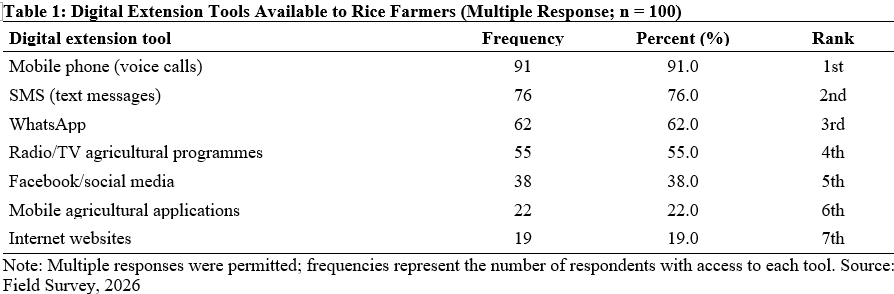
This study identified the digital extension tools available to rice farmers, the factors influencing their willingness to use these tools, and the constraints to their use in Lafia Local Government Area (LGA), Nasarawa State, Nigeria. Primary data were collected from 100 rice farmers selected through a multi-stage sampling procedure and analysed using multiple response analysis, binary logistic regression, and Likert constraint analysis. Results showed that mobile phone voice calls (91%), SMS messages (76%), and WhatsApp (62%) were the most accessible digital extension tools. The binary logistic regression model was statistically significant (χ² = 43.82; p < .001; Nagelkerke R² = .547; correct classification = 76.0%). Perceived usefulness (β = 0.604; p = .001) and perceived ease of use (β = 0.558; p = .001) were the strongest predictors of willingness, followed by access to credit (β = 0.597; p = .005), extension contact (β = 0.496; p = .008), educational level (β = 0.306; p = .007), and cooperative membership (β = 0.472; p = .019); age was not significant (p = .074). High cost of mobile data (mean = 4.21), poor network connectivity (mean = 4.08), and low digital literacy (mean = 3.96) were the top-ranked constraints. The study concludes that the Technology Acceptance Model constructs perceived usefulness and perceived ease of use, together with institutional support factors, are the dominant drivers of willingness, and recommends subsidised data access, local-language advisory content, targeted digital literacy training, and cooperative-based dissemination of digital extension services in Lafia LGA.
References
Abioye, D. O., Popoola, O., Akande, A., Fadare, D. A., Omitoyin, S. A., Yinusa, B., & Kolade, O. O. (2024). Farmers' willingness to adopt digital application tools in Ogun State, Nigeria. Journal of Strategy and Management. Advance online publication. https://doi.org/10.1108/JSMA-06-2023-0135
Akinwale, J. A., Oluwole, B. O., & Wole-Alo, F. I. (2023). Digital platforms for linking investors with smallholder farmers in Nigeria. Journal of Agricultural Extension, 27(2), 65–72. https://doi.org/10.4314/jae.v27i2.6
Amoussohoui, R., Arouna, A., Bavorova, M., Verner, V., Yergo, W., & Banout, J. (2024). Analysis of the factors influencing the adoption of digital extension services: Evidence from the RiceAdvice application in Nigeria. The Journal of Agricultural Education and Extension, 30(3), 387–416. https://doi.org/10.1080/1389224X.2023.2222109
Anteneh, A., & Melak, A. (2024). ICT-based agricultural extension and advisory service in Ethiopia: A review. Cogent Food & Agriculture, 10(1), Article 2391121. https://doi.org/10.1080/23311932.2024.2391121
Aremu, T., & Reynolds, T. W. (2024). Welfare benefits associated with access to agricultural extension services in Nigeria. Food Security, 16(2), 295–320.
Davis, F. D., Granić, A., & Marangunić, N. (2023). The Technology Acceptance Model: 30 years of TAM. Springer. https://doi.org/10.1007/978-3-030-45274-2
Deji, O. F., Famakinwa, M., Alabi, D. L., & Faniyi, E. O. (2023). Utilisation of artificial intelligence-based technology for agricultural extension services among extension professionals in Nigeria. Journal of Agricultural Extension, 27(3), 80–90. https://doi.org/10.4314/jae.v27i3.9
FAO. (2022). The state of food and agriculture 2022: Leveraging automation in agriculture for transforming agrifood systems. Food and Agriculture Organization of the United Nations. https://doi.org/10.4060/cb9479en
GSMA. (2024). The mobile economy Sub-Saharan Africa 2024. GSMA Intelligence. https://www.gsma.com/mobileeconomy/sub-saharan-africa/
Karki Nepal, A., Choudhary, D., Pandit, N. R., & Khanal, N. (2025). Impact of training and digital extension services on agricultural technology adoption and rice yields. PLOS ONE, 20(12), Article e0337456. https://doi.org/10.1371/journal.pone.0337456
Makwin, M. F., Bako, S. A., Selzing, P. M., & Dalla, A. A. (2024). Socio-economic factors influencing the use of information and communication technology for accessing agricultural information among cowpea farmers in Alkaleri Local Government Area of Bauchi State, Nigeria. Journal of Applied Sciences and Environmental Management, 28(5).
Nigerian Communications Commission. (2024). Industry statistics: Subscriber data. https://www.ncc.gov.ng/statistics-reports/industry-overview
Sen, L. T. H., Chou, P., Dacuyan, F. B., Nyberg, Y., & Wetterlind, J. (2024). Barriers and enablers of digital extension services' adoption among smallholder farmers: The case of Cambodia, the Philippines and Vietnam. International Journal of Agricultural Sustainability, 22(1), Article 2368351. https://doi.org/10.1080/14735903.2024.2368351
Sen, L. T. H., Phuong, L. T. H., Chou, P., Dacuyan, F. B., Nyberg, Y., & Wetterlind, J. (2025). The opportunities and barriers in developing interactive digital extension services for smallholder farmers as a pathway to sustainable agriculture: A systematic review. Sustainability, 17(7), Article 3007. https://doi.org/10.3390/su17073007
Downloads
Published
Issue
Section
Categories
License
Copyright (c) 2026 Abubakar Onoja Salami, Abdulrafiu Tayo Yusuf, Ezra Sokogaye Anamayi, Usman Bello Mohammed, Susan Ojone Shuaibu, Badarudeen Sani Abdulazeez

This work is licensed under a Creative Commons Attribution 4.0 International License.


