
A Mixed Fractional‑Order Stochastic Malaria Model with Immune Memory and Extinction Thresholds: Implications for Elimination Strategies in Nigeria
DOI:
https://doi.org/10.33003/fjs-2026-1014-5558Keywords:
Stochastic differential equations ·, Malaria elimination ·, Immune memory ·, Extinction probability, Fractional calculus, NigeriaAbstract
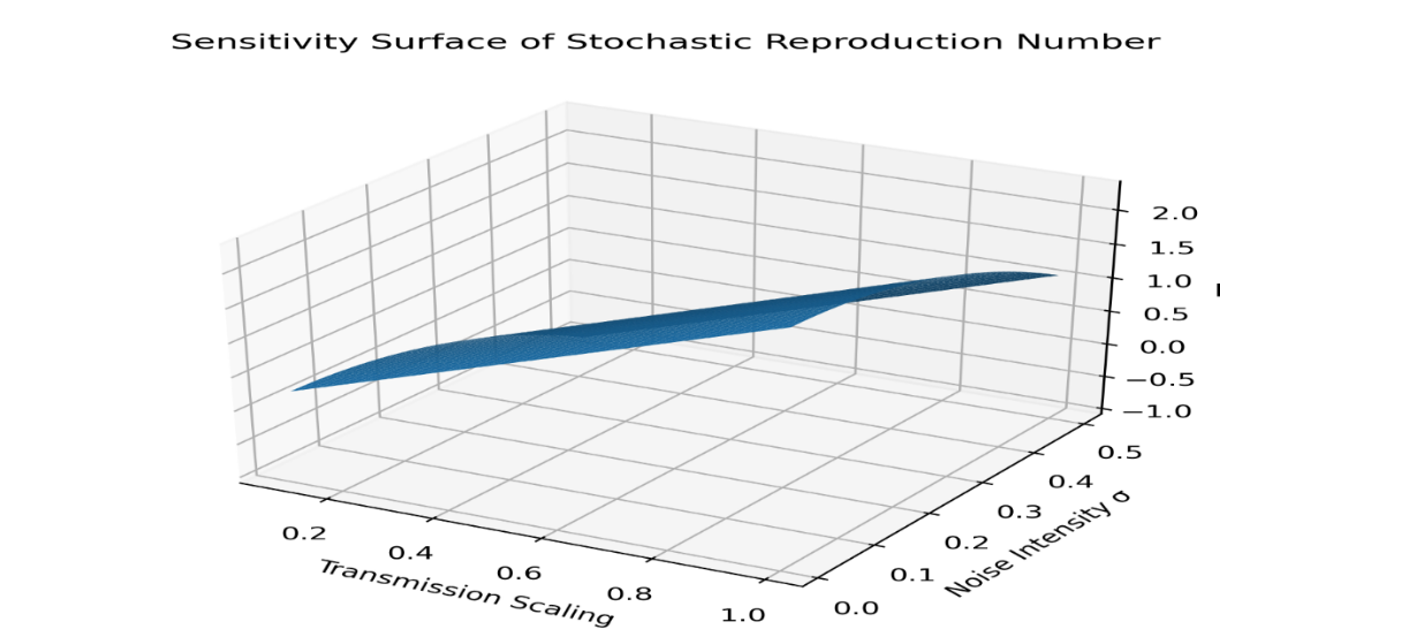
Despite vector control efforts, Nigeria remains highly endemic for malaria. Classical epidemiological models ignore both environmental variability and immunological memory, and these two factors critical to malaria transmission dynamics. This study introduces a novel mixed fractional-order stochastic malaria model incorporating human immune memory (Caputo derivatives, α = 0.9) and environmental stochasticity in mosquito dynamics (integer-order SDEs with multiplicative noise). We prove well-posedness, positivity, boundedness, and global Mittag–Leffler stability of the disease-free equilibrium when R₀ < 1. Using a stochastic next-generation operator, we derive the stochastic reproduction threshold showing that Rₛ < 1 ensures almost-sure extinction. Calibrated to Nigerian malaria surveillance data, the fractional model delays epidemic peaks by 12–18 days and reduces peak prevalence by 15–20% relative to integer-order models. Although the deterministic model predicts persistence at R₀ = 35, environmental fluctuations induce extinction probabilities of 0%, 18%, and 73.2% at σ = 0.05, 0.15, and 0.30, respectively. Sensitivity analysis identifies environmental variability and transmission rates as the dominant determinants of elimination feasibility. Our findings demonstrate that reliance solely on deterministic R₀ underestimates elimination opportunities. We propose policy recommendations for Nigeria, including seasonal intervention windows and monitoring prevalence variability as indicators of elimination potential.
References
Abimbade, S. F., Chuma, F. M., Sangoniyi, S. O., Lebelo, R. S., Okosun, K. O., & Olaniyi, S. (2024). Global Dynamics of a Social Hierarchy-Stratified Malaria Model: Insight from Fractional Calculus. Mathematics, 12(10), 1593. https://doi.org/10.3390/math12101593
Abioye, A. I., Ogunlaran, O. M., & Ogunwale, S. A. (2021). A fractional-order co infection model of malaria and cholera. Applied Mathematical Modelling, 90, 488–507.
Abioye, A. I., Peter, O. J., Ogunseye, H. A., Oguntolu, F. A., Ayoola, T. A., & Oladapo, A. O. (2023). A fractional-order mathematical model for malaria and COVID-19 co-infection dynamics. Healthcare Analytics, 4, 100210.
Aguila-Camacho, N., Duarte-Mermoud, M. A., & Gallegos, J. A. (2014). Lyapunov functions for fractional-order systems. Communications in Nonlinear Science and Numerical Simulation, 19(9), 2951–2957. https://doi.org/10.1016/j.cnsns.2014.01.022
Allen, L. J. S. (2008). An introduction to stochastic epidemic models. In F. Brauer, P. van den Driessche, & J. Wu (Eds.), Mathematical epidemiology (pp. 81–130). Springer. https://doi.org/10.1007/978-3-540-78911-6_3
Britton, T., Traoré, A., & Watmough, J. (2019). A stochastic next-generation matrix for epidemic models. Journal of Mathematical Biology, 78(5), 1585–1614. https://doi.org/10.1007/s00285-018-01353-0
Chen, Y., Liu, F., Yu, Q., & Li, T. (2021). Review of fractional epidemic models. Applied Mathematical Modelling, 97, 281–307. https://doi.org/10.1016/j.apm.2021.03.044
Diethelm, K. (2010). The analysis of fractional differential equations. Springer.
https://doi.org/10.1007/978-3-642-14574-2
Diethelm, K., Ford, N.J. & Freed, A.D. (2004). Detailed Error Analysis for a Fractional Adams Method. Numerical Algorithms 36, 31–5 https://doi.org/10.1023/B:NUMA.0000027736.85078.be
Gizaw, Z., & Deressa, W. (2021). Temperature driven variability in malaria transmission in Ethiopia: A stochastic model. Malaria Journal, 20(1), 234.
Ngonghala, C. N., Teboh-Ewungkem, M. I., & Gumel, A. B. (2015). Mathematical assessment of the role of non-pharmaceutical interventions on curtailing the 2014 Ebola outbreak. Mathematical Biosciences, 266, 26–40. https://doi.org/10.1016/j.mbs.2015.04.005
Nigerian Malaria Indicator Survey (NMIS). (2022). National Malaria Elimination Programme Report. Abuja, Nigeria.
Podlubny, I. (1999). Fractional differential equations. Academic Press.
van den Driessche, P., & Watmough, J. (2002). Reproduction numbers and sub-threshold endemic equilibria for compartmental models of disease transmission. Mathematical Biosciences, 180(1–2), 29–48. https://doi.org/10.1016/S0025-5564(02)00108-6
World Health Organization. (2023). World malaria report 2023. WHO. https://www.who.int/teams/global-malaria-programme/reports/world-malaria-report-2023
Downloads
Published
Issue
Section
Categories
License
Copyright (c) 2026 Ohiemi Echude, Benjami Oyediran Oyelami, Emmanuel Azuaba

This work is licensed under a Creative Commons Attribution 4.0 International License.


