
Effect of Wet and Dry Processing on the Proximate and Mineral Composition of Traditional Nigerian Steamed Legume Pudding (Moi-Moi) Prepared from Cowpea (Vigna unguiculata) and Bambara Groundnut (Vigna subterranea)
DOI:
https://doi.org/10.33003/fjs-2026-1014-5513Keywords:
Moi-Moi;, Cowpea, Bambara groundnut, Wet processing, Dry processing, Proximate composition, Mineral compositionAbstract
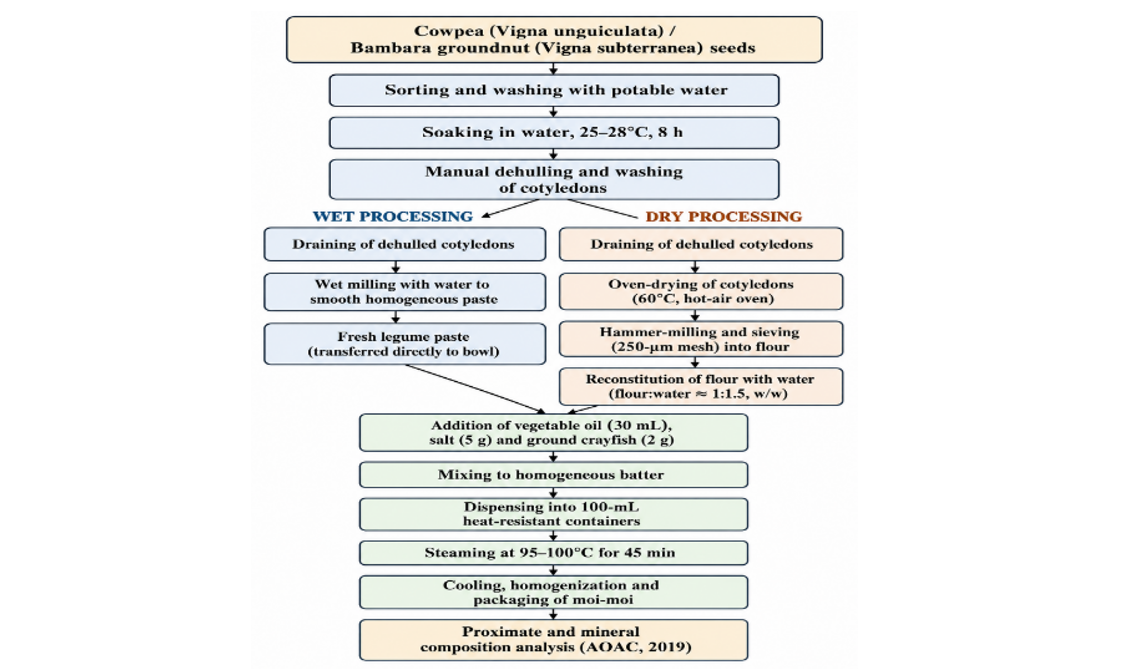
Moi moi is a widely consumed steamed legume pudding in Nigeria, traditionally prepared from cowpea (Vigna unguiculata) but increasingly formulated with other legumes such as Bambara groundnut (Vigna subterranea). This study evaluated the effects of wet and dry processing on the proximate and mineral compositions of moi-moi, a traditional Nigerian steamed legume pudding prepared from cowpea (Vigna unguiculata) and Bambara groundnut (Vigna subterranea). Four samples of moi-moi formulation were prepared from wet-processed beans, dry-processed beans, wet-processed Bambara groundnuts, and dry-processed Bambara groundnuts. Proximate analysis of composition (protein, fat, fibre, ash, moisture, and carbohydrates) and mineral analysis (magnesium, potassium, calcium, iron, zinc, and phosphorus) were conducted using the standardized procedures of AOAC with data analysis through ANOVA with Bonferroni multiple paired comparisons at p < 0.05. Dry processing significantly increased the concentrations of protein, fibre, and ash compared to wet processing in the two legumes. The highest protein concentration was observed in the dry bean moi-moi sample (24.23%), while the lowest was recorded in the wet Bambara groundnut moi-moi sample (16.67%). Magnesium and calcium concentrations were highest in the dry Bambara groundnut moi-moi sample (68.56 mg/100g and 88.97 mg/100g, respectively). Potassium, iron, zinc, and phosphorus concentrations were highest in the dry bean moi-moi sample (231.09 mg/100g, 12.43 mg/100g, 8.24 mg/100g, and 119.22 mg/100g, respectively). Dry processing retained higher mineral content than wet processing, while Bambara groundnut enhanced nutritional value. Dry-processed Bambara groundnut moi-moi offers a nutrient-dense alternative for improving dietary quality.
References
Abebe, B., and Alemayehu, M. (2022). A review of the nutritional use of cowpea (Vigna unguiculata L. Walp) for human and animal diets. Journal of Agriculture and Food Research. https://doi.org/10.1016/j.jafr.2022.100383
Adeleke, O. R., Adiamo, O., and Fawale, O. (2017). Nutritional, physicochemical, and functional properties of protein concentrate and isolate of newly-developed Bambara groundnut (Vigna subterrenea L.) cultivars. Food Science and Nutrition, 6, 229–242. https://doi.org/10.1002/fsn3.552
Affrifah, N. S., Phillips, R. D., and Saalia, F. (2021). Cowpeas: Nutritional profile, processing methods and products—A review. Legume Science, 4. https://doi.org/10.1002/leg3.131
Ajala, O., Adelusi, O. A., Kajihausa, O., Onabanjo, O., Bandele, O. O., and Obadina, A. (2024). Nutritional and anti-nutritional properties of extruded puffed snack produced from pearl millet and Bambara groundnut flour blends. Food Science and Nutrition, 13. https://doi.org/10.1002/fsn3.4670
Akinyele, I. O. (1989). Effects of traditional methods of processing on the nutrient content and some antinutritional factors in cowpeas (Vigna unguiculata). Food Chemistry, 33, 291–299. https://doi.org/10.1016/0308-8146(89)90039-3
Akissoé, L., Madodé, Y., Hemery, Y., Donadjè, B. V., Icard-Vernière, C., Hounhouigan, D., and Mouquet-Rivier, C. (2021). Impact of traditional processing on proximate composition, folate, mineral, phytate, and alpha-galacto-oligosaccharide contents of two West African cowpea (Vigna unguiculata L. Walp) based doughnuts. Journal of Food Composition and Analysis, 96, 103753. https://doi.org/10.1016/j.jfca.2020.103753
AOAC. (2019). Official Methods of Analysis of AOAC International (21st ed.). AOAC International, Rockville, MD, USA.
Arukwe, D., Okoli, J. N., and Chimezie, U. G. (2023). Functional, chemical and organoleptic properties of Moi-Moi prepared from blends of cowpea (Vigna unguiculata) and sprouted pigeon pea (Cajanus cajan) flours. Science World Journal. https://doi.org/10.4314/swj.v18i3.17
Association of Official Analytical Chemists. (2019). Official methods of analysis (21st ed.). AOAC International.
Carpathian Journal of Food Science and Technology. (2024). Micronutrient, physicochemical and acceptability responses of "Moi-Moi" as a function of cowpea (Vigna unguiculate L. Walp) partial substitution with yellow maize. Carpathian Journal of Food Science and Technology, 16(3). https://doi.org/10.34302/crpjfst/2024.16.3.13
Chelangat, M., Muturi, P., Gichimu, B., Gitari, J., and Mukono, S. T. (2023). Nutritional and phytochemical composition of Bambara groundnut (Vigna subterranea [L.] Verdc) landraces in Kenya. International Journal of Agronomy. https://doi.org/10.1155/2023/9881028
Dumoulin, L., Jacquet, N., Malumba, P., Richel, A., and Blecker, C. (2021). Dry and wet fractionation of plant proteins: How a hybrid process increases yield and impacts nutritional value of faba bean proteins. Innovative Food Science and Emerging Technologies. https://doi.org/10.1016/j.ifset.2021.102747
Ghaffar, F., Mehmood, Z., Khurshid, H., and Sana, R. (2025). Influence of wet processing techniques (soaking, boiling, and pressure cooking) on phytic acid reduction, mineral retention, and solubility in common beans Phaseolus vulgaris L., Vigna unguiculata, Vigna radiata, and Cicer arietinum L. Indus Journal of Bioscience Research. https://doi.org/10.70749/ijbr.v3i4.1168
Halimi, R. A., Barkla, B., Mayes, S., and King, G. (2019). The potential of the underutilized pulse Bambara groundnut (Vigna subterranea (L.) Verdc.) for nutritional food security. Journal of Food Composition and Analysis. https://doi.org/10.1016/j.jfca.2018.12.008
Kamani, M. H., Liu, J., Fitzsimons, S., Fenelon, M., and Murphy, E. G. (2024). Determining the influence of fava bean pre-processing on extractability and functional quality of protein isolates. Food Chemistry: X, 21. https://doi.org/10.1016/j.fochx.2024.101200
Khan, M., Rafii, M. Y., Ramlee, S., Jusoh, M., and Al-Mamun, M. (2021). Bambara groundnut (Vigna subterranea L. Verdc): A crop for the new millennium, its genetic diversity, and improvements to mitigate future food and nutritional challenges. Sustainability, 13, 5530. https://doi.org/10.3390/su13105530
Linus-Chibuezeh, A., Adindu-Linus, C., John, P., Ejeh, F. E., and Iwe, M. O. (2025). Development, comparison and nutrient evaluation of Moi-Moi from different varieties of beans. EUREKA: Life Sciences. https://doi.org/10.21303/2504-5695.2025.003590
Liu, R., Flanagan, B., Ratanpaul, V., and Gidley, M. (2025). Valorising legume protein extraction side-streams: Isolation and characterisation of fibre-rich and starch-rich co-products from wet fractionation of five legumes. Food Hydrocolloids. https://doi.org/10.1016/j.foodhyd.2025.111191
Mamoudou, H., and Mune, M. M. (2024). Investigating Bambara bean (Vigna subterranea (Verdc.) L.) protein and hydrolysates: A comprehensive analysis of biological and biochemical properties. Applied Food Research. https://doi.org/10.1016/j.afres.2024.100489
Mashau, M., Takalani, T., Bamidele, O., and Ramashia, S. E. (2025). Elucidation of nutritional quality, antinutrients, and protein digestibility of dehulled and malted flours produced from three varieties of Bambara groundnut (Vigna subterranean). Foods, 14. https://doi.org/10.3390/foods14142450
Mazahib, A. M., Nuha, M., Salawa, I. S., and Babiker, E. E. (2013). Some nutritional attributes of Bambara groundnut as influenced by domestic processing. International Food Research Journal, 20, 1165–1171.
Okwunodulu, I. N., Nwaorienta, C., Okwunodulu, F. U., Onuorah, C. C., Ndife, J., and Ojimelukwe, P. (2019). Impact of different packaging materials on some physicochemical and acceptability properties of Moi-Moi prepared from cowpea (Vigna unguiculata). Acta Scientific Nutritional Health. https://doi.org/10.31080/asnh.2019.03.0403
Okwunodulu, I., Osuagwu, C., Onwuzuruike, U. A., and Uzochukwu, U. (2021). Physicochemical, Atwater factor and acceptability changes of Moi-Moi prepared from cowpea (Vigna unguiculata (L) Walp) as a function of white maize substitution. Sustainable Food Production. https://doi.org/10.18052/www.scipress.com/sfp.10.1
Omueti, O., and Ashaye, O. A. (1998). Effect of processing methods on the characteristics of cowpea (Vigna unguiculata) for moin-moin production. Plant Foods for Human Nutrition, 52, 179–186.
Otunola, G. A., and Afolayan, A. J. (2018). Evaluation of the physicochemical, proximate, and sensory properties of moin-moin from blends of cowpea and water yam flour. Food Science and Nutrition, 6(4), 991–997.
Owuamanam, C. I., Edom, T. A., Ogueke, C. C., Iwouno, J. O., and Olawuni, I. A. (2013). Quality characteristics of some tropical legume flours for steamed paste (moin-moin) production as affected by seed sprouting. Asian Journal of Biological Sciences, 6(6), 347–355.
Ramatsetse, K. E., Ramashia, E. S., and Mashau, M. (2022). A review on health benefits, antimicrobial and antioxidant properties of Bambara groundnut (Vigna subterranean). International Journal of Food Properties, 26, 91–107. https://doi.org/10.1080/10942912.2022.2153864
Rousseau, S., Kyomugasho, C., Celus, M., Hendrickx, M., and Grauwet, T. (2020). Barriers impairing mineral bioaccessibility and bioavailability in plant-based foods and the perspectives for food processing. Critical Reviews in Food Science and Nutrition, 60, 826–843. https://doi.org/10.1080/10408398.2018.1552243
Schutyser, M. I., Novoa, S. C., Wetterauw, K., Politiek, R., and Wilms, P. (2025). Dry fractionation for sustainable production of functional, nutritional and palatable grain legume protein ingredients. Food Engineering Reviews, 17, 344–358. https://doi.org/10.1007/s12393-024-09394-2
Silotolo, S., Makhubela, N. F., Chauke, N., and Mawela, K. (2026). Selection of the best method for inherent tannin reduction and high nutrient retention. Onderstepoort Journal of Veterinary Research, 93. https://doi.org/10.4102/ojvr.v93i1.2236
Tan, X., Azam-Ali, S., Von Goh, E., Mustafa, M., Chai, H., Ho, W. K., Mayes, S., Mabhaudhi, T., Azam-Ali, S., and Massawe, F. (2020). Bambara groundnut: An underutilized leguminous crop for global food security and nutrition. Frontiers in Nutrition, 7. https://doi.org/10.3389/fnut.2020.601496
Ukpong, E. S., Ijeomah, O. C., and Lawrence, F. (2026). Effects of processing methods on nutritional, antinutritional and sensory properties of Bambara groundnut seeds. Nutrition and Food Science. https://doi.org/10.1108/nfs-11-2025-0401
Yahaya, D., Seidu, O. A., Tiesaah, C. H., and Iddrisu, M. (2022). The role of soaking, steaming, and dehulling on the nutritional quality of Bambara groundnuts (Vigna subterranea (L) Verdc.). Frontiers in Sustainable Food Systems. https://doi.org/10.3389/fsufs.2022.887311
Downloads
Published
Issue
Section
Categories
License
Copyright (c) 2026 Angela Ngozi Anosike, Jonathan Luka, Angelo Moses, Abdulrazaq Olawale Toyin

This work is licensed under a Creative Commons Attribution 4.0 International License.


