
Yam Microbial Rot Biocontrol Study: Sub-Sahara Africa Indigenous Trichoderma harzianum
DOI:
https://doi.org/10.33003/fjs-2026-1013-5509Keywords:
Antagonistic, Aspergillus flavus, Trichoderma harzianum, Rot, YamAbstract
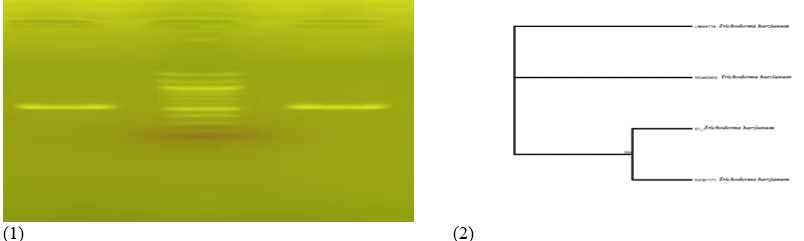
This work examines the isolation, identification and characterization of Trichoderma species from yam tubers sourced from South-South region of Nigeria, evaluating their potential as biocontrol agent against prevalent fungal that cause yam rot. Fungal isolates were obtained by inoculation of yam peels/tissues on Potato Dextrose Agar (PDA), followed by morphological analysis. Microscopic inspection revealed septate hyphae, with distinctive conidia arrangement indicating the genera Penicillium, Aspergillus, and Trichoderma. The antagonistic capabilities of Trichoderma were investigated using dual-culture tests, which demonstrated that Trichoderma exhibited considerable growth suppression of the pathogens, especially Aspergillus flavus and Penicillium sp., with inhibition percentages of 77% and 70%, respectively, DNA sequencing of the ITS region further validated the identity of the isolates as Trichoderma harzianum was a 100% match to sequences in the NCBI database accession number PQ637288.1. The result imply that Trichoderma harzianum holds substantial promise as a biological control agent for treating fungal diseases in yam crops. Based on these findings, it is advised that T. harzianum be examined for use in pre-harvest and post-harvest treatments, such as soil inoculation and seed treatment, reduce fungal contamination and improve yam output. Further studies should investigate the specific mechanisms behind the antagonistic effects of T. harzianum and its potential for large scale agricultural applications.
References
Adebayo, T. A., & Oyebanji, I. A. (2022) Global Production and Economic Importance of Yam (Dioscorea spp.): West Africa as a Major Producer. Food Security Journal, 14(5), 1231-1243.
Adeyeye, E. I., & Ayodele, A. E. (2020). Microbial Contamination and Quality Assessment of Yam Tubers in Nigerian Markets. Food Control, 110, 107016.
Akomah-Abadaike, O. N., & Ayooluwa, S. C-M. (2023). Phylogenetical Identification of Trichoderma species; an Antagonistic Isolate from South-East Geopolitical Zone of Nigeria. European Journal of Agriculture and Food Sciences, 5(2), 8–12. https://doi.org/10.24018/ejfood.2023.5.2.637.
Asare, R., & Quaye, W. (2023). Economic impact of yam cultivation and the challenges of postharvest losses in West Africa. Agricultural Economics and Development, 45(2), 98-112.
Błaszczyk, L., Siwulski, M., & Sobieralski, K. (2020). Trichoderma spp. – Applications in agriculture and industry. Frontiers in Microbiology, 11, 1523.
Fakoya, E. O., Adeyeye, E. I., & Akinmoladun, O. O. (2023). Impact of Climate Change on Yam (Dioscorea spp.) Production in West Africa: Challenges and Adaptation Strategies. African Journal of Agricultural Research, 18(5), 123-134.
Harman, G. E., & Shoresh, M. (2020). Mechanisms of fungal antagonism by Trichoderma spp. Current Opinion in Plant Biology, 56, 67-74.
Hewedy, O. A.; Abdel-Lateif, K.S and Bakr, R.A. (2020) Genetic diversity and biocontrol efficacy of indigenous Trichoderma isolates against Fusarium wilt of pepper. Journal of Basic Microbiology, 60, 126–135. https://doi.org/10.1002/jobm.201900493.
Kim, J., Rosenberg, N. A., & Palacios, J. A. (2020). Distance metrics for ranked evolutionary trees. Proceedings of the National Academy of Sciences, 117(46), 28876-28886. https://doi.org/10.1073/pnas.1922851117.
Kiselev, K.V., Nityagovsky, N.N. & Aleynova, O.A (2023). A Method of DNA Extraction from Plants for Metagenomic Analysis Based on the Example of Grape Vitis amurensis Rupr. Applied Biochemistry and Microbiology 59, 361–367. https://doi.org/10.1134/S0003683823030110.
Nagae, S., Sato, K., Tanabe, T., & Hasegawa, K. (2021). Symbiosis of the millipede parasitic nematodes Rhigonematoidea and Thelastomatoidea with evolutionary different origins. BMC Ecology and Evolution, 21(1), 120. https://doi.org/10.1186/s12862-021-01851-4.
Nwankiti, A., & Gwa, V. (2018). Evaluation of antagonistic effect of Trichoderma harzianum against Fusarium oxysporum, causal agent of white yam (Dioscorea rotundata Poir) tuber rot. Trends in Technical & Scientific Research, 1(1), 1–8. https://doi.org/10.19080/TTSR.2018.01.555554.
Ogunleye,A., Kehinde, A., Mishra, A., & Ogundeji, A (2021). Impact of Farmer’s Participation in Social Capital networks or Climate Change Adaptation Strategies Adoption in Nigeria. Heliyon 7:12 e08624, https://doi.org/10.1016/heligon.2021.e08624.
Salvatore, M., Raimondo, M. L., Vitale, S., Lanzuise, S., & Pascale, A. (2022). Role of Trichoderma in reducing mycotoxins in agricultural produce. Journal of Plant Pathology, 104(1), 103–115.
Sharma, A., Ghosh, S., & Kapoor, M. (2021). Siderophore production by Trichoderma: A review. Journal of Microbiology and Biotechnology, 31(5), 631-638.
Sharma, P., & Ghosh, R. (2020). Trichoderma Species as Biocontrol Agents: Mechanisms of Action and Applications in Agriculture. Microbiological Research, 241, 126600.
Singh, R., & Kumar, A. (2023).Biocontrol potential of Trichoderma species in managing fungal pathogens of postharvest crops. Plant Pathology Journal, 39(2), 218–231.
Tunde-Akinbode, A. B., & Akinmoladun, O. O. (2022). Impact of Different Storage Techniques on the Shelf Life and Nutritional Quality of Yam Tubers. Journal of Food Science and Technology, 59(7), 2870-2879.
Woo, S. L., Ruocco, M., Vinale, F., Lorito, M., Marra, R., & Lanzuise, S. (2021). Biological control mechanisms of Trichoderma spp. and their integration into sustainable farming systems. Frontiers in Plant Science, 12, 1357. https://doi.org/10.2174/187443700148010071
Wu, Q., Liu, H., & Zhang, Y. (2021). Growth-promoting effects of Trichoderma spp. and their application in agricultural practices. Journal of Agricultural Science and Technology, 23(1), 45-58.
Downloads
Published
Issue
Section
Categories
License
Copyright (c) 2026 Onyinyechi Ndimele Akomah-Abadaike, George Idoreyin Ime, Happiness Eke

This work is licensed under a Creative Commons Attribution 4.0 International License.


