
Fundamentals, Sustainable Strategies, and Emerging Technologies of Metal Protection and Corrosion Prevention: A Comprehensive Review
DOI:
https://doi.org/10.33003/fjs-2026-1018-5507Keywords:
Artificial Intelligence, Corrosion Prevention, Corrosion Monitoring, Green Inhibitors, Metal ProtectionAbstract
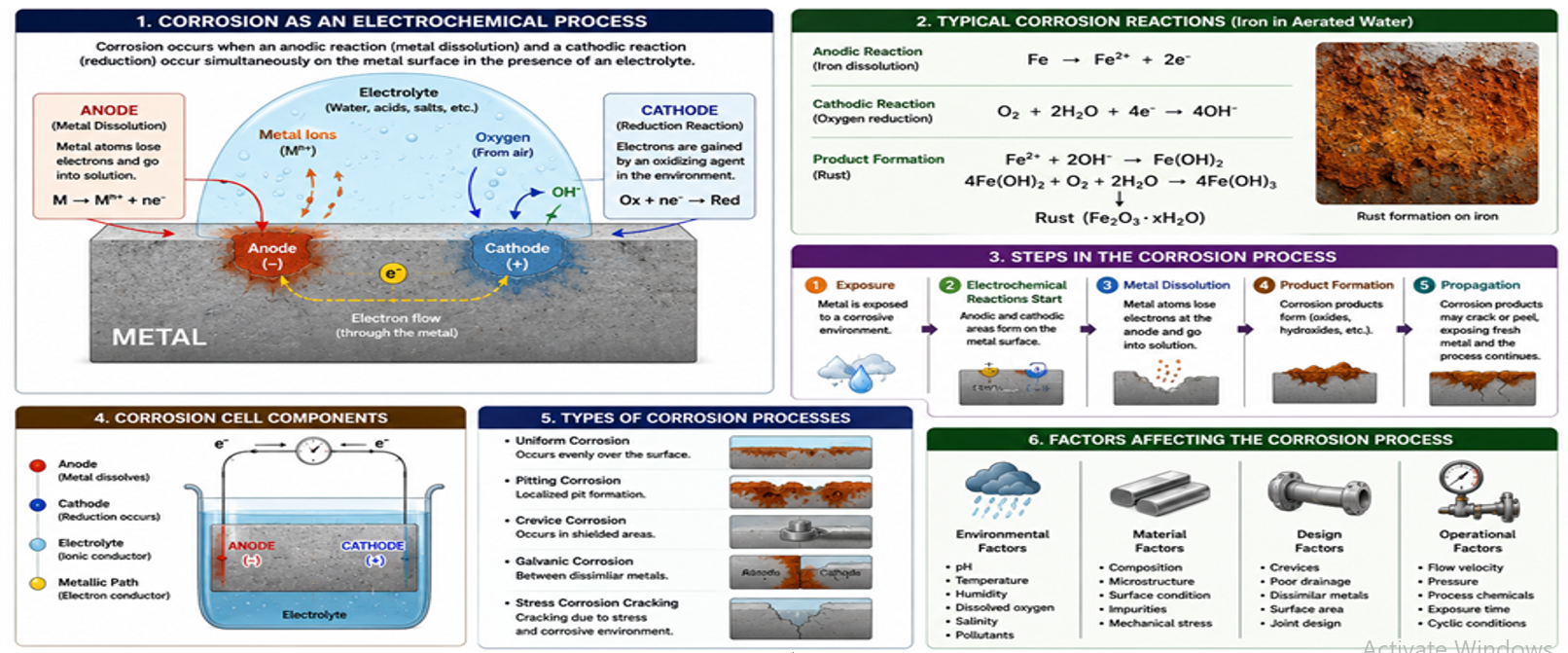
Corrosion is an intricate physicochemical process that gradually degrades and reduces the practical and engineering integrity of metallic substances or materials through exchange with their immediate environment. Mechanisms such as aggressive chemical species, electrochemical reactions, moisture, and extreme dissolved salt concentrations accelerate material deterioration, which often leads to structural and material failures. Corrosion impacts are widespread across critical sectors including manufacturing, production, energy, transportation, and civil infrastructure. This study presents a comprehensive review of corrosion science, corrosion monitoring techniques, and emerging artificial intelligence (AI)-driven approaches for corrosion prevention and corrosion management. Information on trends and patterns of publications on corrosion was systematically collected, synthesized, and refined from journals, conference proceedings, theses, books, and other credible scientific sources published between 1800 and June 2026. Universal academic search aggregators, engines, discipline-specific and regional repositories were utilised to identify and produce relevant papers. The review identified major forms of corrosion as atmospheric, cavitation, erosion, fatigue, fretting, galvanic, intergranular, microbiological, pitting, stress or cracking, selective leaching, chemical, electrochemical, and waterline. It was established that there are four phases of publications on corrosion and corrosion-related topics. Corrosion prevention methods depend on several factors. It was revealed that heterocyclic corrosion inhibitors include C5H5N, C3H4N2, C7H6N2, C2H3N3, C4H4S, C3H3NS, C3H3NO and C6H5N3. The study concludes that early corrosion prediction, coupled with effective monitoring and control strategies, can substantially reduce economic losses, while AI-driven approaches offer practical advantages over traditional methods of corrosion prevention, particularly in inaccessible or hazardous environments.
References
Abdallah, M., Soliman, K. A., Al-Gorair, A. S., Felaly, R. N., Al-Fahemi, J. H., Al-Juaid, S. S., & Sobhi, M. (2026). Experimental and computational analysis of poly (4-vinyl pyridine) and polyvinylpyrrolidone as effective corrosion inhibitors for low carbon steel in sulfuric acid. Journal of Dispersion Science and Technology, 47(4), 679-695.
Abdulmutaali, A., Aldrich, C., &Lepkova, K. (2025). Unsupervised process monitoring of corrosion based on electrochemical noise and multivariate image analysis. npj Materials Degradation, 9(1), 43. https://doi.org/10.1038/s41529-025-00585-8
Abu Orabi, F. M., Abu-Orabi, S. T., Fodeh, O. A., Algethami, F. K., Rawashdeh, A. M. M., Bataineh, T. T., & Al-Qudah, M. A. (2024). Ajuga Orientalis L. Extract as a Green Corrosion Inhibitor of Aluminum in an acidic solution: an experimental and DFT Study. Metals, 14(11), 1227.
Chen, Q., Cai, Y., Zhu, Y., Ji, H., Ma, X., & Wang, H. (2025). An Integrated Approach Using GA-XGBoost and GMM-RegGAN for Marine Corrosion Prediction under Small Sample Size. Materials, 18(16), 3760.
Chmielewska-Śmietanko, D., and Sartowska, B. (2025). Emerging Issues of Corrosion in Nuclear Power Plants: The Case of Small Modular Reactors. Energies, 18(24), 6376.
Chouhan, J. S., Dixit, A., & Gupta, D. (2013). Green inhibitors for prevention of metal and alloys corrosion: an overview. Chem. Mat. Res, 3(6), 16-24
Ding, R., Li, W., Wang, X., Gui, T., Li, B., Han, P., Tian, H., Liu, A., Wang, X., Liu, X., Gao, X., & Wang, W. (2018). A brief review of corrosion protective films and coatings based on graphene and graphene oxide. Journal of Alloys and Compounds, 764, 1039–1055. https://doi.org/10.1016/j.jallcom.2018.06.133
Eissa, M., Etaiw, S. H., El-Waseef, E. E., El-Hossiany, A., and Fouda, A. S. (2024). The impact of environmentally friendly supramolecular coordination polymers as carbon steel corrosion inhibitors in HCl solution: synthesis and characterization. Scientific Reports, 14(1), 2413.
Fehintola, E. O. (2026). Trend and Pattern of Studies on Corrosion and Corrosion Science: Fundamentals of Corrosion Science and Application of Artificial Intelligence and Machine Learning. In Journal of Pure and Applied Sciences (Science Forum)26,(3), 239-270.
Fehintola, E.O. (2021). Corrosion inhibition of Acalypha wilkesiana L. leaves, Acalypha godseffiana J. Leaves and Cola nitida A. husk extracts in acidic medium. Unpublished PhD. Thesis .Federal University of Technology, Akure
Fernández-Solis, C. D., Vimalanandan, A., Altin, A., Mondragón-Ochoa, J. S., Kreth, K., Keil, P., and Erbe, A. (2015). Fundamentals of electrochemistry, corrosion and corrosion protection. In Soft Matter at Aqueous Interfaces (pp. 29-70). Cham: Springer International Publishing.
Gajagouni, S. P., Barsoum, I., and AlFantazi, A. (2026). Nanoporous Oxide Formation and Corrosion Behavior of Stainless Steel in Chloride and Borated Media. Corrosion, 82(5), 419-430.
Ghali, E., Sastri, V. S., and Elboujdaini, M. (2007). Corrosion prevention and protection: practical solutions. John Wiley and Sons.
Gill, A., Chawla, V., Handa, A., & Kumar, S. (2026). High-temperature (>500 °C) erosion–corrosion of carbide-reinforced thermal spray coatings: A critical review of WC- and Cr₃C₂-based systems. Journal of Materials Research and Technology, 42, 947–980. https://doi.org/10.1016/j.jmrt.2026.03.020
Guma, T. N., & Dele, D. O. (2025). Advances in corrosion monitoring techniques. In Z. Abdel Hamid & M. H. Gomaa (Eds.), The challenges of corrosion control on metallic surfaces. IntechOpen. https://doi.org/10.5772/intechopen.1011118
Guo, R., & Rong, J. (2026). Machine learning in corrosion electrochemistry: a critical review of prediction and corrosion-type identification. International Journal of Electrochemical Science, 21(4), 101324.
Hamid, Z. A, & Gomaa, M. H. (2025). Introductory chapter: The challenges of corrosion control for metallic surfaces. In Z. Abdel Hamid & M. H. Gomaa (Eds.), The challenges of corrosion control on metallic surfaces. IntechOpen. https://doi.org/10.5772/intechopen.1011782
Jaddoa, H. A., Abdulhussein, B. A., and Ali, J. M. (2025). Novel efficiency of turmeric extract as a green inhibitor of low carbon steel corrosion in 3.5% NaCl solution. Case Studies in Chemical and Environmental Engineering, 11, 101086.
Jasim, A. H., Radhi, N., Al-Khafaji, Z., Falah, M., Musheer, S. A., Al-Khazaali, S. Y. H., and Kutaif, Y. Y. (2025). Characterization of corrosion behavior and mechanical properties of reinforced composite materials (epoxy-nano-SiO2) used in lining oil pipelines. International Journal of Corrosion and Scale Inhibition, 14(4), 2461-2477.
Jawad, M. N., Thami, K. H., Abbas, W. F., Qasim, H. H., Aliedane, H. A., & Saleh, O. J. (2026). A Comprehensive Review of Advances and Challenges in Sacrificial Anode Cathodic Protection Systems for Storage Tanks. Archives of Current Research International, 26(1), 179-192
Jones, D. A. (1996). Principles and prevention. Corrosion, 2(168), 83.
Jumbo-Egwurugwu, P., Ridha, S., Rasool, M. H., Ekwe, O. A., & Krishna, S. (2026). Corrosion inhibitors in drilling mud: Advances, challenges, and future directions. Petroleum Research, 11(3), 974–994. https://doi.org/10.1016/j.ptlrs.2026.02.004
Kalu, K. M., Ibrahim, M., Mtswere, S.-S., Baka, A., & Mohammed, H. S. (2024). Green Emulsion Paint: Utilization of Waste Expanded Polystyrène and Rice Husk for a Sustainable Future. DBiseJournal of Pure and Applied Sciences (DU JOPAS), 10(4b), 277 - 284. https://doi.org/10.4314/dujopas.v10i4b.26
Kalu, K. M., Saa-Aondo, M., & John, L. (2025). Advancements in corrosion resistance: Innovations in protective coatings for enhanced durability (A concise review). Dutse Journal of Pure and Applied Sciences, 11(2c), 191–199. https://doi.org/10.4314/dujopas.v11i2c.20
Kamal, M. L., Hamid, F. H., Hasan, S., & Jantan, K. A. (2026). Comparative study of Hibiscus rosa-sinensis and Azadirachta indica leaf extracts as efficient green corrosion inhibitors for mild steel in 1M HCl. Malaysian Journal of Analytical Sciences, 30(1)
Kang, S. J., Kim, G. I., Kim, S. H., Lee, J. H., Kim, J. S., Im, S. U., & Kim, J. G. (2024). Corrosion behavior of Ti–Pt-coated stainless steel for bipolar plates in polymer electrolyte membranes under water electrolysis conditions. Heliyon, 10(14).
Koufi, A., Ziat, Y., Belkhanchi, H., and Laghlimi, C. (2026). Organic Pyridinium Salts as Corrosion Inhibitors for Mild Steel in Acidic Wastewater: Experimental and DFT Study. Coatings, 16(2), 148.
Kucharlapati, R. N. V., Sangal, A., Shirazi, S. A., & Nassef, A. S. (2025). Predictive Analytics in Corrosion Monitoring Using AI/ML: Empowering the Oil and Gas Industry. In MECC 2025 (pp. 1-16). Association for Materials Protection and Performance
Li, X., Zhang, D., Liu, Z., Zhong Li, Cuiwei Du &ChaofangDong. (2015) Materials science: Share corrosion data. Nature 527, 441–442 (2015). https://doi.org/10.1038/527441a
Liu Q, Li N, Yongga A, Duan J, & Yan W. (2021) The evaluation of the corrosion rates of alloys applied to the heating tower heat pump (hthp) by machine learning. Energies. 2021; 14(7):1972. https://doi.org/10.3390/en14071972.
Liu, Y., Zhang, M., and Yu, Q. (2026). A Review of Computer Vision-Based Damage Detection in Steel Structures. Industrial Construction, 56(5), 215-231.
Lozrt, J., Votava, J., Kumbär, V., &Polcar, A. (2025). Analysis of Corrosion-Mechanical Properties of Electroplated and Hot-Dip Zinc Coatings on Mechanically Pre-Treated Steel Substrate. Applied Sciences, 15(5), 2626. https://doi.org/10.3390/appl5052626
Manu, K. C., Madhushree, C., Chandini, M. S., Shree, N., Hemanth, S., and Jeevan, T. P. (2025). Corrosion in Steel Structures: A Review. Journal of Mines, Metals and Fuels, 73(1).
Melchers, R. E. (2020). Long-term durability of marine reinforced concrete structures. Journal of Marine Science and Engineering, 8(4), 290.
Morsy, A., Thyab, R. M., Mahmoud, A. S., Abdel‐Salam, A. H., Ewais, H. A., Morsy, A., &Blall, E. G. (2026). Hybrid g‐C3N4/Graphene Nanocoatings for Enhanced Corrosion Protection of Steel Anodes. ChemNanoMat, 12(5), e202500716.
Mubeen, M., Khalid, S., Tabish, M., Bibi, F., Ilyas, H. M. A., Chen, S., Yasin, G., Zhao, J., & Yang, C. (2026). Performance evolution, predictive modeling and smart nanocomposite strategies for organic corrosion protection coatings. Corrosion Communications. Advance online publication. https://doi.org/10.1016/j.corcom.2026.02.008
Muthu, R. P. U. (2026). Techniques in Corrosion Assessment & Control. Materials Research Foundations,188188.
Nine, M. J., Cole, M. A., Tran, D. N. H., &Losic, D. (2015). Graphene: A multipurpose material for protective coatings. Journal of Materials Chemistry A, 3(24), 12580–12602. https://doi.org/10.1039/C5TA01010A
Nrior, M. M., Nitonye, S., Adumene, S., & Orji, C. U. (2026). Probabilistic Finite Element Analysis of Temperature-Dependent Corrosion in Oil and Gas Pipelines. Scientific Journal of Engineering Research, 2(2), 248-257.
Odeyemi, O. O., & Alaba, P. A. (2025). Efficient and reliable corrosion control for subsea assets: Challenges in the design and testing of corrosion probes in aggressive marine environments. Corrosion Reviews, 43(1), 79-126.
Okuma, S. O., Nwaeju, C. C., &Ofuyekpone, O. D. (2026). The role of carbon steel as a fundamental material in oil and gas industry applications: Exploring the properties, performance, and protection strategies for enhanced durability in harsh environments. In M. N. Uddin, M. M. Rahman, M. A. Islam, M. A. Chowdhury, M. R. Repon, M. R. Rahman, & J. Uddin (Eds.), Carbon nanomaterials—Latest trends in synthesis, properties and applications. IntechOpen. https://doi.org/10.5772/intechopen.1009094
Omran, B. A., and Abdel-Salam, M. O. (2020). Basic corrosion fundamentals, aspects and currently applied strategies for corrosion mitigation. In A New Era for Microbial Corrosion Mitigation Using Nanotechnology: Biocorrosion and Nanotechnology (pp. 1-45). Cham: Springer International Publishing.
Onyechi, P. C., Obuka, N., Agbo, C. O., & Igwegbe, C. A. (2014). Monitoring and Evaluation of Cathodic Protection Performance for Oil and Gas Pipelines: A Nigerian Situation.International journal of advanced scientific and technical research 4 (1), 46 – 67
Osta, M. O., Azeem, A., Rashid, S., Harun, M., and Hanif, A. (2026). Marine resilience: Understanding the durability and effects on concrete structures—A Comprehensive Review. Arabian Journal for Science and Engineering, 51(4), 3981-4006.
Oyetola, E. O. (2026). Machine Learning-Enhanced Optimization of Nanoscale Phytochemical Synergistic Films for High-Temperature Industrial Corrosion Protection: A Review. Nanoparticle, 7(1), 21.
Pyun, S. I. (2020). Strategies of metal corrosion protection. ChemTexts, 7(1), 2.
Ridwan M, Ko J, Leung CK & Ming W-K (2026) The green potential of artificial intelligence: revisiting energy consumption, growth, and ecological footprint in the United States. Front. Environ. Sci. 14:1717269. https://doi:10.3389/fenvs.2026.1717269
Rodrigo E, Litskas VD, Mairata A, Martínez Vidaurre JM & Pou A (2026) Effect of organic mulches in vineyards: CH4 and N2O emissions and their contribution to the GWP and carbon balance. Front. Environ. Sci. 14:1846259. https://doi:10.3389/fenvs.2026.1846259
Roscher, J., Liu, D., Xie, X., and Holze, R. (2024). Aromatic metal corrosion inhibitors. Corrosion and Materials Degradation, 5(4), 513-560.
Ruiz, D., Casas, A., Escobar, C. A., Perez, A., & Gonzalez, V. (2024). Advanced machine learning techniques for corrosion rate estimation and prediction in industrial cooling water pipelines. Sensors, 24(11), 3564
Samadzadeh, M., Boura, S. H., Peikari, M., Kasiriha, S. M., & Ashrafi, A. (2010). A review on self-healing coatings based on micro/nanocapsules. Progress in Organic Coatings, 68(3), 159–164.
Schweitzer, P. A. (2009). Fundamentals of corrosion: mechanisms, causes, and preventative methods. CRC Press.
Silaban, T. O. J., Setiawan, A. F., Siswosukarto, S., Wiranata, A., Putra, R. A., Priyotomo, G., & Kudus, S. A. (2026). Types, mechanisms, and efficiency rate of galvanized steel as corrosion protection in atmospheric corrosion: A systematic review. In Journal of the Civil Engineering Forum (Vol. 12, No. 2, pp. 201-216).
Singh, H., Singh, J., Kaushal, P., & Singh, G. (2025). Advances and Challenges in Corrosion Research. Fabrication of Wear and Corrosion Resistant Materials, 23-43.
Souza, M. D., Moro, G., Melo, R. S., Moretto, L. M., Brasil, S. L., & Zanardi, C. (2025). Carbon steel corrosion monitoring: Why opting for an electroanalytical approach. Journal of Electroanalytical Chemistry, 995, 119312
Stankiewicz, A., & Szczygiel, B. (2013). Self-healing coatings in anti-corrosion applications. Journal of Materials Science, 48, 8041–8051. https://doi.org/10.1007/s10853-013-7616-y
Syam, S. M., Nady, H., Eid, S., & El-Katori, E. E. (2025). Experimental and theoretical assessment to investigate the impact of Gast reg drug on the copper corrosion control in an acidic environment. Scientific Reports, 15(1), 5216.
Tan Y, Zhang Y, Wan F & Han Y (2026) Study based on machine learning on the impact of fluoride-contaminated farmland remediation on farmers’ income structure and rural economic revitalization. Front. Environ. Sci. 14:1805611. https://doi:10.3389/fenvs.2026.1805611
Thakur, A., Quadri, T. W., Anadebe, V. C., Msagati, T. A., &Ebenso, E. E. (2026). Surface science perspectives on eco-friendly corrosion inhibitors. Next Materials, 11, 101782.
Thakur, A., Zarrouk, A., Selvaraj, M., Assiri, M. A., Khanna, V., Kumar, A., &Eliboev, I. (2025). Nanomaterial-based smart coatings for sustainable corrosion protection in harsh marine environments: Advances in environmental management and durability. Inorganic Chemistry Communications, 176, 114280.
Ulhaq Toor, I. (2025). Artificial intelligence and machine learning in corrosion inhibitor design and development: Advances, challenges, and future perspectives. International Journal of Electrochemical Science, 101274.
Usman, A., Sulaiman, A. D. I., Hassan, U., & Inuwa, A. M. (2025). Systematic corrosion prediction techniques in oil and gas pipelines using machine learning methods. Petroleum Science and Engineering, 9(2), 173–188. https://doi.org/10.11648/j.pse.20250902.22
Verma, C., Ebenso, E. E., Bahadur, I., & Quraishi, M. A. (2018). An overview on plant extracts as environmental sustainable and green corrosion inhibitors for metals and alloys in aggressive corrosive media. Journal of Molecular Liquids, 266, 577–590. https://doi.org/10.1016/j.molliq.2018.06.110
Yang, Z., Long, Z., & You, L. (2026). Interpretable corrosion rate prediction and rational design of amorphous alloy coatings: a deep learning framework with DenseLoss and SHAP interpretability. Applied Physics A, 132(5), 393.
Yuldashova, S. G., Muzaffarova, N. S., Nomozov, A. K., Shaymardanova, M. A., Durmanova, S. S., Esanov, A. M., .& Nazirov, S. S. (2026). Nanocoatings and anti-corrosion strategies: anti-corrosion solutions in medical devices. Int. J. Corros. Scale Inhib, 15(3), 58-88.
Zaher, A., Lgaz, H., Boukhraz, A., Aldalbahi, A., Lee, H. S., Bourkhiss, B., and Ouhssine, M. (2024). Bio-based corrosion inhibition of carbon steel using Ammi visnaga L. essential oil in acidic mediums: experimental analysis and molecular modeling. Coatings, 14(12), 1556.
Zhang, F., Ju, P., Pan, M., Zhang, D., Huang, Y., Li, G., & Li, X. (2018). Self-healing mechanisms in smart protective coatings: A review. Corrosion Science, 144, 74–88. https://doi.org/10.1016/j.corsci.2018.08.005
Zhang, Y., Hu, S., Wen, Y., Ikeuba, A. I., Tan, X., Sun, T., and Liu, X. (2025). Electrochemical noise analysis of the hot corrosion of TP347H stainless steel: Effect of temperature and coal ash thickness. Electrochimica Acta, 525, 146105.
Zheludkevich, M. L., Shchukin, D. G., Yasakau, K. A., Möhwald, H., & Ferreira, M. G. S. (2007). Anticorrosion coatings with self-healing effect based on nanocontainers impregnated with corrosion inhibitor. Chemistry of Materials, 19(3), 402–411. https://doi.org/10.1021/cm062066k
Downloads
Published
Issue
Section
Categories
License
Copyright (c) 2026 Oluwaseun Ezekiel Fehintola

This work is licensed under a Creative Commons Attribution 4.0 International License.


