
Salicylaldimine based complexes and their Ascorbic acid ternary Analogues: Synthesis, Characterisation, Antimicrobial Evaluation, Molecular docking and DFT Considerations
DOI:
https://doi.org/10.33003/Keywords:
Salicylaldehyde, Schiff Bases, Binary/Mixed-Ligand Complexes, Biological Evaluation, DFT CalculationAbstract
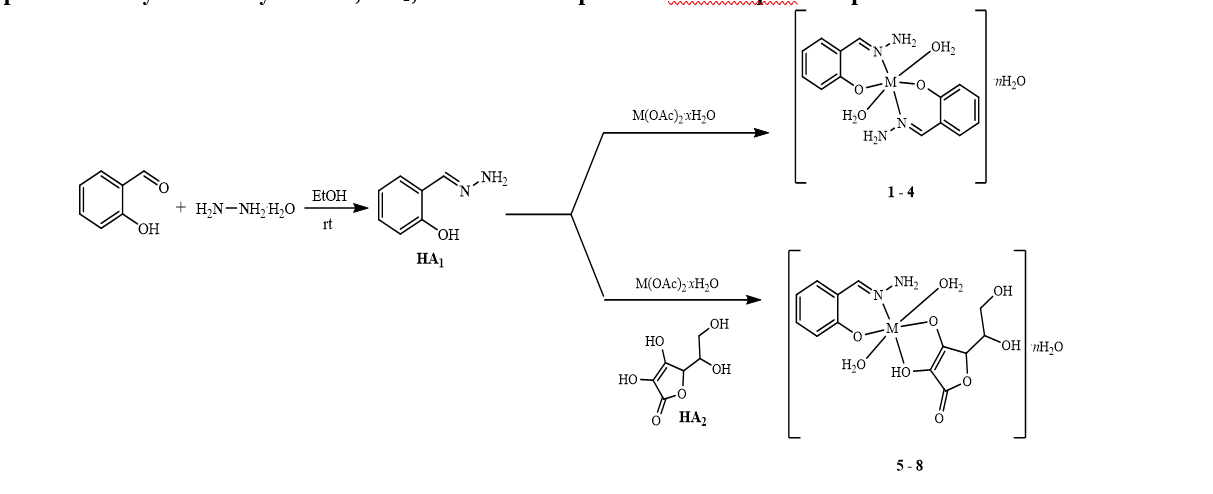
This study reports a series of complexes with the general formula [M(A1)2(H2O)2]·nH2O (1 – 4) and [M(A1)(A2)(H2O)2]·nH2O (5 – 8) {where M = Co, Ni, Cu and Zn; HA1 = (E)-2-(hydrazineylidenemethyl)phenol and HA2 = ascorbic acid}. The prepared compounds were characterised by 1H nmr, Fourier Transform infrared (FTIR) and electronic spectroscopies as well as magnetic susceptibility measurement. Quantum calculation were carried out using DFT/B3LYP-D3/6-31G** for the ligands and DFT/B3LYP-D3/LACVP** for the complexes. The magnetic moments for the Co(II) {5.06–5.49 B.M} and Ni(II) {3.15–3.16 B.M} complexes suggest octahedral geometry, with orbital contribution. The Cu(II) complexes appear to be octahedral with the homoleptic complex (3) displaying a subnormal value (1.58 B.M). Generally, the complexes showed better antimicrobial activity than the ligands. The mixed ligand complexes showed better activity than respective homoleptic analogue – while the mixed ligand complexes displayed Minimum Inhibitory Concentration (MIC) in the range 0.125–2.00 mg/mL, the homoleptic complexes displayed MIC in range 0.50–2.00 mg/mL. The Ni(II) mixed ligand complex, 6, recorded the highest (negative) docking scores; -5.667 kcal/mol, -6.614 kcal/mol and -5.542 kcal/mol against E. coli, S. aur and C. alb, respectively – with better scores than ciprofloxacin (-5.379 kcal/mol and -4.183 kcal/mol against E. coli and S. aur, respectively) but lower than ketoconazole (-8.288 kcal/mol against C. alb); 6 also displayed the best global softness (0.6196 eV-1), in comparison to other complexes (except for the spin down {β} variants of compounds 3 and 7 {3β and 7β}). Thus, the prepared compounds are potential antimicrobial agents.
References
Abdelrhman, E. M., El-Shetary, B. A., Shebl, M. & Adly, O. M. I. (2021). Coordinating behavior of hydrazone ligand bearing chromone moiety towards Cu(II) ions: Synthesis, spectral, density functional theory (DFT) calculations, antitumor, and docking studies. Applied Organometallic Chemistry, 35:e6183 https://doi.org/10.1002/aoc.6183
Abiodun R. O., Ogwuche S., Eugene-Osoikhia. T. 2025 “Synthesis, Characterization, and In Silico Studies of Tricarbonyl[Η⁴-5-(N-(4-hydroxyphenyl)cinnamamide)cyclohexa-1,3-diene] iron and Its Demetallated Derivative as Potential Antileishmanial Agents” FUDMA Journal of Science, 9(11), 356 – 366 https://doi.org/10.33003/fjs-2025-0911-3670
Antimicrobial Resistance Collaborators. (2022). Global burden of bacterial antimicrobial resistance in 2019: a systematic analysis” The Lancet, 399(10325), 629 – 655. https://doi.org/10.1016/S0140-6736(21)02724-0
Çınarlı, M., Ataol, Ç. Y., Zeyrek, C. T., Öğütcü, H., Açık, L. & Batı, H. (2025). Design, synthesis, characterization, theoretical calculations, molecular docking studies, and biological evaluation of new Fe(II) and Cu(II) complexes of 2-acetylpyridine derivative sulfonyl hydrazone Schiff base. Journal of Molecular Structure, 1321, 140112 https://doi.org/10.1016/j.molstruc.2024.140112
Demirbağ, B., Yıldırım, M., Çimentepe, M., Necip, A., Ünver, H. & Tiftik, E. N. (2025). Salicylaldehyde-derived Hydrazones: Synthesis, characterization, antibacterial activity, antioxidant and anti-inflammatory effects on LPS-induced RAW264.7 macrophage cells, drug-likeness properties, and molecular docking analysis. Biochemical and Biophysical Research Communications, 766, 151872 https://doi.org/10.1016/j.bbrc.2025.151872
Dey, A., Roy, S. & Das, S. (2025). Recent advances in five-coordinate Co(II) single ion magnets. Crystal Engineering Communication, 27, 7460 – 7483
http://dx.doi.org/10.1039/d5ce00761e
Duffey, M., Shafer, R. W., Timm, J., Burrows, J. N., Fotouhi, N., Cockett, M. & Leroy, D. (2024). Combating antimicrobial resistance in malaria, HIV and tuberculosis. Nature Reviews Drug Discovery, 23, 461 – 479 https://doi.org/10.1038/s41573-024-00933-4
El-Asmy, A. A. & Al-Hazmi, G. A. A. (2009). Synthesis and spectral feature of benzophenone-substituted thiosemicarbazones and their Ni(II) and Cu(II) complexes. Spectrochimica Acta Part A: Molecular and Biomolecular Spectroscopy, 71, 1885 – 1890 http://dx.doi.org/10.1016/j.saa.2008.07.005
El-Gammal, O. A., Abdel-Latif, E., Farag, M. G. & Abdel-Rhman, M. H. (2021). Synthesis, characterization, and anticancer activity of new binuclear complexes of 2,2/-malonylbis(N-phenylhydrazine-1-carbothioamide). Applied Organometallic Chemistry, 35(5): e6194 https://doi.org/10.1002/aoc.6194
El-Sherbini, S. S., El-Reash, G. M. A. & El-Gamil, M. M. (2026). Multifunctional Schiff base cyanoacetohydrazide complexes of Manganese, Cobalt, Copper, and Zinc: Spectroscopic, DFT, fluorescence, bioactivity investigations, and molecular docking. Inorganic Chemistry Communications, 188, 116623 https://doi.org/10.1016/j.inoche.2026.116623
El-Sherif, A. A., Shoukry, M. M. & Abd-Elgawad, M. M. A. (2012). Synthesis, characterization, biological activity and equilibrium studies of metal(II) ion complexes with tridentate hydrazone ligand derived from hydralazine. Spectrochimica Acta Part A: Molecular and Biomolecular Spectroscopy, 98, 307 – 321 http://dx.doi.org/10.1016/j.saa.2012.08.034
Fabretti, A. C., Franchini, G. C. & Peyronel, G. (1982). Cobalt(II), Nickel(II), Copper(II) and Copper(I) Complexes of 2-Mercapto-5-methyl-l,3,4-thiadiazole and 2,5-Bis(methylmercapto)-1,3,4-thiadiazole. Transition Metal Chemistry, 7, 105 – 108 http://dx.doi.org/10.1007/BF00618193
Fatriansyah, J. F., Pradana, A. F., Driasaditya, A., Sinaga, A. A., Sahlan, M. & Surip, S. N. (2025). Molecular Docking and Molecular Dynamics Study of Propolis Compounds of Sulabiroin-A, Sulabiroin-B, and Broussoflavonol F Toward Tuberculosis 3PTY Target Protein. Journal of Tropical Medicine Volume 2025, Article ID 6631193, 13 pages https://doi.org/10.1155/jotm/6631193
Gęgotek, A. & Skrzydlewska, E. (2022). Antioxidative and Anti-Inflammatory Activity of Ascorbic Acid. Antioxidants, 11, 1993; 18 pages. https://doi.org/10.3390/antiox11101993
Gupta, N., Kaur, T., Bhalla, V., Parihar, R. D., Ohri, P., Kaur, G. & Kumar, M. (2017). A naphthalimide-based solid state luminescent probe for ratiometric detection of aluminum ions: in vitro and in vivo applications. Chemical Commununications, 53, 12646 – 12649 http://dx.doi.org/10.1039/c7cc07996f
Hast, M. A. & Beese, L. S. (2008). Structure of Protein Geranylgeranyltransferase-I from the Human Pathogen Candida albicans Complexed with a Lipid Substrate. Journal of Biological Chemistry, 283(46), 31933 – 31940 https://doi.org/10.1074/jbc.M805330200
Hollis, L. S., Stern, E. W., Amundsen, A. R., Miller, A. V. & Doran, S. L. (1987). Platinum Complexes of Vitamin C. NMR Studies on the Solution Chemistry of m-Pt(diamine)(ascorbate) Complexes. Journal of the American Chemical Society, 109, 3596 – 3602 https://doi.org/10.1021/ja00246a016
Ieque, A. L., Palomo, C. T., Spanhol, V. G. de F., Dacome, M. L. F. da M., Pereira, J. J. do C., Candido, F. C., Caleffi-Ferracioli, K. R., Siqueira, V. L. D., Cardoso, R. F., Vandresen, F., Alves-Olher, V. G. & Scodro, R. B. de L. (2024). Preclinical tests for salicylhydrazones derivatives to explore their potential for new antituberculosis agents. Tuberculosis, 148, 102545 https://doi.org/10.1016/j.tube.2024.102545
Jaguar, version 11.9, Schrodinger, Inc., New York, NY, 2023.
Jha, N. N & Ray, I. P (2000). Magnetic Studies on Ni(II) and Co(II) Complexes of Hydroxamic Acid. Asian Journal of Chemistry, 12(3), 703 – 706
Kaushik, A., Peshrana, A., Barapatre, R., Pansheriya, S. & Kaushal, R. S. (2025). Unveiling the properties of ascorbic acid against M. tb through in silico approach: A comparative drug based study. Journal of Molecular Modeling, 31:94, 24 pages https://doi.org/10.1007/s00894-025-06322-x
Lu, X., Nan, M., Zhang, H., Liu, X., Yuan, H. & Yang, J. (2007). Investigation of the Antioxidant Property of Ascorbic Acid. The Journal of Physical Chemistry C, 111, 14998 – 15002 https://doi.org/10.1021/jp072551i
Malviy, K., Shrivastava, S. & Sonwane, S. (2021). Synthesis, Characterization and Antimicrobial Activity of Mixed Ligand Complexes of Inner Transition Metal with L-Ascorbic acid, its Derivative and Adenine Base. Journal of Advanced Scientific Research, 12 (3) Suppl 2: 188 – 197 https://doi.org/10.55218/JASR.s2202112322
Okafor, E. C. (1978). On the Condensation of Salicylaldehyde with Hydrazine. Talanta, 25(4), 241 – 242 https://doi.org/10.1016/0039-9140(78)80016-2
Onyenze, U., Otuokere, I. E. & Igwe, J. C. (2016). Co(II) and Fe(II) mixed ligand complexes of Pefloxacin and Ascorbic acid: Synthesis, Characterization and Antibacterial Studies. Research Journal of Science and Technology, 8(4), 215 – 220 https://doi.org/10.5958/2349-2988.2016.00032.2
Pautsch, A. & Schulz, G. E. (1998). Structure of the outer membrane protein A transmembrane domain. Nature Structural Biology, 5(11), 1013 – 1017 https://doi.org/10.1038/2983
Rathi, M., Devi, J., Dhillayan, N., Asija, S. (2026). Bioactive Transition Metal(II) Hydrazone Complexes: Spectral Elucidation, Antimalarial, Antioxidant, and Antimicrobial Activities Correlated With Molecular Docking and Absorption, Distribution, Metabolism, Excretion, and Toxicity. ChemMedChem., 21:e202501071 https://doi.org/10.1002/cmdc.202501071
Ribeiro, N. & Correia, I. (2024). A review of hydrazide-hydrazone metal complexes’ antitumor potential. Frontiers in Chemical Biology, 3, 1398873
https://doi.org/10.3389/fchbi.2024.1398873
Rupa, S. A., Moni, M. R., Patwary, M. A. M., Mahmud, M. M., Haque, M. A., Uddin, J. & Abedin, S. M. T. (2022). Synthesis of Novel Tritopic Hydrazone Ligands: Spectroscopy, Biological Activity, DFT, and Molecular Docking Studies. Molecules, 27, 1656, 20 pages https://doi.org/10.3390/molecules27051656
Sogukomerogullari, H. G., Başaran, E., Çakmak, R., Muhammed, M. T. & Akkoc, S. (2025). Novel transition metal (II) complexes of hydrazones as potential antitumor agents: Synthesis, characterization, DFT computations, cytotoxic activities, molecular docking and simulation studies. Inorganic Chimica Acta, 581, 122634 https://doi.org/10.1016/j.ica.2025.122634
Sule, A. O., Obiyenwa, K. G., Salawu, O. W. & Banjo S. (2025). In silico evaluation of Co(II), Mn(II), Cu(II), and Zn(II) complexes with hydrazide ligands: DFT, spectroscopic, and molecular docking studies. International Journal of Chemical Studies, 13(3), 96 – 113 https://www.doi.org/10.22271/chemi.2025.v13.i3b.12545
Tafere, D. A., Gebrezgiabher, M., Elemo, F., Sani, T., Atisme, T. B., Ashebr, T. G. & Ahmed, I. N. (2025). Hydrazones, hydrazones-based coinage metal complexes, and their biological applications. RSC Advances, 15, 6191 – 6207 https://doi.org/10.1039/d4ra07794f
Wadday, F. Y. & Hussein, A. A. (2022). Synthesis, Identification, Thermodynamic and Biological Studies of New Ligand Derivative from L-ascorbic acid and its Complexes with some Metal ions. Research Journal of Pharmacy and Technology, 15(8), 3452 – 3458 https://doi.org/10.52711/0974-360X.2022.00578
York, A., Lloyd, A. J., del Genio, C. I. Shearer, J., Hinxman, K. J., Fritz, K., Fulop, V., Dowson, C. G., Khalid, S. & Roper, D. I. (2021). Structure-based modeling and dynamics of MurM, a Streptococcus pneumoniae penicillin resistance determinant present at the cytoplasmic membrane. Structure, 79, 731 – 742 https://doi.org/10.1016/j.str.2021.03.001
Yuge, H. & Miyamoto, T. K. (1996). New Synthesis and Crystal Structures of Platinum(II) L-Ascorbate Complexes. Chemistry Letters, 375 – 376 https://doi.org/10.1246/cl.1996.375
Yuge, H. & Miyamoto, T. K. (2002). Steric influence on platinum(II) ascorbate complexes. Inorganica Chimica Acta, 329, 66 – 70 https://doi.org/10.1016/S0020-1693(01)00810-6
Downloads
Published
Issue
Section
Categories
License
Copyright (c) 2026 Raymond Akong Akong, Desmond Chibuike Mmadu, Samuel Kelechi Anyanwu, Isiaka Mohammed, Joseph Anthony Orighomisan Woods

This work is licensed under a Creative Commons Attribution 4.0 International License.


