
Bioaerosol Capture by Vehicle Air Filters and its Implications for Forensic Applications Along the Ado-Ikere-Iju-Itaogbolu-Akure Road, Southwestern Nigeria
DOI:
https://doi.org/10.33003/fjs-2026-1017-5497Keywords:
Forensic, Ado-Ikere-Iju-Akure Road, Palynomorphs, Car Air Filter, Vehicular Tracking, VegetationAbstract
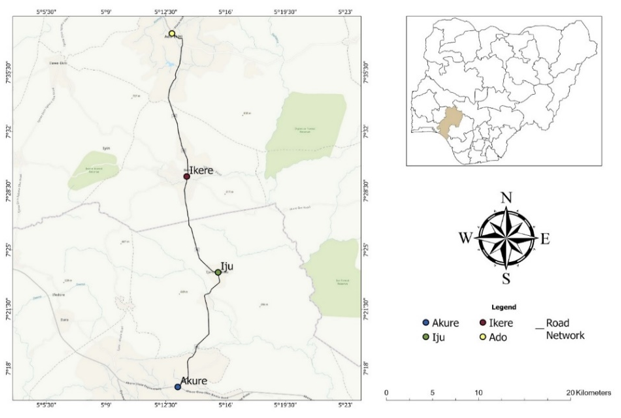
Pollen grains and spores, are valuable indicators of vegetation composition and environmental conditions, and have important applications in forensic investigations. This study evaluated the potential of vehicle air filters as passive collectors of airborne biological particles and assessed their forensic significance along the Ado-Ikere-Iju-Itaogbolu-Akure Road in southwestern Nigeria. A vegetation survey and palynological analysis were conducted to compare the roadside floristic composition with the spectrum of airborne particles captured in vehicle air filters. The vegetation assessment recorded 858 individuals belonging to 54 species, 47 genera, and 29 families in the study area. Herbs constituted the largest proportion of individuals (388), followed by grasses (117), trees (132), shrubs (79), climbers (75), and a few creepers, ferns, and lianas. The dominant plant species included Chromolaena odorata, Tithonia diversifolia, and Panicum maximum. Palynological analysis revealed 49 pollen types belonging to 33 families, 80 fungal and fern spores, 17 insect remains, 9 zooplankton, and 6 diatom frustules in the samples. Dominant palynomorphs included Hagenia abyssinica, Chromolaena odorata, Cannabis sativa, Curvularia, Glomus, and Peronospora. Rainfall, relative humidity, and wind speed significantly influenced the distribution of airborne pollen and spores in the study area. A strong correspondence was observed between roadside vegetation and atmospheric pollen assemblages. Vehicle air filters effectively capture pollen and spores that reflect the surrounding vegetation and environmental conditions along the travel routes. These pollen markers can serve as valuable forensic tools for linking vehicles and other objects to specific geographical locations, thereby supporting criminal investigations and geographic source attribution.
References
Adekanmbi, O. H., Ogundipe, O. T., & Okwong, J. W. (2022). Palynological investigation of crimes in Lagos, Nigeria. Ife Journal of Science, 24(1), 35–44.
Adekanmbi, O. H., Ogundipe, O. T., & Walter, O. J. (2021). Pollen: A silent witness in forensic investigations of crime. Journal of Scientific Research and Development, 20(1), 1–15.
Adeleye, M. A., Haberle, S. G., McWethy, D., Connor, S. E., & Stevenson, J. (2021). Environmental change during the last glacial on an ancient land bridge of southeast Australia. Journal of Biogeography, 48(11), 2946–2960.
Ajikah, L. B., Roffe, S. J., Neumann, F. H., Bamford, M. K., Esterhuizen, N., Berman, D., & Peter, J. (2023). Meteorological influences on airborne pollen and spores in Johannesburg (Gauteng), South Africa. Aerobiologia, 39(3), 363–388.
Akobundu, I. O., & Agyakwa, C. W. (1998). A handbook of West African weeds (2nd ed., pp. 194–195). Ibadan, Nigeria: International Institute of Tropical Agriculture.
Bani Khalifi, N., Platymesi, K., Vlachos, S., Bartzanas, T., & Avgoustaki, D. D. (2025). Quantifying the scaling effects of urban green infrastructure on air quality and greenhouse gas dynamics: Insights from a multi-site evaluation in Athens, Greece. Sustainability, 17(22), 10310.
Beggs, P. J. (2025). Phenology and aerobiology. In Phenology: An Integrative Environmental Science (pp. 595–608). Springer Nature Switzerland.
Bhoyar, L., & Srivastava, B. (2025). Revolutionizing forensic investigations through AI-driven pollen analysis: A narrative review. Review of Palaeobotany and Palynology, 105440.
Córdova Rodríguez, A., Solís Montero, L., de Jesús Uc Escamilla, R., García Crisóstomo, J. F., & Aragón Moreno, A. A. (2025). Atlas of pollen of melliferous plants: Dataset from the Soconusco region, Chiapas, Mexico. Data in Brief, 112422.
Dagnachew, S., Teketay, D., Demissew, S., Awas, T., & Kindu, M. (2022). Herbarium-based study of flowering and fruiting phenology of twelve indigenous and endemic plant species from Ethiopia. South African Journal of Botany, 150, 260–274.
Delport, J., Muasya, A. M., Strauss, P., Esterhuizen, N., Wossler, T., & Manzano, S. (2025). Pollen atlas of bee plants from the Greater Cape Floristic Region, South Africa. South African Journal of Botany, 186, 723–765.
Dhawan, S., Kumar, A., Mehta, D. S., & Khare, M. (2025). A review of airborne pollen and its interactions with air pollutants, urbanization, and climate change: Implications for human health and monitoring gaps. Current Allergy and Asthma Reports, 25(1), 62.
do Rosario Nogueira, R., Nahas, L., & Del Claro, K. (2025). Post-fire recovery in Malpighiaceae species with differing levels of ant–plant associations: The potential role of extrafloral nectaries in the Cerrado. Arthropod-Plant Interactions, 19(5), 73.
Dong, X., Li, B., Yan, Z., Guan, L., Huang, S., Li, S., Qi, Z., Tang, L., Tian, H., Fu, Z., & Yang, H. (2024). Impacts of high temperature, relative air humidity, and vapor pressure deficit on the seed set of contrasting maize genotypes during flowering. Journal of Integrative Agriculture, 23(9), 2955–2969.
Ghosh, B., Das, A., & Lal, H. (2022). Bioaerosol and its impact on human health. In Airborne Particulate Matter: Source, Chemistry and Health (pp. 167–193). Springer Nature Singapore.
Grimm, E. C. (2020). Tilia and TiliaGraph: Pollen data spreadsheet and graphics program. Illinois State Museum.
Hamann, L., Foat, T., & Blanke, A. (2025). The diversity of biological models for bio-inspired aerosol filters. Journal of the Royal Society Interface, 22(227).
Hammer, Ø., & Harper, D. A. (2024). Paleontological data analysis. John Wiley & Sons.
Ige, P. O., Shomide, P. O., Okofoh, W. O., & Omilabu, T. I. (2025). Assessment of tree species diversity, aboveground biomass and diameter distribution modelling in Omo Biosphere Reserve, Nigeria. Journal of Forest and Environmental Science, 41(4), 420–430.
International Plant Names Index. (2025). International Plant Names Index. http://www.ipni.org
International Union for Conservation of Nature. (2025). The IUCN Red List of Threatened Species (Version 2022-2). https://www.iucnredlist.org
Kazadzis, S., Fountoulakis, I., Damialis, A., Masoom, A., Papachristopoulou, K., Gilles, S., Coen, M. C., Tummon, F., Crouzy, B., Clot, B., & Pat, Y. (2025). Aerosol measurements and decadal changes: The role of climatic changes and how it reflects in respiratory allergies and asthma. Allergy, 80(6), 1613–1628.
Küçük, Z., & Celenk, S. (2025). Microscopic investigation of pollen attachment on different fabric types: Implications for forensic and allergy research. Micron, 190, 103781.
Laurencea, A. R., & Bryant, V. M. (2019). Forensic palynology and the search for geolocation: Factors for analysis and the Baby Doe case. Forensic Science International, 302, 109903.
Lopez, M. (2025). Forensic palynology: Utilizing pollen analysis in crime scene investigations. International Journal of Applied Biology and Forensics, 9(3), 185–189.
Mehmood, M., Tanveer, N. A., Joyia, F. A., Ullah, I., & Mohamed, H. I. (2025). Effect of high temperature on pollen grains and yield in economically important crops: A review. Planta, 261(6), 141.
Meng, M., Jie, D., Gao, G., Gao, T., Xu, S., Lian, Y., & Liu, L. (2022). Characteristics of burned phytoliths from representative plants in Northeast China and implications for paleo-fire reconstruction. Review of Palaeobotany and Palynology, 300, 104628.
Milne, L. A., Bryant, V. M., & Mildenhall, D. C. (2024). Forensic palynology. In Forensic Botany (pp. 112–146). CRC Press.
Nyayapathi, P. P., Namuduri, S., & Kolli, S. K. (2025). A comprehensive review of vertical profiling of ambient air quality particulate matter and its impacts on climatic and environmental health. Air Quality, Atmosphere & Health, 18(5), 1569–1595.
Onuminya, T. O., Walter, O. J., Ajikah, L. B., Ogundipe, O. T., & Bolarinde, T. S. (2025). Seasonal variation of airborne pollen and spore concentration in the University of Lagos, Akoka, Lagos, Nigeria. Annals of West University of Timișoara, Series of Biology, 28(2).
Orijemie, E. A., & Israel, I. (2019). Palynomorphs and travel history of vehicles in Nigeria. Aerobiologia, 35(3), 497–510.
Patel, V. R., Chourasiya, S., Dubey, A., & Yadav, B. (2025). Forensic analysis of soil and sediments. In Introducing the Synergy Between Forensic Science and Environmental Analysis (pp. 267–299). Springer Nature Singapore.
Ravindra, K., Goyal, A., & Mor, S. (2022). Influence of meteorological parameters and air pollutants on the airborne pollen of Chandigarh, India. Science of the Total Environment, 818, 151829.
Rull, V., Sigro, J., & Vegas Vilarrúbia, T. (2024). Cannabis pollen sources and dispersal in the Iberian Pyrenees during the last century: Preliminary results and proposals for future studies. Review of Palaeobotany and Palynology, 331, 105208.
Savina, K. A., Kuzmicheva, E. A., Severova, E. E., Khasanov, B. F., Girmay, W. W., Nemomissa, S., & Savinetsky, A. B. (2025). Modern pollen rain in the Bale Mountains (Ethiopia) along an elevational gradient. Biology Bulletin, 52(5), 187.
Siddiqui, S. (2025). Global patterns and drivers of species and genera richness of Fabaceae. Frontiers in Plant Science, 16, 1581814.
Suffert, F. (2025). Disruptive effect of rainfalls on the diurnal periodicity of airborne wheat rust spores under field conditions. Agricultural and Forest Meteorology, 368, 110527.
Trzyna, A., Rybak, J., Górka, M., Olszowski, T., Kamińska, J. A., Węsierski, T., & Majder-Łopatka, M. (2023). Comparison of active and passive methods for atmospheric particulate matter collection: From case study to a useful biomonitoring tool. Chemosphere, 334, 139004.
Tummon, F., Bruffaerts, N., Celenk, S., Choël, M., Clot, B., Crouzy, B., Galán, C., Gilge, S., Hajkova, L., Mokin, V., & O'Connor, D. (2024). Towards standardization of automatic pollen and fungal spore monitoring: Best practices and guidelines. Aerobiologia, 40(1), 39–55.
Walter, O. J., Adekanmbi, O. H., & Olowokudejo, J. D. (2019). Palynological and lithological investigation of forensic materials at the University of Lagos, Nigeria: First experimental palynological approach in Nigeria. Journal of Forensic Science and Criminology, 7(1), 104.
Walter, O. J., Adekanmbi, O. H., Onuminya, T. O., & Olowokudejo, J. D. (2023). Evaluation of pollen grains and spores potential in revealing vehicle travel history on the Ife–Ondo Road, Southwestern Nigeria. Journal of Applied Sciences and Environmental Management, 27(8).
Waudby, C. M., Sherwood, S. C., Osborne, N. J., Beggs, P. J., Al Kouba, J., Ebert, E. E., & Muscatello, D. J. (2022). Combined synoptic and regional weather patterns affecting atmospheric Poaceae pollen concentrations in Sydney, Australia. Aerobiologia, 38(4), 533–555.
Wu, S., Sun, A., Shen, X., Luo, X., & Li, X. (2025). The dispersal and deposition characteristics of airborne pollen and its response to meteorological factors in northern Beijing, China. Aerobiologia, 41(2), 169–187.
Yu, X., Han, Y., Cao, Y., Liu, J., Liu, Z., Li, Y., & Feng, W. (2025). Bioparticle sources, dispersion, and influencing factors in rural environmental air. Aerobiology, 3(2), 4.
Zhu, X., Ma, X., Zhang, Z., Liu, Y., Luo, Y., Yan, K., Pei, T., & Huete, A. (2024). Floating in the air: Forecasting allergenic pollen concentration for managing urban public health. International Journal of Digital Earth, 17(1), 2306894.
Downloads
Published
Issue
Section
Categories
License
Copyright (c) 2026 Okwong Walter, Temitope Onuminya, James Olowokudejo

This work is licensed under a Creative Commons Attribution 4.0 International License.


