In-Vitro Assessment of the Antioxidant, Anti-Inflammatory and Antidiabetic Properties of the Ethanolic Leaf Extract of Urtica dioica (Stinging Nettle) in Organized Chemical and Cell-Based Models
DOI:
https://doi.org/10.33003/fjs-2026-1015-5493Keywords:
Urtica dioica, Antioxidant, Anti-inflammatory, Antidiabetic, Oxidative Stress, PhytochemicalsAbstract
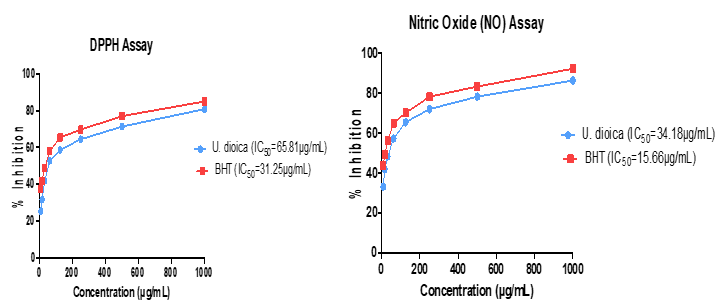
Various studies have shown that plants are capable of producing diverse chemical substances that perform vital biological roles, including protection from predators like insects, fungi, and plant-eating mammals. This study evaluated the in-vitro antioxidant, anti-inflammatory, and antidiabetic activities of U. dioica leaf extract. Antioxidant potential was assessed using DPPH, nitric oxide [NO], hydroxyl radical [HO•], and hydrogen peroxide [H₂O₂] scavenging assays. Anti-inflammatory activity was determined by membrane stabilization, protein denaturation inhibition, and protease inhibitory assays. Antidiabetic potential was evaluated using the glucose uptake inhibition assay. Butylated Hydroxytoluene [BHT], Diclofenac sodium, and Metronidazole were used as standards. The extract exhibited significant, dose-dependent activity in all assays. For antioxidant activity, IC50 values were DPPH = 65.81 µg/mL, NO = 34.18 µg/mL, HO• = 18.13 µg/mL, and H₂O₂ = 42.21 µg/mL. For anti-inflammatory activity, IC50 values were: membrane stabilization = 66.41 µg/mL, protein denaturation = 62.89 µg/mL, and protease inhibition = 52.02 µg/mL. The extract also showed glucose uptake inhibitory activity with an IC50 of 96.83 µg/mL. While the standards showed higher potency, the results indicate that U. dioica possesses broad-spectrum bioactivity, likely due to its flavonoid and phenolic content. The findings validate the traditional use of U. dioica and suggest its potential as a natural source of antioxidant, anti-inflammatory, and antidiabetic agents for therapeutic development.
References
Al-Khayri, J. M., Rashmi, R., Toppo, V., Chole, P. B., Banadka, A., Sudheer, W. N., & Rezk, A. A. S. (2023). Plant secondary metabolites: the weapons for biotic stress management. Metabolites, 13(6), 716.
Altamimi, J. Z., Alfaris, N. A., Alshammari, G. M., Algalil, F. M., Al-Sabhan, F. A., Yahya, M. A., & Al-Badr, N. A. (2022). Hydroethanolic extract of Urtica dioica L. (stinging nettle) leaves as disaccharidase inhibitor and glucose transport in Caco-2 hinderer. Molecules, 27(24), 8872. https://doi.org/10.3390/molecules27248872
Bauer, L. S., et al. (2019). The Role of Natural Products in the Development of Novel Antimicrobials. Future Microbiology, 14(4), 435-451.
Bhattarai, S., Shrestha, S., Marasini, B. P., & Chaudhary, R. (2023). Antioxidant activity of Urtica dioica: An important property contributing to multiple biological activities. Plants, 12(1), 101. https://doi.org/10.3390/plants12010101
Bnouham, M., Ziyyat, A., Mekhfi, H., Tahri, A., & Legssyer, A. (2006). Medicinal plants with potential antidiabetic activity - A review of ten years of herbal drug research. International Journal of Diabetes and Metabolism, 14, 1–25.
Cirillo, V. P. (1962). Mechanism of glucose transport across the yeast cell membrane. Journal of bacteriology, 84(3), 485-491.
Devkota, H. P., Paudel, K. R., Khanal, S., Baral, A., Panth, N., Adhikari-Devkota, A., Jha, N. K., Das, N., Singh, S. K., Chellappan, D. K., Dua, K., & Hansbro, P. M. (2022). Stinging nettle (Urtica dioica L.): Nutritional composition, bioactive compounds, and food functional properties. Molecules, 27(16), 5219. https://doi.org/10.3390/molecules27165219
Divekar, P.A.; Narayana, S.; Divekar, B.A.; Kumar, R. et. al. (2022) Plant Secondary Metabolites as Defense Tools against Herbivores for Sustainable Crop Protection. International Journal of Molecular Sciences, 23(5): 2690.
Enema, O.J., Umoh, U.F. & Johnny, I.I. (2024). GC-MS Analysis, Quantitative Phytochemical Profile and In-vitro Antioxidant Studies of the Stem back of Dennettia tripetala. European Journal of Med. Plants. 35(4), 30-41.
Ghorbani, Z., Samavati, M., Hedayati, M., & Elahi, S. (2022). Anti-diabetic potential of Urtica dioica: Current knowledge and future direction. Journal of Diabetes & Metabolic Disorders, 21(1), 1033–1043. https://doi.org/10.1007/s40200-022-01021-3
Gülçin, I., Küfrevioğlu, O. I., Oktay, M., & Büyükokuroğlu, M. E. (2010). Antioxidant, antimicrobial, antiulcer and analgesic activities of nettle (Urtica dioica L.). Journal of Ethnopharmacology, 90, 205–215. https://doi.org/10.1016/j.jep.2003.09.028
Halliwell, B., & Gutteridge, J. M. C. (2015). Free radicals in biology and medicine (5th ed.). Oxford University Press.
Harborne, J. B. (1998). Phytochemical methods: A guide to modern techniques of plant analysis (3rd ed.). Chapman & Hall.
Hotamisligil, G. S. (2017). Inflammation, metaflammation and immunometabolic disorders. Nature, 542(7640), 177-185.
Okoroh P.N, Duru M.K.C, Onuoha S.C, Amadi B.A. (2019) Proximate composition, phytochemical and mineral analysis of the fruit of Ficus capensis. International Journal of Innovative Research and Development, 8(8): 84-88.
Pietta, P. G. (2010). Flavonoids as antioxidants. Journal of Natural Products, 63, 1035–1042. https://doi.org/10.1021/np9904509
Ruch, R. J., Cheng, S. J., & Klaunig, J. E. (1989). Prevention of cytotoxicity and inhibition of intercellular communication by antioxidant catechins isolated from Chinese green tea. Carcinogenesis, 10, 1003–1008. https://doi.org/10.1093/carcin/10.6.1003
Saini, R., Garg, V., Dangwal, K., & Garg, M. (2015). Evaluation of antioxidant and anti-inflammatory activity of Cassia fistula bark extract. International Journal of Pharmacy and Pharmaceutical Sciences, 7, 321–325.
Sakat, S., Juvekar, A. R., & Gambhire, M. N. (2010). In vitro antioxidant and anti-inflammatory activity of methanol extract of Oxalis corniculata Linn. International Journal of Pharmacy and Pharmaceutical Sciences, 2, 146–155.[1]
Semalty, M., et al. (2017). A Comprehensive Review on Phytochemistry and Pharmacological Effects of Stinging Nettle (Urtica dioica). Current Traditional Medicine, 3(3), 1–10.
Smirnoff, N., & Cumbes, Q. J. (1989). Hydroxyl radical scavenging activity of compatible solutes. Phytochemistry, 28(4), 1057-1060.
Somani, R., Yadav, A., Singh, R., & Sharma, K. (2024). Potential benefits of Urtica dioica and its combination with vitamin E in experimental diabetes. Journal of Medicinal and Pharmaceutical Clinical Research, 4(2), 114–125.
Soobrattee, M. A., Neergheen, V. S., Luximon-Ramma, A., Aruoma, O. I., & Bahorun, T. (2005). Phenolics as potential antioxidant therapeutic agents: Mechanism and actions. Mutation Research/Fundamental and Molecular Mechanisms of Mutagenesis, 579[1–2], 200–213. https://doi.org/10.1016/j.mrfmmm.2005.03.023
Downloads
Published
Issue
Section
Categories
License
Copyright (c) 2026 Abdulhakeem Funsho Ahmed, Abdulhameed Oluwatomi Alli, Bashir Dayo Abdulrahman, Abubakar Olayinka Musa, Abdullahi Alhaji Ahmad, Surajudeen Alade Shittu, Dolapo Ahmod Asafa, Abdullahi Olaide Ahmed

This work is licensed under a Creative Commons Attribution 4.0 International License.