
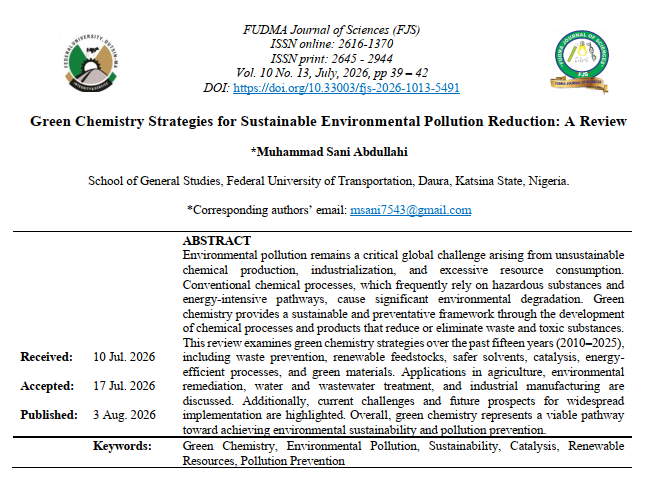
Green Chemistry Strategies for Sustainable Environmental Pollution Reduction: A Review
DOI:
https://doi.org/10.33003/fjs-2026-1013-5491Keywords:
Green Chemistry, Environmental Pollution, Sustainability, Catalysis, Renewable Resources, Pollution PreventionAbstract
Environmental pollution remains a critical global challenge arising from unsustainable chemical production, industrialization, and excessive resource consumption. Conventional chemical processes, which frequently rely on hazardous substances and energy-intensive pathways, cause significant environmental degradation. Green chemistry provides a sustainable and preventative framework through the development of chemical processes and products that reduce or eliminate waste and toxic substances. This review examines green chemistry strategies over the past fifteen years (2010–2025), including waste prevention, renewable feedstocks, safer solvents, catalysis, energy-efficient processes, and green materials. Applications in agriculture, environmental remediation, water and wastewater treatment, and industrial manufacturing are discussed. Additionally, current challenges and future prospects for widespread implementation are highlighted. Overall, green chemistry represents a viable pathway toward achieving environmental sustainability and pollution prevention.
References
Agarwal, T., Atray, N., & Sharma, J. G. (2024). A critical examination of advanced approaches in green chemistry: Microbial bioremediation strategies for sustainable mitigation of plastic pollution. Future Journal of Pharmaceutical Sciences, 10, 78. https://doi.org/10.1186/s43094-024-00645-x
Akhtar, M. S., & Zaman, W. (2025). Sustainable catalysis for green chemistry and energy transition. Catalysts, 15(8), 773. https://doi.org/10.3390/catal15080773
Anastas, P. T., & Kirchhoff, M. M. (2002). Origins, current status, and future challenges of green chemistry. Accounts of Chemical Research, 35(9), 686–694. https://doi.org/10.1021/ar010065m
Anastas, P. T., & Warner, J. C. (1998). Green Chemistry: Theory and Practice. Oxford University Press.
Asghar, N., Hussain, A., Nguyen, D. A., et al. (2024). Advancement in nanomaterials for environmental pollutants remediation: A systematic review. Journal of Nanobiotechnology, 22, 26. https://doi.org/10.1186/s12951-023-02151-3
Bala, S., Garg, D., Thirumalesh, B. V., et al. (2022). Recent strategies for bioremediation of emerging pollutants: A review for a green and sustainable environment. Toxics, 10(8), 484. https://doi.org/10.3390/toxics10080484
Beepala, S. K., Sunitha, P. S., & Maripi, S. (2025). Towards sustainable environmental chemistry: A comprehensive review. Journal of Research in Chemistry, 6(2), 201–203.
Chemat, F., Vian, M. A., & Cravotto, G. (2012). Green extraction of natural products: Concept and principles. International Journal of Molecular Sciences, 13(7), 8615–8627. https://doi.org/10.3390/ijms13078615
Clark, J. H., & Deswarte, F. E. I. (2015). Introduction to Chemicals from Biomass (2nd ed.). Wiley.
Dunn, P. J., Wells, A. S., & Williams, M. T. (2010). Green Chemistry in the Pharmaceutical Industry. Wiley-VCH.
EPA. (2023). Basics of green chemistry. United States Environmental Protection Agency. URL: https://www.epa.gov/greenchemistry/basics-green-chemistry
Gavrilescu, M., Demnerová, K., Aamand, J., et al. (2015). Emerging pollutants in the environment: Present and future challenges in biomonitoring, ecological risks and bioremediation. New Biotechnology, 32(1), 147–156. https://doi.org/10.1016/j.nbt.2014.01.001
Ibrahim, M. M., & El-Zawawy, W. K. (2015). Biodegradable polymers and their applications. In Green Chemistry and Sustainable Technology. Springer.
Idoko, F. A., Ezeamii, G. C., & Ojochogwu, O. J. (2024). Green chemistry in manufacturing: Innovations in reducing environmental impact. World Journal of Advanced Research and Reviews, 23(3), 2826–2841. https://doi.org/10.30574/wjarr.2024.23.3.2938
Isikgor, F. H., & Becer, C. R. (2015). Lignocellulosic biomass: A sustainable platform for the production of bio-based chemicals and polymers. Polymer Chemistry, 6(25), 4497–4559. https://doi.org/10.1039/C5PY00263J
Li, C., Zhang, G., & Xu, S. (2020). Recent advances in green chemistry for sustainable development. Chemical Reviews, 120(15), 7235–7287.
Liu, Y., Wang, J., & Zhang, L. (2015). Catalysis and green chemistry: A review of recent developments. Green Chemistry Letters and Reviews, 8(2), 1–12.
Maki, M. A. A., Tan, K. F., & Yee, M. T. S. (2025). Green solvents as a sustainable strategy to reduce the impact of hazardous waste on human health. Discover Chemistry, 2, 342. https://doi.org/10.1007/s44371-025-00450-2
Mishra, M., Singh, A., & Singh, R. (2018). Bioremediation of heavy metals: A review. Journal of Environmental Management, 208, 78–94.
Mori, T., & Koizumi, H. (2015). Green agrochemicals: Advances and perspectives. Journal of Agricultural and Food Chemistry, 63(2), 1–12.
Qu, X., Alvarez, P. J. J., & Li, Q. (2013). Applications of nanotechnology in water and wastewater treatment. Water Research, 47(12), 3931–3946. https://doi.org/10.1016/j.watres.2012.09.05
Ramesh, P., & Vinodh, S. (2020). Bioplastics: A review on properties, applications and environmental impact. Environmental Science and Pollution Research, 27(3), 2477–2492.
Sánchez-Morales, R., Sáenz-López, P., & de las Heras Pérez, M. A. (2024). Green chemistry and its impact on the transition towards sustainable chemistry: A systematic review. Sustainability, 16(15), 6526. https://doi.org/10.3390/su16156526
Santhosh, C., Velmurugan, V., Jacob, G., et al. (2016). Role of nanomaterials in water treatment applications: A review. Chemical Engineering Journal, 306, 1116–1137.
Sharma, N., & Basera, P. (2025). Green chemistry strategies in pulping and biomass valorization: Toward a circular bioeconomy. Frontiers in Chemistry, 13, 1724324. https://doi.org/10.3389/fchem.2025.1724324
Sheldon, R. A. (2018). Metrics of green chemistry and sustainability: Past, present, and future. ACS Sustainable Chemistry & Engineering, 6(1), 32–48. https://doi.org/10.1021/acssuschemeng.7b03505
Smith, E. L., Abbott, A. P., & Ryder, K. S. (2014). Deep eutectic solvents (DESs) and their applications. Chemical Reviews, 114(21), 11060–11082.
Tundo, P., Anastas, P. T., & Black, D. S. (2010). Green chemistry: Principles and practice. Chemical Society Reviews, 39(1), 1–5.
Vörösmarty, C. J., McIntyre, P. B., Gessner, M. O., et al. (2010). Global threats to human water security and river biodiversity. Nature, 467, 555–561. https://doi.org/10.1038/nature0944
Welton, T. (2015). Ionic liquids: A brief history. Biophysical Reviews, 7(2), 137–144. https://doi.org/10.1007/s12551-015-0173-6
Wu, H., Li, H., Su, Y., & Yang, S. (2023). Sustainable catalytic production of bio-based compounds. Frontiers in Chemistry, 11, 1210932. https://doi.org/10.3389/fchem.2023.1210932
Zhang, Z., Song, J., & Han, B. (2017). Catalytic transformation of lignocellulose into chemicals and fuels. Chemical Reviews, 117(10), 6834–6880. https://doi.org/10.1021/acs.chemrev.6b00657
Downloads
Published
Issue
Section
Categories
License
Copyright (c) 2026 Muhammad Sani Abdullahi

This work is licensed under a Creative Commons Attribution 4.0 International License.


