
Comparative Analysis of the Modified Spatial Variance Shift Outlier Model
DOI:
https://doi.org/10.33003/fjs-2026-1015-5489Keywords:
Outliers, m-SVSOM, MSE, SGLMM, SAR, Spatial dependencyAbstract
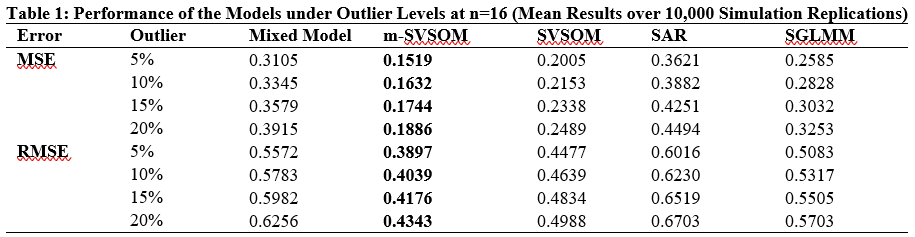
Spatial outliers pose substantial challenges in spatial data analysis, often distorting parameter estimates and leading to misleading conclusions. Various accommodation strategies have evolved through variance-shift frameworks and hierarchical robust approaches, but comprehensive evaluations across multiple contamination levels remain limited. While standard frameworks such as Mixed Models (MM), Spatial Autoregressive (SAR) models and Spatial Generalized Linear Mixed Models (SGLMM) address specific data complexities like random effects or spatial dependencies, they generally fail to account for spatial outliers concurrently. This study evaluates the performance of the Modified Spatial Variance Shift Outlier Model (m-SVSOM) in comparison with these earlier methods and the existing Spatial Variance Shift Outlier Model (SVSOM). A simulation study was conducted across various sample sizes (n = 16, 100, 256, 1000) and varying outlier proportions (5%, 10%, 15%, and 20%). The estimation accuracy of the proposed model was assessed using the Mean Squared Error (MSE) and Root Mean Squared Error (RMSE). The results consistently demonstrate that the m-SVSOM outperforms the Mixed Model, SAR, SGLMM, and the SVSOM across all scenarios. Specifically, the Modified SVSOM maintained the lowest error metrics even as contamination levels increased, indicating superior robustness in accommodating outliers and managing spatial dependencies. These findings suggest that the m-SVSOM provides a more robust and efficient framework for accommodating spatial outliers while retaining the information contained in influential observations.
References
Akeyede, I., Saleh, I.M. & Babalola, O.A. (2015). Proportional Effect of outliers on over dispersion. FULafia journal of science and technology, 1(1), 95-100.
Baba, A.M., Midi, H., Adam, M.B. & Rahman, N.H.A.(2022). Spatial Outlier Accommodation Using a Spatial Variance Shift Outlier Model. Mathematics, 10,1-19.
Boubeta, M., Lombardía, M.J. & Morales, D. (2023). Small Area Prediction of Proportions and Counts Under a Spatial Poisson Mixed Model. Statistical Methods & Applications, 33, 1193-1215.
Breslow, N. E. (1984). Extra-Poisson variation in Log-linear models. Applied Statistics, 33,38–44.
Breslow, N. E. & D. G. Clayton (1993). Approximate inference in generalized linear mixed models. Journal of the American Statistical Association, 88, 9–25.
Chavez-Chong, A., Melo, O., & Martinez, C. (2024). Ridge Regularization for Spatial Autoregressive Models with Multicollinearity Issues. AStA Advances in Statistical Analysis, 108, 729–753.
Cheng, Y., & Song, Y. (2023). Simultaneous outlier detection and variable selection for the spatial Durbin model. Brazilian Journal of Probability and Statistics, 37(4), 789–812.
Cook, R.D. &Weisberg, S.(1982). Residuals and Influence in Regression; Chapman and Hall: New York, NY, USA.
Dai, X., Jin, L., Shi, A., & Shi, L.(2016). Outlier Detection and Accommodation in General Spatial Models. Statistical Methods Application, 25, 453–475.
Diggle, P. J., Tawn, J. A. & Moyeed, R. A. (1998). Model-Based Geostatistics. Journal of the Royal Statistical Society. Series C (Applied Statistics), 47(3), 299–350.
Gumedze, F.N., Welham, S.J., Gogel, B.J. & Thompson. R. (2010). A Variance Shift Model for Detection of Outliers in the Linear Mixed Model. Computing Statistical Data Analysis, 54, 2128–2144.
Jiang, J. (2021) Linear and Generalized Linear Mixed Models and Their Applications, 2nd ed. New York: Springer.
Kowalskie, J. (2025). The Impact of Outliers on Linear Regression Models: Detection and Correction Strategies. OTS Canadian Journal, 4, 108-118.
Moore, D.S. & McCabe, G.P. (1999). Introduction to the practice of Statistics, 3rd edition. W.H.Freeman, New York.
Nicolas, P. (2019). Mean squared error in predictive modeling. Statistical Publishing.
Sirait, T. (2023). Spatial Autoregressive Modelling on Linear Mixed Models for Dependency Between Regions, Aceh International Journal of Science and Technology, 12(1), 40-52.
Song, Y., Fang, M., Wang, Y. & Hou, Y. (2024). Rapid outlier detection, model selection and variable selection using penalized likelihood estimation for general spatial models. Journal of Spatial Statistics, 61, 1-14.
Stroup, W.W. (2016). Generalized Linear Mixed Models: Modern Concepts, Methods and Applications, Boca Raton, FL: CRC Press.
Sugasawa, S., Kawakubo, Y., & Datta, G. S. (2024). Hierarchical gamma-divergence for robust linear mixed models. Journal of the American Statistical Association, 119(546), 1234–1247.
Venables, W. N. & Ripley, B. D. (2002). Modern Applied Statistics with S. Springer, New York, fourth edition.
Williams, D. A. (1982). Extra-binomial variation in logistic linear models. Applied Statistics, 31, 144–148.
Downloads
Published
Issue
Section
Categories
License
Copyright (c) 2026 Ehiosasu Idusuyi, Adesupo Adeoye Akinrefon, Emmanuel Torsen, Abraham Okolo

This work is licensed under a Creative Commons Attribution 4.0 International License.


