
Effect of Physicochemical Parameters on Abundance and Diversity of Insects in Jabi Lake, Abuja, Nigeria
DOI:
https://doi.org/10.33003/fjs-2026-1010-5461Keywords:
Abundance, Diversity, Insects, Jabi Lake, Physicochemical parameters, SeasonsAbstract
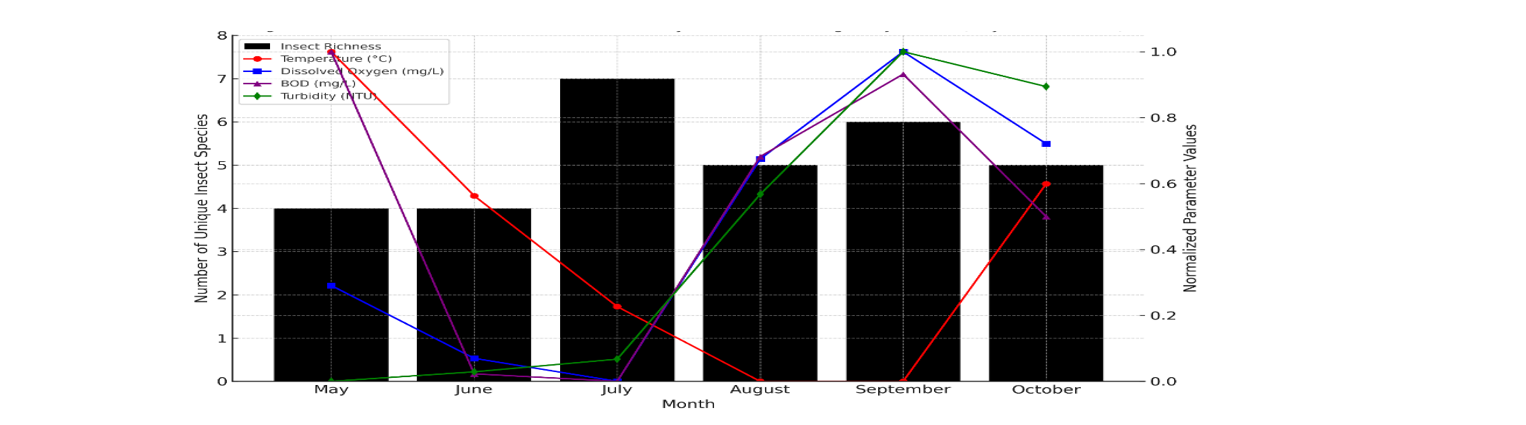
Insects represent the most diverse and adaptable group of animals, comprising over 80% of all identified species and occurring in nearly all habitats except marine environments. This study assessed the abundance, diversity, and ecological distribution of aquatic insects in Jabi Lake, Abuja, from May to October 2025, with emphasis on their relationship to seasonal changes in water quality. Five ecological stations were established, and samples were collected triweekly using standard sweep netting techniques. Physicochemical parameters—temperature, pH, turbidity, depth, dissolved oxygen (DO), and biochemical oxygen demand (BOD)—were measured concurrently.
Mean water temperature declined from 28.46 ± 0.03 °C in May to 25.99 ± 0.00 °C in August (p < 0.05), while pH fluctuated between 5.90 and 6.94. Depth increased from 1.74 m to 2.46 m, and turbidity rose from 8.45 to 9.49 NTU. Dissolved oxygen ranged between 5.18 and 6.04 mg/L, showing an inverse relationship with BOD (2.02–2.90 mg/L).
Seven insect taxa were recorded: Chironomus sp., Notonecta glauca, Gerris sp., Dytiscus sp., Orthetrum sp., Brachythemis sp., and Pseudocloeon sp., with peak species richness in July under moderate temperature and elevated DO. The Shannon–Weiner diversity index peaked at 1.946 during July–September, coinciding with optimal conditions for Odonata and Ephemeroptera emergence. RLQ ordination explained 78.4% of trait–environment covariance, distinguishing oxygen-demanding taxa in deeper, well-oxygenated waters (Axis 1 = 58.2%) from tolerant species in nutrient-enriched zones (Axis 2 = 20.2%).
References
Addo-Bediako, A. (2021). Spatio-temporal distribution patterns of functional feeding groups of benthic macroinvertebrates in Blyde River, South Africa. Applied Ecology and Environmental Research, 19(3), 2241–2257. https://doi.org/10.15666/aeer/1903_22412257
Adejuwon, E. O., Ogwueleka, T. C., Ogungbemi, E. O., Prabhu, R., Rendon-Nava, A., & Yates, K. (2025). Assessment of surface water quality using chemometric tools: A case study of Jabi Lake, Abuja, Nigeria. Iranian Journal of Science and Technology, 49, 829–852. https://doi.org/10.1007/s40996-024-01712-2
Ajagbe, J. T. (2020). Standard procedures for water quality assessment in Nigerian freshwater systems. Journal of Nigerian Water Assessment and Monitoring, 5(1), 34–46.
Akindele, E. O., Ehlers, S. M., & Koop, J. H. J. L. (2019). First empirical study of freshwater microplastics in West Africa using gastropods from Nigeria as bioindicators. Limnologica, 78, 125708. https://doi.org/10.1016/j.limno.2019.125708
Ali, M. O., Jaiswal, P., Bhandekar, R., & Thiske, S. (2024). A review on: Insects as bioindicators for an ecosystem and key species in trophic level. World Journal of Advanced Research and Reviews. https://doi.org/10.30574/wjarr.2024.24.1.3007
Andrades, R., Saldanha, P. C., & Leite, R. G. (2019). Organic enrichment and macroinvertebrate responses in tropical freshwater ecosystems. Ecological Indicators, 98, 534–543.
Antczak-Orlewska, O., Świtoniak, M., & Pleskot, K. (2021). The effect of environmental gradients on aquatic macroinvertebrate diversity in temperate freshwater systems. Environmental Monitoring and Assessment, 193(4), 217.
American Public Health Association. (2012). Standard methods for the examination of water and wastewater (22nd ed.).
Baskar, K., & Gawade, S. (2021). Aquatic insects and their importance in assessing ecosystem health. MOJ Ecology & Environmental Sciences. https://doi.org/10.15406/mojes.2021.06.00226
Chakravarty, T., & Gupta, S. (2024). Aquatic insects as indicators of water quality: Seasonal distribution and biomonitoring insights from a hilly river in the Eastern Himalayan region, India. Cleaner Water, 2, 100056. https://doi.org/10.1016/j.clwat.2024.100056
Daniel, M., Sawyerr, H. O., Opasola, O. A., Ekundayo, D. E., Atimiwoaye, A. D., Musa, O., & Sule, R. (2023). Water quality assessment of the man-made Jabi Lake, Federal Capital Territory, Abuja, Nigeria. Journal of Applied Sciences and Environmental Management, 27(6), 1141–1146. https://doi.org/10.4314/jasem.v27i6.12
Dankishiya, I. R. T. (2024). An assessment of the chemical hydrology of Jabi Lake, Abuja, Nigeria. International Journal of Science and Research. https://doi.org/10.21275/sr24309231205
Ergović, N., Vilenica, M., & Mihaljević, Z. (2025). Physicochemical drivers of macroinvertebrate community patterns in freshwater lakes. Hydrobiologia, 852(3), 455–471.
Fadel, A. M., Guerrieri, F. J., & Pincebourde, S. (2023). The functional relationship between aquatic insects and cyanobacteria: A systematic literature review reveals major knowledge gaps. Total Environment Research Themes. https://doi.org/10.1016/j.totert.2023.100078
Fang, K., Zhang, Z.-Q., Shen, H., Lu, Y.-Z., Yang, L., & Luo, Z.-L. (2025). Environmental stressors drive fungal community homogenization and diversity loss in plateau freshwater lakes. BMC Microbiology, 25. https://doi.org/10.1186/s12866-025-04144-8
Fusi, M., Rigaud, S., Guadagnin, G., Barausse, A., Marasco, R., Daffonchio, D., Régis, J., Huchet, L., Camin, C., Pettit, L., Vina-Herbon, C., & Giomi, F. (2023). Ideas and perspectives: The fluctuating nature of oxygen shapes the ecology of aquatic habitats and their biogeochemical cycles – the aquatic oxyscape. Biogeosciences. https://doi.org/10.5194/bg-20-3509-2023
Gerstle, V., Bollinger, E., Manfrin, A., Pietz, S., Kolbenschlag, S., Feckler, A., Entling, M., & Brühl, C. (2024). Trophic effects of Bti-based mosquito control on two top predators in floodplain pond mesocosms. Environmental Science and Pollution Research International, 31, 45485–45494. https://doi.org/10.1007/s11356-024-34124-w
Hébert, M., Soued, C., Fussmann, G., & Beisner, B. (2022). Dissolved organic matter mediates the effects of warming and inorganic nutrients on a lake planktonic food web. Limnology and Oceanography, 68. https://doi.org/10.1002/lno.12177
Keerthika, N., Ravishankar, B., Reddy, B. S. K., Suthar, D. P., Doley, A. K., Balsane, M. K., Sujatha, B., & Painkra, D. S. (2026). Ecological significance of insect–animal networks in terrestrial and aquatic systems: A review. Uttar Pradesh Journal of Zoology. https://doi.org/10.56557/upjoz/2026/v47i85625
Larance, S., Wang, J., Delavar, M. A., & Fahs, M. (2025). Assessing water temperature and dissolved oxygen and their potential effects on aquatic ecosystem using a SARIMA model. Environments. https://doi.org/10.3390/environments12010025
Mariu, A., Chatha, A., Naz, S., Khan, M. F., Safdar, W., & Ashraf, I. (2023). Effect of temperature, pH, salinity and dissolved oxygen on fishes. Journal of Zoology and Systematics. https://doi.org/10.56946/jzs.v1i2.198
Moise, A. I., & Abdullahi, H. A. (2020). Climatic patterns and seasonal dynamics in the Federal Capital Territory, Nigeria. Journal of Nigerian Meteorological Sciences, 10(2), 145–158.
Omokunle, A. B. (2023). Ecological assessment of a tropical river using aquatic insects’ assemblage and water quality as indicators. Entomology and Applied Science Letters, 10(3), 1–9.
Pfister, H., D’Avignon, G., Wang, A., Felismino, M. E. L., & Ricciardi, A. (2025). Caddisfly larvae (Trichoptera: Limnephilidae) facilitate the uptake of microplastics by a freshwater fish (Ameiurus nebulosus). Environmental Pollution, 127133. https://doi.org/10.1016/j.envpol.2025.127133
Thaware, V. H. (2023). Study of aquatic insects, their role in improving biodiversity and balancing the food web of a freshwater ecosystem at Karadkhed Dam in Nanded, Maharashtra. Journal of Entomology and Zoology Studies. https://doi.org/10.22271/j.ento.2023.v11.i1c.9153
Vitheepradit, A., Phuthi-On, W., Jumrongsawat, J., & Suksomjarung, U. (2024). Aquatic insect biodiversity, water quality variables, and microplastics in a freshwater ecosystem. Aquatic Ecosystem Health and Management, 27(2), 121–133.
Woodward, G., Perkins, D. M., & Brown, L. E. (2010). Climate change and freshwater ecosystems: Impacts across multiple levels of organization. Advances in Ecological Research, 42, 71–138.
Hristov, P.; Neov, B.; Shumkova, R.; Palova, N. Significance of Apoidea as Main Pollinators. Ecol. Econ. Impact Implic. Hum. Nutrition. Divers. 2020, 12, 280.
Downloads
Published
Issue
Section
Categories
License
Copyright (c) 2026 Rachael Toyosi Idowu, Tawakalitu Biola Alabi, Bala Adamu Azare

This work is licensed under a Creative Commons Attribution 4.0 International License.


