
Effect of Land Use Types on Soil Carbon Sequestration and Hydraulic Properties around Kunvyi Area, Taraba State, Nigeria
DOI:
https://doi.org/10.33003/fjs-2026-1014-5455Keywords:
Land use, Soil organic carbon, Hydraulic properties, Soil fertility, Carbon storageAbstract
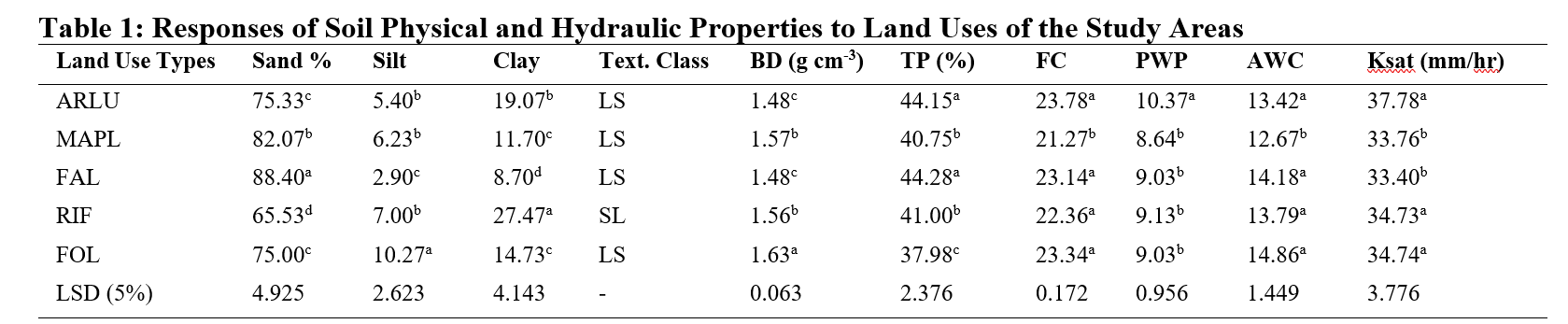
This study evaluated the effects of contrasting land use types on soil organic carbon sequestration and selected physical, chemical and hydraulic properties in Kunvyi, Wukari Local Government Area, Taraba State, Nigeria. Soil samples were collected at 0–30 cm depth from five land use types: arable land, mango plantation, fallow land, rice field and forest land. Selected soil physical, chemical and hydraulic properties were determined using standard laboratory procedures. Data were subjected to analysis of variance, and treatment means were separated using the least significant difference at the 5% probability level. Significant differences occurred among land use types in most soil properties. Fallow land had the highest sand content (88.40%), whereas rice field had the highest clay content (27.47%). Bulk density was greatest under forest land (1.63 g cm⁻³), while total porosity was highest under fallow and arable lands. Forest land recorded the greatest available water content (14.86%), whereas mango plantation had the lowest (12.67%). Saturated hydraulic conductivity was highest under arable land (37.78 mm h⁻¹). Among chemical properties, fallow land recorded the highest total nitrogen, available phosphorus and exchangeable potassium. Soil pH remained relatively stable across land uses. Rice field had the highest soil organic carbon stock (18.68 Mg ha⁻¹), followed by arable land (16.21 Mg ha⁻¹). Correlation analysis revealed strong positive relationships between organic carbon and clay, organic carbon stock and organic carbon, and total porosity and total nitrogen. The findings demonstrate that land use and associated management practices substantially influence soil fertility, carbon storage and hydraulic functioning.
References
Adeleke, B. O., Ajayi, O. A., & Ogunbode, C. A. (2024). Urban expansion and land use changes in Nigerian cities: A remote sensing analysis. Journal of Urban and Regional Planning, 46(2), 55–70.
Alemayehu Kifku AK, Sheleme Beyene SB (2013) Effects of different land use systems on selected soil properties in South Ethiopia. J Soil Sci Environ Manag 4:100–107
Adebayo, S. O., & Olatunji, M. A. (2022). Land use impacts on infiltration and soil water characteristics in Ekiti State. African Journal of Agricultural Research, 17(3), 215–223.
Alani, R., Odunuga, S., Andrew-Essien, N., Appia, Y. and Muyiolu, K. (2017). Assessment of the Effects of Temperature, Precipitation and Altitude on Greenhouse Gas Emission from Soils in Lagos Metropolis.
Awoonor, J. K., Adiyah, F. and Dogbey, B. F. (2022). Land- Use Change on Soil C and N Stocks in the Humid Savannah Agro-Ecological Zone of Ghana. Journal of Environmental Protection. 13(1) : 32-68.
Adeleye, A. B., Ogunyemi, S. A., & Ayeni, A. O. (2023). Land use changes and their implications for soil physical properties in Southwestern Nigeria. Environmental Management Journal, 28(2), 121–134.
Akinyemi, K. A., Ayoola, B. I., & Aboyeji, C. M. (2023). Land degradation and compaction under various land use types in a derived savannah zone. Tropical Agriculture and Soil Science, 10(1), 89–98.
Aliyu, S. Y., & Adeoye, O. A. (2023). Assessment of degraded land and desertification trends in northern Nigeria. Journal of Arid Land Studies, 30(2), 112–128.
Abdulrahman, A. A., Bello, R. S., & Yusuf, O. A. (2023). Soil carbon dynamics under contrasting land use types in central Nigeria. Nigerian Journal of Soil and Environmental Research, 23(1), 45–53.
Adebayo, S. O., & Olatunji, M. A. (2022). Effect of land use change on soil carbon stocks in southwestern Nigeria. African Journal of Environmental Management, 19(2), 102–111.
Bai, Z., Ma, Z., Liu, G. and Zhang, Y. (2023). Impacts of land use change on soil properties and hydrological behavior in subtropical agroecosystems. Geoderma, 431, 116341.
Brady, N. C., & Weil, R. R. (2017). The Nature and Properties of Soils (15th ed.). Pearson.
Bationo, A., et al. (2007). Soil fertility management in Africa. Nutrient Cycling in Agroecosystems, 78, 1–15Havlin, J. L., Tisdale, S. L., Nelson, W. L., & Beaton, J. D. (2014). Soil Fertility and Fertilizers (8th ed.). Pearson.
Bayu, W., Mucheru-Muna, M. and Mugendi, D. (2021). Agroforestry and soil carbon dynamics in sub-humid tropics: A review. Agroforestry Systems, 95(4), 791–805.
Blake, G. R. and Hartge, K. H. (1986). Bulk density. In A. Klute (Ed.), Methods of soil analysis: Part 1—Physical and mineralogical methods (2nd ed.). American Society of Agronomy-Soil Science Society of America, pp. 363–375.
Bradford, M.A., Wieder, W.R., Bonan, G.B., Fierer, N., Raymond, P.A. and Crowther, T.W. (2016). Managing uncertainty in soil carbon feedbacks to climate change. Nature Climate Change. 6(8): 751-758.
Bremner, J.M. and Mulvaney, C.S. (1982). Nitrogen total. In Methods of Soil Analysis. Part 2. Chemical and Microbiological properties, Page, AL., Miller, R.H. and Keeney, D.R. Eds., America Society of Agronomy, Soil Science Society of America, Madison, Wiscosin, pp. 595 – 624.
Blanco-Canqui, H., & Lal, R. (2009). Crop residue removal impacts on soil productivity. Soil Science Society of America Journal.
Bronick, C. J., & Lal, R. (2005). Soil structure and management. Geoderma.
Hamza, M. A., & Anderson, W. K. (2005). Soil compaction in cropping systems. Soil & Tillage Research.
Bronick, C. J., & Lal, R. (2005). Soil structure and management: A review. Geoderma, 124, 3–22.
Chimdi A, Gurmessa E (2023) Effects of land use on selected soil properties and carbon sequestration in the Gurra watershed: the case of Chalia District, West Shoa Zone, Oromia, Ethiopia. S Afr J Bot 156(April):21–28.
Cherinet Miju; Alemayehu Kiflu; Shimelis Gizachew; (2025). Effects of land use/land cover change on soil physicochemical properties and soil carbon stock in Kochore district, southern Ethiopia. Arabian Journal of Geosciences 18:41
Chimdi A, Gurmessa E (2023) Effects of land use on selected soil properties and carbon sequestration in the Gurra watershed: the case of Chalia District, West Shoa Zone, Oromia, Ethiopia. S Afr J Bot 156(April):21–28.
Don, A., Schumacher, J. and Freibauer, A. (2011). Impact of tropical land-use change on soil organic carbon stocks – A meta-analysis. Global Change Biology, 17(4), 1658–1670.
ESA (Ecological Society of America). (2000). Carbon Sequestration in Soils. Ecological Society of America, Washington, DC.
Elbasiouny, H., El-Ramady, H., Elbehiry, F., Rajput, V. D., Minkina, T. and Mandzhieva, S. (2022). Plant nutrition under climate change and soil carbon sequestration. Sustainability. 14(2): 914.
FAO and ITPS, (2018). Global Soil Organic Carbon Map - GSOCmap. Version 1.2.0. FAO, Rome, Italy.
FAO. (2015). Learning tool on Nationally Appropriate Mitigation Actions (NAMAs) in the agriculture, forestry and other land use (AFOLU) sector. Rome: FAO.
Ezeaku, P. I., Anikwe, M. A. N., & Okolo, C. C. (2023). Land use practices and their implications for sustainable land management in Southeastern Nigeria. Nigerian Journal of Soil and Environmental Research, 21(1), 67–77.
FAO. (2023). Nigeria: Country Profile – Agriculture and land use. Food and Agriculture Organization of the United Nations. https://www.fao.org
FAO. (2021). Global Soil Organic Carbon Sequestration Potential Map. Food and Agriculture Organization of the United Nations.
Gee, G.W. and Bauder, J.W. (1986). Particle size analysis by hydrometer method; a simplified method for routine textural analysis and sensitivity test of mineral parameters. Soil Science Society America Journal, 43: 1004 – 1007.
Global Forest Watch. (2023). Deforestation and forest carbon loss in Nigeria. Retrieved from https://www.globalforestwatch.org
Gupta M, Sharma (2008) E1ects of tree plantations on soil properties, profile morphology and productivity index-II. Poplar in Yamunanagar district of Haryana. Ann for 16(2):209–224.
Hirmas, D. R., Giménez, D., Nemes, A., et al. (2018). Climate-induced changes in continental-scale soil macroporosity may intensify water cycle. Nature, 561(7723), 100–103.
Hillel, D. (2004). Introduction to Environmental Soil Physics. Elsevier.
Hudson, B. D. (1994). Soil organic matter and available water capacity. Journal of Soil and Water Conservation, 49, 189–194.
Hiernaux, P., et al. (1999). Effects of grazing on soil nutrients in Sahelian rangelands. Journal of Arid Environments, 41, 87–102.
Irohibe, I. J., & Agwu, A. E. (2023). Land use change and climate risk in Nigeria: Policy gaps and implications. Journal of Environmental Policy and Planning, 25(3), 285–298.
Ijeoma, M. C., Okorie, C. A., & Nwankwo, J. C. (2024). Comparative analysis of soil bulk density and porosity across land use types in Southeast Nigeria. Soil Research and Conservation, 9(1), 33–41.
IPCC. (2023). Climate Change (2023). Synthesis Report. Intergovernmental Panel on Climate Change.
Jobbágy, E. G., & Jackson, R. B. (2001). The distribution of soil nutrients under different vegetation types. Ecological Applications, 11, 108–120.
Jackson, M.L. (1958). Soil Chemical Analysis. Prentice Hall Incorporated, 183 – 204.
Klute, A. (1986). Water retention, laboratory methods, In Klutes (Eds), Methods of Soil Analysis, Part 1: Physical and Mineralogical Methods. 2 nd Ed. SSA, SSSA, Madison, W1, 1986b.
Johnson, J.M.F., Franzluebbers, A.J., Weyers, S.L. and Reicosky, D.C. (2007). Agricultural opportunities to mitigate greenhouse gas emissions. Environmental Pollution. 150(1): 107-124.
Kedir J (2020) Effects of different land use system on physico-chemical properties of soil in Wudma Sub watershed district, southern Ethiopia. Agric Sci 9(6):151–159
Kiem, R. and Kögel-Knabner, I. (2002). Refractory organic carbon in particle-size fractions of arable soils II: organic carbon in relation to mineral surface area and iron oxides in fractions< 6 m. Organic Geochemistry. 33(12): 1699-1713.
Li, J., Nie, M., Powell, J. R., Bissett, A. and Pendall, E. (2020). Soil physico-chemical properties are critical for predicting carbon storage and nutrient availability across Australia. Environmental Research Letters. 15(9): 094088.
Lal, R., Negassa, W. and Lorenz, K. (2015). Carbon sequestration in soil. Current Opinion in Environmental Sustainability. 15: 79-86.
Luo, Z., Feng, W., Luo, Y., Baldock, J. and Wang, E. (2017). Soil organic carbon dynamics jointly controlled by climate, carbon inputs, soil properties and soil carbon fractions. Global Change Biology. 23(10): 4430- 4439.
Lal, R. (2020). Regenerative agriculture for food and climate. Journal of Soil and Water Conservation, 75(5), 123A–124A.
(Lal, 2015).Lal, R. (2015). Restoring soil quality to mitigate soil degradation. Sustainability, 7, 5875–5895.
Laborczi A, Szatmari G, Kaposi AD, Pasztor L (2019) Comparison of soil texture maps synthetized from standard depth layers with directly compiled products. Geoderma 352:360–372
Lal, R. (2015). Restoring soil quality to mitigate soil degradation. Sustainability, 7, 5875–5895.
Mulumba, L. N., & Lal, R. (2008). Mulching effects on soil water and temperature. Soil & Tillage Research, 98, 106–111.
Minasny, B., et al. (2017). Soil carbon 4 per mile. Geoderma, 292, 59–86.
Nwite, J. C., & Alu, M. O. (2023). Effect of land use on soil physical properties and organic matter in tropical soils. International Journal of Agricultural Science and Soil Science, 12(2), 67–75.
Nwankwo, O. C., Etim, E. E., & Ofoegbu, C. J. (2022). Wetland degradation and conservation in the Niger Delta region of Nigeria. Wetlands Ecology and Management, 30(4), 401–416.
Nelson, D.W. and Sommer, L.E. (1982). Total Carbon, Organic Carbon and Organic Matter. Methods of Soil Analysis, Part 2. Chemical and Microbiological Properties, 2nd Edition. ASA-SSSA, Madison, 595-579.
Ogunyemi, S. A., Onifade, O. O., & Babatunde, A. O. (2022). Spatial analysis of land use and agro-ecological transitions in Nigeria. Geojournal of Environmental Planning, 16(4), 321–335.
Okeke, M. O., & Ifeanyi-Obi, C. C. (2023). Land use systems and sustainability in the Nigerian Middle Belt. African Journal of Agricultural Research, 18(5), 87–97.
Oladipo, E. O., Usman, M. M., & Danjuma, M. A. (2022). Pastoral land use and vegetation degradation in Northern Nigeria. Environmental Research Letters, 17(2), 024019.
Obi M.E. (2000). A Compendium of lectures on soil physics, Atlanta Publishers, Nsukka, Nigeria, 148.
Osujieke, D.N., Tanimu, J., Osibe, K. O. & Angyu, M. D. (2018). Characterization and Erodibility Evaluation of Soils of Wukari Metropolis Northeast Nigeria. Nigerian Journal of Soil Science. 28 (2) 123 – 130.
Ovung, Etsoshan Yinga, Kewat Sanjay, Kumar, Chowlani, Manpoong, Shri Kant, Tripathi, Prasad Khanduri, Vinod, Sudhir Kumar, Singh (2020) Influence of land use pattern on soil quality in a steeply sloped tropical mountainous region India. https:// doi. org/ 10. 1080/ 03650 340. 2020. 18584 78
Odeh, I. A., Adebayo, S. E. and Babalola, T. O. (2022). Land use effects on soil carbon dynamics and physical properties in savanna agroecosystems. Nigerian Journal of Soil and Environmental Research, 20(1), 45–56.
Pluske, W., Murphy, D. and Sheppard, J. (2014). Fact sheets total organic carbon. Retrieved April 25, 2014, from http://www.soilquality.org.au/factsheets/organic-carbon
Post, W.M. and Kwon, K.C. (2000). Soil carbon sequestration and land use change: processes and potential. Global Change Biology. 6(3): 317-327.
Poeplau, C. and Don, A. (2015). Carbon sequestration in agricultural soils via cultivation of cover crops – A meta-analysis. Agriculture, Ecosystems and Environment, 200, 33–41.
Reynolds, W. D., Elrick, D. E. and Youngs, E. G. (2002). Saturated hydraulic conductivity of soil: Issues and recommendations. Canadian Journal of Soil Science, 82(1): 61-77.
Six, J., et al. (2004). The role of soil structure in soil organic matter stabilisation. Soil & Tillage Research.
Strudley, M. W., et al. (2008). Tillage effects on soil properties. Soil & Tillage Research.
Salami, A. T., Balogun, A. L., & Lawal, O. R. (2024). Remote sensing-based monitoring of land use change in Nigeria: Trends and future directions. Remote Sensing Applications: Society and Environment, 33, 101045.
Sheikh, M.A., Kumar, M. and Bussmann, R.W. (2009). Altitudinal variation in soil organic carbon stock in coniferous subtropical and broadleaf temperate forests in Garhwal Himalaya. Carbon Balance and Management. 4(1): 1-6.
Salami, A. T., Balogun, A. L., & Lawal, O. R. (2024). Remote sensing-based monitoring of land use change in Nigeria: Trends and future directions. Remote Sensing Applications: Society and Environment, 33, 101045.
Smith, P., Soussana, J. F., Angers, D., et al. (2021). How to measure, report and verify soil carbon change to realize the potential of soil carbon sequestration. Global Change Biology, 27(1), 13–25.
Six, J., Bossuyt, H., Degryze, S., & Denef, K. (2004). Soil organic matter, biota and aggregation. Soil & Tillage Research, 79, 7–31.
Sahrawat, K. L. (2004). Organic matter accumulation in submerged soils. Current Science, 86, 1317–1318.
Tiessen, H., et al. (1992). Phosphorus dynamics in tropical soils. Geoderma, 53, 113–131.
Thangasamy A (2016) Characterisation , classification and evaluation of soil resources in Sivagiri micro-watershed of Chittoor district in Andhra Pradesh for sustainable land use planning characterisation, classification and evaluation of soil resources in Sivagiri Microwa. E Indian Soc Soil Sci 53(1):11–21
Ujoh, F., & Alhassan, M. M. (2023). Classification and drivers of land use in Nigeria’s ecological zones. International Journal of Land Use Policy, 125, 107595.
Ukaegbu, K. C., Ezeaku, P. I., & Onwualu, A. P. (2022). Land use-induced variations in soil physical and chemical properties in Nsukka agro-ecological zone. Nigerian Agricultural Journal, 53(1), 89–96.
Wang, Q., Wang, S. and He, T. (2020). Land use effects on soil hydraulic properties and their implications for ecosystem water supply in semi-arid landscapes. Hydrological Processes, 34(14),
Wilson, G.W., Rice, C.W., Rillig, M.C., Springer, A. and Hartnett, D.C. (2009). Soil aggregation and carbon sequestration are tightly correlated with the abundance of arbuscular mycorrhizal fungi: results from long term field experiments. Ecology Letters. 12(5): 452-461.
Zhang, Y., Bai, E. and Wang, X. (2022). Land use legacy and its long-term impact on soil carbon sequestration: A meta-analysis. Science of the Total Environment, 838, 155973.
Downloads
Published
Issue
Section
Categories
License
Copyright (c) 2026 Muhammad Adamu Aliyu, Yaseer Khallah ibrahim, Galadima J. M.

This work is licensed under a Creative Commons Attribution 4.0 International License.


