
The Weighted Sanni–Lindley Distribution: A Flexible Model for Reliability and Failure Time Analysis
DOI:
https://doi.org/10.33003/fjs-2026-1016-5443Keywords:
Weighted Distribution, Lindley Distribution, Maximum Likelihood Estimation, Hazard Rate, Goodness-of-Fit, Reliability AnalysisAbstract
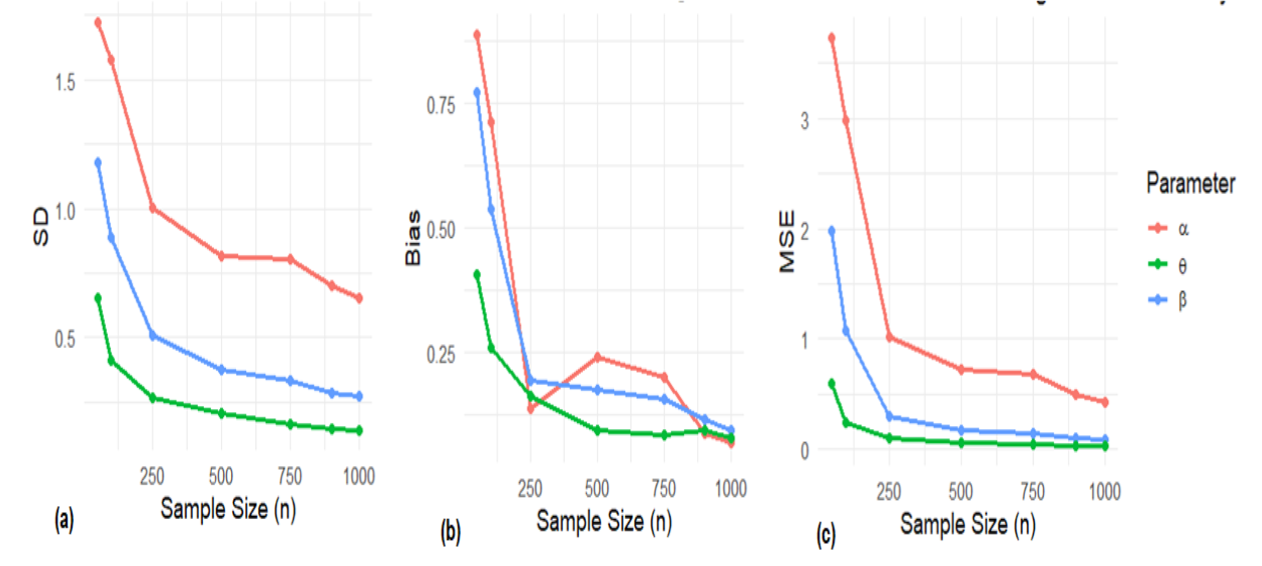
The Lindley distribution has been widely applied in reliability and survival analysis; however, its limited flexibility often restricts its ability to adequately model complex lifetime data. To address this limitation, this study introduces a new three-parameter lifetime model, termed the Weighted Sanni–Lindley Distribution (WSLD), obtained by incorporating a weighting mechanism into the recently proposed Sanni distribution framework. The additional parameter enhances the model's flexibility and enables it to accommodate a broader range of distributional shapes and failure-rate behaviours encountered in reliability studies. Fundamental statistical properties of the proposed distribution are derived, including its probability density function, cumulative distribution function, moments, survival function, hazard rate function, Rényi entropy, and order statistics. Parameter estimation is carried out using the method of maximum likelihood, and the corresponding Fisher information matrix is established to facilitate statistical inference and confidence interval construction. Furthermore, a comprehensive Monte Carlo simulation study is conducted to evaluate the finite-sample performance of the maximum likelihood estimators in terms of bias, mean squared error, and standard deviation. The practical applicability of the model is demonstrated using two real-life datasets involving aircraft windshield failures and glass fibre strengths. Comparative analyses based on log-likelihood, AIC, AICc, and BIC reveal that the proposed WSLD consistently provides a superior fit relative to competing lifetime distributions, thereby offering a robust and flexible framework for reliability and survival data modelling.
References
Aderoju. (2021). Samade probability distribution: its properties and application to real lifetime data. Asian Journal of Probability and Statistics, 14(1), 1–11.
Aderoju, & Adeniyi, I. (2022). On power generalized akash distribution with properties and applications. Journal of Statistical Modeling and Analytics (JOSMA), 4(1).
Aderoju, & Babaniyi, O. (2023). Power samade distribution: its properties and application to real lifetime data.
Ahmad, Ahmad, S., & Ahmed, A. (2016). Length-biased weighted lomax distribution: statistical properties and application. Pakistan Journal of Statistics and Operation Research, 245–255.
Akaike, H. (1973). Maximum likelihood identification of gaussian autoregressive moving average models. Biometrika, 60(2), 255–265.
Aldeni, M., Famoye, F., & Lee, C. (2019). A generalized family of lifetime distributions and survival models. Journal of Modern Applied Statistical Methods, 18.
Anderson, T. W., & Darling, D. A. (1952). Asymptotic theory of certain goodness-of-fit criteria based on stochastic processes. The Annals of Mathematical Statistics, 23(2), 193-212.
Anderson, T. W., & Darling, D. A. (1954). A test of goodness of fit. Journal of the American Statistical Association, 49(268), 765-769. https://doi.org/10.1080/01621459.1954.10501232
Arai, Y., Yamashidta, T., Suzuki, T., & Ohishi, Y. (2009). Upconversion properties of tb3+–yb3+ codoped fluorophosphate glasses. Journal of Applied Physics, 105(8).
Bashiru, S. O., Isa, A. M., Ali, I., Arum, K. C., Oranye, H. E., Ugah, T. E., & Okoacha, N. G. (2025). Unit probability distributions: A comprehensive review of models, properties, and applications. FUDMA JOURNAL OF SCIENCES, 9(7), 126-132.
Bemmaor, A. C., & Glady, N. (2012). Modeling purchasing behavior with sudden “death”: A flexible customer lifetime model. Management Science, 58(5), 1012–1021.
Benchiha, S., Al-Omari, A. I., Alotaibi, N., & Shrahili, M. (2021). Weighted generalized quasi lindley distribution: Different methods of estimation, applications for covid-19 and engineering data. AIMS Math, 6, 11850–11878.
Cramér, H. (1928). On the composition of elementary errors. Scandinavian Actuarial Journal, 1928(1), 13-74. https://doi.org/10.1080/03461238.1928.10416862
Das, K. K., & Roy, T. D. (2011a). Applicability of length biased weighted generalized rayleigh distribution. Advances in Applied Science Research, 2(4), 320–327.
Das, K. K., & Roy, T. D. (2011b). On some length-biased weighted weibull distribution. Advances in Applied Science Research, 2(5), 465–475.
Ghitany, Alqallaf, F., Al-Mutairi, D., & Husain, H. (2011). A two-parameter weighted lindley distribution and its applications to survival data. Mathematics and Computers in Simulation, 81(6), 1190–1201.
Hurvich, C. M., & Tsai, C.-L. (1989). Regression and time series model selection in small samples. Biometrika, 76(2), 297–307.
Joshi, R. K., & Kumar, V. (2020). Lindley-chen distribution with applications. International Journals of Engineering, Science & Mathematics (IJESM), 9(10), 12–22.
Kalu, U., Aderoju, S. A., Sanni, B. I., Yussuf, T. A., Adeshola, A. D., & Kunle, S. A. (2026). A Hybrid Exponential-Generalized Gamma Distribution With Mean Bases Mixing Proportion: Theory And Applications. Fudma Journal Of Sciences, 10(4), 139-147. https://doi.org/10.33003/fjs-2026-1004-4691
Kleinbaum, D. G., & Klein, M. (1996). Survival analysis a self-learning text. Springer.
Kolmogorov, A. N. (1933). Sulla determinazione empirica di una legge di distribuzione. Giornale dell'Istituto Italiano degli Attuari, 4, 83-91.
Lai. (2013). Constructions and applications of lifetime distributions. Applied Stochastic Models in Business and Industry, 29(2), 127–140.
Lai, & Xie, M. (2006). Bathtub shaped failure rate life distributions. Stochastic ageing and dependence for reliability, 71–107.
Lindley, D. V. (1958). Fiducial distributions and bayes’ theorem. Journal of the Royal Statistical Society. Series B (Methodological), 102–107.
Liu, S., & Shi, L. (2025). Book review: Statistical outliers and related topics. Taylor & Francis.
Murthy, D. P., Xie, M., & Jiang, R. (2004). Weibull models. John Wiley & Sons.
Nanuwong, N., Bodhisuwan, W., & Pudprommarat, C. (2015). A new mixture pareto distribution and its application. Thailand Statistician, 13(2), 191–207.
Ogunwale, O., Adewusi, O., & Ayeni, T. (2019). Exponential-gamma distribution. International Journal of Emerging Technology and Advanced Engineering, 9(10), 245–249.
Pham, H. (2006). Handbook of reliability engineering. Springer Science & Business Media.
R Core Team. (2025). R: A language and environment for statistical computing [Computer software manual]. Vienna, Austria. Retrieved from https://www.R-project.org/
Ramos, & Louzada, F. (2016). The generalized weighted lindley distribution: Properties, estimation, and applications. Cogent Mathematics, 3(1), 1256022.
Ramos, M., Marinho, P. R. D., da Silva, R. V., & Cordeiro, G. M. (2013). The exponentiated lomax poisson distribution with an application to lifetime data. Advances and Applications in Statistics, 34(2), 107.
Rather, & Ozel, G. (2020). The weighted power lindley distribution with applications on the life time data. Pakistan Journal of Statistics and operation research, 16(2).
Rényi, A. (1961). On measures of entropy and information. In Proceedings of the fourth berkeley symposium on mathematical statistics and probability, volume 1: Contributions to the theory of statistics (Vol. 4, pp. 547–562).
Salau, G. M., Sanni, B. I., Aderoju, S. A., et al. (2025). The new extended exponential gamma (neeg) distribution: properties and applications to infectious disease modelling. Journal of Basics and Applied Sciences Research, 3(4), 225–235.
Sanni, B. I., Aderoju, S. A., Lamidi, R. K., Adeshola, A. D., Jimoh, A. K., & Adeniyi, E. J. (2025). The new two-parameter exponential-gamma-based distribution: Properties and application to non-communicable disease data. Journal of Science and Technology, 12. https://doi.org/10.20428/jst.v30i12.3314
Schwarz, G. (1978). Estimating the dimension of a model. The annals of statistics, 461–464.
Shanker, R., & Mishra, A. (2013). A quasi lindley distribution. African Journal of Mathematics and Computer Science Research, 6(4), 64–71.
Shanker, R., Sharma, S., & Shanker, R. (2013). A two-parameter lindley distribution for modeling waiting and survival times data.
Shanker, R., Shukla, K. K., Shanker, R., & Leonida, T. A. (2017). A three-parameter lindley distribution. American Journal of Mathematics and Statistics, 7(1), 15–26.
Smirnov, N. V. (1948). Table for estimating the goodness of fit of empirical distributions. The Annals of Mathematical Statistics, 19(2), 279-281. https://doi.org/10.1214/aoms/1177730256
Smith, R. H., & Naylor, J. (1987). A comparison of maximum likelihood and Bayesian estimators for the three-parameter weibull distribution. Journal of the Royal Statistical Society Series C: Applied Statistics, 36 (3), 358–369 Zaindin, M., & Sarhan, A. M. (2009). Parameters estimation of the modified weibull distribution. Applied Mathematical Sciences, 3(11), 541–550.
Von Mises, R. (1931). Wahrscheinlichkeitsrechnung und ihre Anwendung in der Statistik und theoretischen Physik. Vienna, Austria: Deuticke.
Zaindin, M., & Sarhan, A. M. (2009). Parameters estimation of the modified weibull distribution. Applied Mathematical Sciences, 3(11), 541–550.
Downloads
Published
Issue
Section
Categories
License
Copyright (c) 2026 Bello Ishola Sanni, Samuel Adewale Aderoju, Adediran Dauda Adeshola, Oyeniyi Esther Olabamiji, Uchechukwu Kalu

This work is licensed under a Creative Commons Attribution 4.0 International License.


