
Qualitative and Quantitative Phytochemical Screening of Ethanolic Leaf Extracts of Jatropha Tanjorensis Ellis & Saroja and Leptadenia Hastata (Pers.) Decne
DOI:
https://doi.org/10.33003/fjs-2026-1010-5441Keywords:
Jatropha Tanjorensis, Leptadenia Hastata, Phytochemical Screening, Ethanolic Leaf Extract, Medicinal PlantsAbstract
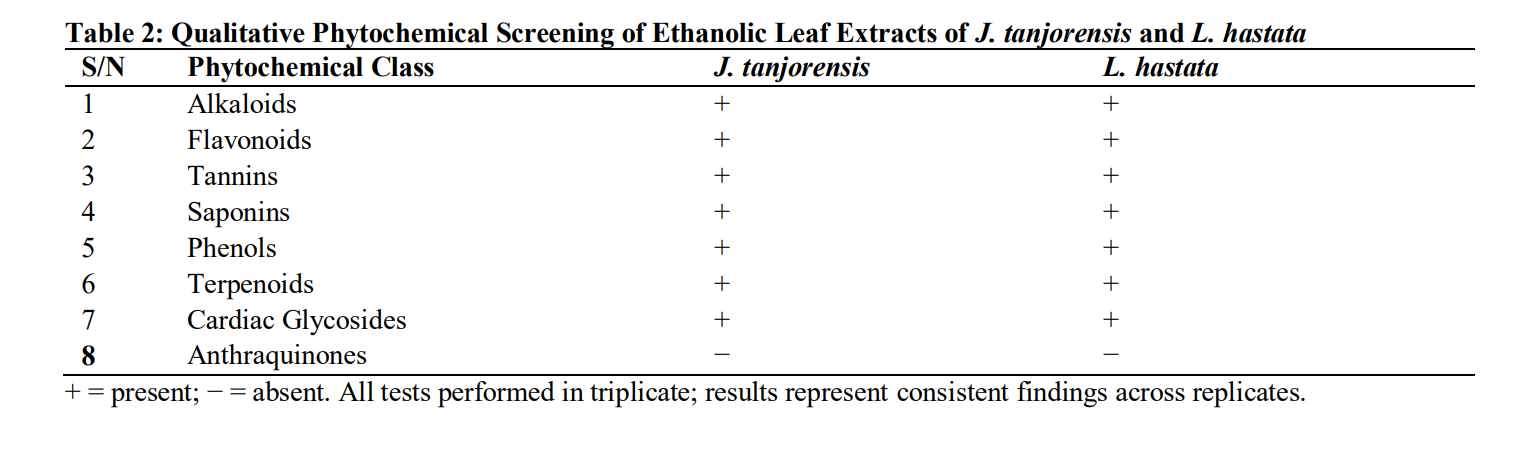
The phytochemical composition of a plant extract provides the mechanistic basis for its pharmacological activity. This study screened the qualitative and quantitative phytochemical constituents of ethanolic leaf extracts of J. tanjorensis (JT), L. hastata (LH). The sample was collected, identify and authenticated at the department of Biological Sciences, Nigerian Defence Academy Kaduna. Shade-dried, powdered leaves of both plants were macerated separately in 70% ethanol for 72 hours. Qualitative screening for alkaloids, flavonoids, tannins, saponins, phenols, terpenoids, cardiac glycosides and anthraquinones was performed using standard colorimetric and precipitation methods. Total phenolic, flavonoid, alkaloid, tannin and saponin contents were quantified spectrophotometrically and gravimetrically in triplicate. Extraction yields were 9.32% (JT), 10.59% (LH) and 9.93% (combination). Both extracts tested positive for alkaloids, flavonoids, tannins, saponins, phenols, terpenoids and cardiac glycosides, were all present, while anthraquinones was absent from both extracts. Quantitatively, JT contained significantly higher total phenolics (24.18 ± 0.71mg GAE/g), flavonoids (12.76 ± 0.43mg QE/g), alkaloids (18.24 ± 0.62mg/g) and tannins (8.34 ± 0.28mg TAE/g), whereas LH contained markedly higher total saponins (9.12 ± 0.31mg/g; 2.18-fold higher than JT). Jatropha tanjorensis and Leptadenia hastata possess overlapping but quantitatively distinct phytochemical profiles, with JT favouring phenolic-rich constituents and LH favouring saponin-rich constituents.
References
Belcher, J. D., Chen, C., Nguyen, J., Milbauer, L., Abdulla, F., Alayash, A. I., Smith, A., Nath, K. A., Hebbel, R. P., & Vercellotti, G. M. (2014). Heme triggers TLR4 signaling leading to endothelial cell activation and vascular occlusion in murine sickle cell disease. Blood, 123(3), 377–390. https://doi.org/10.1182/blood-2013-04-495887
Diallo, A., Eklu-Gadegbeku, K., Mobio, T., Moukha, S., Tfun-Bah, A., Creppy, E. E., & Agbonon, A. (2012). Protective effect of Leptadenia hastata (Pers.) Decne. stem bark ethanol extract against genotoxicity and oxidative stress. Journal of Pharmacology and Toxicology, 7(3), 135–142.
Guo, X., Li, T., Tang, K., & Liu, R. H. (2020). Effect of saponins on the bioavailability of iron. Journal of Agricultural and Food Chemistry, 68(18), 5079–5086. https://doi.org/10.1021/acs.jafc.0c00476
Hagerman, A. E., Riedl, K. M., Jones, G. A., Sovik, K. N., Ritchard, N. T., Hartzfeld, P. W., & Riechel, T. L. (2000). High molecular weight plant polyphenolics (tannins) as biological antioxidants. Journal of Agricultural and Food Chemistry, 46(5), 1887–1892.
Harborne, J. B. (1992). Phytochemical methods: A guide to modern techniques of plant analysis (2nd ed.). Chapman and Hall.
Ibrahim, H. I., Bello, M., Hassan, S., & Mamman, M. (2019). Phytochemical and pharmacological properties of Leptadenia hastata: A review. Journal of Advances in Medical and Pharmaceutical Sciences, 21(3), 1–12.
Iwu, M. M. (2014). Handbook of African medicinal plants (2nd ed.). CRC Press.
Kumaran, A., & Karunakaran, R. J. (2006). Antioxidant activities of the methanol extract of Cardiospermum halicacabum. Pharmaceutical Biology, 44(8), 655–660.
Nafiu, M. O., Akanji, M. A., & Yakubu, M. T. (2017). Phytochemical constituents of aqueous extract of Leptadenia hastata leaves and effects on some haematological indices in anaemic rats. African Journal of Pharmacy and Pharmacology, 11(6), 93–103.
National Population Commission (NPC) & ICF. (2019). Nigeria demographic and health survey 2018. NPC and ICF.
Nwaoguikpe, R. N., Ujowundu, C. O., & Igwe, C. U. (2011). The haematinic effects of ethanolic extract of Jatropha tanjorensis leaf in phenyLHydrazine-induced anaemic rats. International Journal of Biological and Chemical Sciences, 5(6), 2348–2357.
Nworu, C. S., Akah, P. A., Okoye, F. B. C., Toukam, D. K., Udeh, J., & Esimone, C. O. (2012). The leaf extract of Jatropha tanjorensis exhibits immunostimulatory and anti-anaemic activities in animal models. Journal of Immunotoxicology, 9(4), 426–434.
Obadoni, B. O., & Ochuko, P. O. (2001). Phytochemical studies and comparative efficacy of the crude extracts of some haemostatic plants in Edo and Delta States of Nigeria. Global Journal of Pure and Applied Sciences, 8(2), 203–208.
Okon, J. E., Udoh, E. P., & Nwachukwu, N. C. (2019). Haematopoietic activity of ethanolic extract of Jatropha tanjorensis in anaemic Wistar rats. Journal of Medicinal Plants Research, 13(11), 248–255.
Okonkwo, K. C., Effiong, G. S., & Udosen, E. D. (2014). Phytochemical and biochemical evaluation of Jatropha tanjorensis leaves. Academic Research International, 5(4), 226–230.
Oyewole, O. I., & Owoyele, B. V. (2014). In vivo anti-anaemic activities of Jatropha tanjorensis aqueous leaf extract in Wistar rats. Nigerian Journal of Physiological Sciences, 29(2), 141–146.
Sahabi, S. M., Shehu, A., Muhammad, A., Muhammed, A. S., & Lawal, N. (2018). Haematinic effect of a polyherbal formulation containing Leptadenia hastata on Wistar rats. Bayero Journal of Pure and Applied Sciences, 11(1), 254–259.
Smith, J. E. (1990). Erythrocyte membrane: Structure, function, and pathophysiology. Veterinary Pathology, 24(6), 471–476.
Tanaka, M., Kishimoto, Y., Sasaki, M., Sato, A., Kamiya, T., Kondo, K., & Iida, K. (2009). Quercetin ameliorates oxidative stress in erythrocytes and renal cortex of rats fed a high-fructose diet. Food Chemistry, 125(2), 472–477.
Tolkien, Z., Stecher, L., Mander, A. P., Pereira, D. I. A., & Powell, J. J. (2015). Ferrous sulfate supplementation causes significant gastrointestinal side-effects in adults: A systematic review and meta-analysis. PLOS ONE, 10(2), e0117383.
https://doi.org/10.1371/journal.pone.0117383
Trease, G. E., & Evans, W. C. (2002). Pharmacognosy (15th ed.). WB Saunders.
Umar, H. Y., Garba, S. H., Elsa, T. C., Malgwi, I. S., & Garba, M. (2021). Haematopoietic effect of ethanolic leaf extract of Leptadenia hastata on sodium nitrite-induced anaemia model in Wistar rats. Nigerian Journal of Biochemistry and Molecular Biology, 36(2), 40–49.
Van-Burden, T. P., & Robinson, W. C. (1981). Formation of complexes between protein and tannic acid. Journal of Agricultural and Food Chemistry, 29(1), 77–80.
Verma, S., & Mishra, S. N. (2010). Saponin-assisted delivery of quercetin: A model for lipid-based phytosome bioavailability enhancement. Drug Development and Industrial Pharmacy, 36(3), 303–311.
World Health Organization. (2021). Anaemia. https://www.who.int/news-room/fact-
sheets/detail/anaemia
Downloads
Published
Issue
Section
Categories
License
Copyright (c) 2026 Hannah Oha Aboh, Victoria Dan, Gabriel Ajibade, George Onwumere, Eucharia Ngozi Ozioko

This work is licensed under a Creative Commons Attribution 4.0 International License.


