
Identification of Dominant Geo-Helminths in High Area of Anthropogenic Activities in Mubi North Local Govetment Area of Adamawa State
DOI:
https://doi.org/10.33003/fjs-2026-1009-5435Keywords:
Soil, Geohelminths, Parasites, Physiochemical, Raining and Dry SeasonAbstract
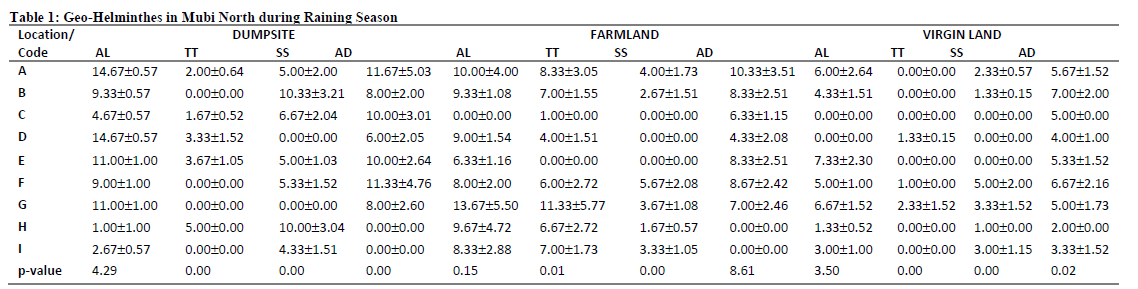
Several factors responsible for the survival of geohelminths parasite such as temperature, soil quality, pH and rainfall as well as organic matter etc. geo-helminthes such as tape warm, rounds, earths and hook worms etc. are parasites that thrives well in environment with poor sanitation. The samples used were obtained in dumpsite, farmland and virgin land during training and dry season. The samples were identification for geohelminths and physicochemical properties were analyzed. Results obtained shows that Ascaris lumbricoides (AL), Trichuris trichura (TT), Strongyloides stercoralis (SS) and Ancyclostoma duodenale were present during raining seasons with a mean score value of AL (1.00 – 14.67), TT (0.00 – 5.00), SS (0.00 – 6.67) and AD (0.00 – 11.67). The results of physicochemical properties of soil samples analyzed in raining and dry seasons in dumpsite, farmland and virgin land across Mubi North during raining season revealed that there were significant difference at (P< 0.05 %) level among the samples in terms of temperature, pH, E.C and O.M across the three locations where 9 samples were analyzed with mean value ranged from temperature, (35.10 – 35.90 oC) in dumpsite, (35.10 – 36.10 oC) in farmland and (35.10 – 36.80 oC) respectively.
References
Aminu, A. H. (2024). Physicochemical properties of soil and characterization of PGPR from legume fields in Kaduna, Nigeria. Science World Journal. Vol. 7(3): 84-96
Assefa, A., Dejenie, T., and Tomass, Z. (2013). Prevalence of intestinal helminth infections and associated risk factors among school children in Ethiopia. Journal of Parasitology and Vector Biology, 5(10), 130–134.
Assefa, A., T. Dejenie and Z. Tomass, (2013). Infection prevalence of Schistosoma mansoni and associated risk factors among school children in suburbs of Mekelle city, Tigray, Northern Ethiopia. Mek Univ., 5(1): 174-188.
Bethony, J., S. Brooker, M. Albonico, S.M. Geiger, D.O., Ogbolu, O.A. Alli, A.O. Amoo, I.I. Olaosun, A. Loukas, D. Diemert and P.J. Hotez, (2006). Soil- G.W. Ilozavbie and F.F. Olusoga-Ogbolu, 2011. Transmitted helminth infections: ascariasis, High-level parasitic contamination of soil sampled in trichuriasis and hookworm. Lancet, 367: 1521-1532.
Blaszkowska, J., A. Wojcik, P. Kurnatowski and K. Szwabe, (2013). Geohelminth egg contamination of children’s plays areas in the city of Lodz (Poland). Veterinary Parasitology, 192(1-2): 228-233.
Błaszkowska, J., Kurnatowski, P., and Damiecka, P. (2013). Contamination of soil with parasite eggs in recreational areas. Annals of Agricultural and Environmental Medicine, 20(2), 267–272.
Bojar, H. and T. Káapeü, (2012). Contamination of soil with eggs of geohelminth in recreational areas in the Lublin region of Poland. Annals of Agricultural Environmental Medicine, 19(2): 267-270.
Bojar, H., and Kłapeć, T. (2012). Contamination of soil with eggs of geohelminths in recreational areas in Poland. Annals of Agricultural and Environmental Medicine, 19(2), 267–270.
Bowman, D.D., S.P. Montgomery, A.M. Zajac, M.L. Eberhard and K.R. Kazacos, (2010). Potential toxo-cariasis transmission risk using Hookworms Geographical Information Systems. Acta of dogs and cats as agents of cutaneous larva Parasitological diseases, 58(3): 328-333.
Chukwu, C. O. C., Nwoke, B. E. B., and Ukaga, C. N. (2009). Prevalence of soil-transmitted helminths in Nigeria. Nigerian Journal of Parasitology, 30(1), 15–19.
Chukwuma, M.C., I.M. Ekejindu, N.R. Agbakoba, D.A. Ezeagwuna, I.C. Anaghalu and D.C. Nwosu., (2009). The Prevalence and Risk Factors of Geohelminth Infections among Primary School Children in Ebenebe Town, Anambra State, Nigeria. Middle-East J. Sci. Res., 4(3): 211-215.
Fikresilasie Samuel, (2015). Status of Soil-Transmitted Helminths Infection in Ethiopia. American Journal of Health Research, 3(3): 170-176.
Fikresilasie, S. (2015). Prevalence of intestinal parasitic infections and associated risk factors among school children in Ethiopia. International Journal of Public Health Science, 4(2), 78–84.
Idris, A. M., Owuna, J. E., Obikezie, S. O., and Owuna, U. (2025). Environmental impact assessment of microbiological and physicochemical quality of soil and water during dry season in Udege mining area, Nasarawa State, Nigeria. IJRIAS.
Ishaya Haruna Nock, D Duniya and M. Galadima, (2007). Geohelminth eggs in the soil and stool of pupils of some primary schools in Samaru, Zaria, Nigeria. Nigerian Journal of Parasitology, 24(1).
Marchioro, A. A., Colli, C. M., Mattia, S., Paludo, M. L., Melo, G. C., Adami, C. M., and Nishi, L. (2013). Parasites in soil and sand from recreational areas in Brazil. Revista do Instituto de Medicina Tropical de São Paulo, 55(6), 377–381.
Nock, I. H., Duniya, D., and Galadima, M. (2007). Geohelminth infections among school children in Northern Nigeria. Journal of Helminthology, 81(2), 123–126.
Nwoke, B. E. B. (2013). Public health parasitology and control of parasitic diseases. Owerri: Springfield Publishers.
Nwoke, E., 2013. Examination of soil samples for the incidence of geohelminth parasites in Ebonyi north central area of Ebonyi State, south-east of Nigeria. Archives of Applied Science Research, 5(6): 41-48.
Ojha, S. C., Jaide, C., Jinawath, N., Rotjanapan, P., and Baral, P. (2014). Geohelminths: Public health significance. Journal of Infection in Developing Countries, 8(1), 5–16.
Oyun, M. B., Adeyemo, A. J., Fasinmirin, J. T., and Jayeoba, O. J. (2025). Evaluation of selected soil physicochemical properties for integrated soil fertility management in Nigeria. Discover Applied Sciences.
Rudohradska, P.Ingrid Papajova and Peter Juris, (2011). Petsas a source of parasitic soil contamination in the settlements of marginalised groups of inhabitants. Folia Veterinaria, 55: 33-35.
Tavalla, M., Oormazdi, H., Akhlaghi, L., Razmjou, E., and Shojaee, S. (2000). Prevalence of parasitic contamination in soil samples. Iranian Journal of Public Health, 29(3–4), 1–6.
Tchakounté BN, Nkouayep VR, Poné JW (2018) Soil contamination rate, prevalence, intensity of infection of geohelminths and associated risk factors among residents in Bazou (West Cameroon). Ethiop J Health Sci 28(1):63–72
Tchakounte, F. T., Ndzi, E. S., and Nkouayep, V. R. (2018). Soil-transmitted helminth infections and associated risk factors in Cameroon. BMC Public Health, 18, 1–9.
Traversa, D. (2012). Pet roundworms and hookworms: A continuing need for global control. Parasites and Vectors, 5, 91.
Traversa, D., (2012). Pet roundworms and hookworms: a continuing need for global worming. Parasite Vectors, 5: 91.
Ukabiala, M. E. (2021). Physicochemical properties as related to mineralogical composition of floodplain soils. Environmental Monitoring and Assessment.
WHO, 2006. World Health Organization and partners unveil new coordinated approach to treat millions suffering from neglected tropical disease.
Downloads
Published
Issue
Section
Categories
License
Copyright (c) 2026 Muhammad M. Adam, Gadzama M. Ibrahim, Wakawa A. Dawi, Esther Okoye, Abubakar Kabiru, Amira Hamman

This work is licensed under a Creative Commons Attribution 4.0 International License.


