
Comparative in Vitro Antifungal Activity of Azadirachta Indica A. Juss. And Anacardium Occidentale L. Leaf Extracts Against Fungal Pathogens of Amaranthus Hybridus
DOI:
https://doi.org/10.33003/fjs-2026-10(ANB-K)-5421Keywords:
Azadirachta indica, Anacardium occidentale, Antifungal activity, Biofungicides, Amaranthus hybridus, Poisoned food techniqueAbstract
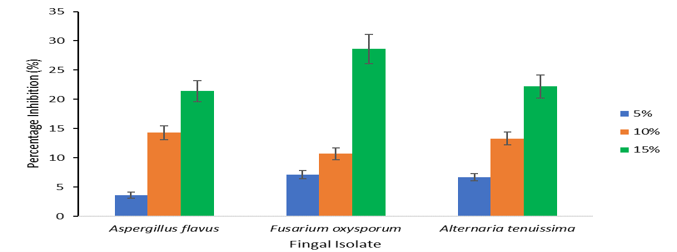
Fungal pathogens significantly affect the cultivation of Amaranthus hybridus, leading to reduced yield and quality. Environmental and health concerns associated with synthetic fungicides have increased interest in plant-based biofungicides as safer alternatives. This study evaluated the antifungal activity of aqueous leaf extracts of Azadirachta indica and Anacardium occidentale against Fusarium oxysporum, Alternaria tenuissima, and Aspergillus flavus. To obtain the extracts, 100 g of dried leaf powder was macerated in 1000 mL of distilled water. Antifungal activity was assessed using the poisoned food technique at 5%, 10%, and 15%. All treatments were replicated three times. The triplicates were analyzed by one-way analysis of variance (ANOVA), followed by Tukey’s post hoc test at p ≤ 0.05. Azadirachta indica demonstrated a clear but moderate concentration-dependent antifungal activity with all tested fungi. The highest inhibition was shown against Fusarium oxysporum (28.6 ± 2.5% at 15% concentration). Anacardium occidentale showed mild antifungal activity, with Alternaria tenuissima showing no observable inhibition at the tested concentrations. These findings indicate that A. indica demonstrates moderate but considerable antifungal potential for managing fungal diseases of Amaranthus hybridus. Further in vivo studies are recommended to validate field efficacy.
References
Akinyemi, O. A., Olayemi, A. B., and Ojo, A. O. (2023). Evaluation of some bioactive compounds of Azadirachta indica and their antifungal activities against plant pathogenic fungi. International Journal of Engineering, Science and Technology, 15(2), 45–58.
Attah, F., Alia, A., and Hammed, A. (2021). Phytochemical profiling and antifungal activity of Anacardium occidentale leaf and nut shell extracts. Journal of Medicinal Plants Research, 15(3), 112–121.
Ayaz, M., Li, C.-H., Ali, Q., Zhao, W., Chi, Y.-K., Shafiq, M., Ali, F., Yu, X.-Y., Yu, Q., Zhao, J.-T., Yu, J.-W., Qi, R.-D., and Huang, W.-K. (2023). bacterial and fungal biocontrol agents for plant disease protection: Journey from lab to field, current status, challenges, and global perspectives. Molecules, 28(18), 6735.
Dutta, S., Sarkar, R., Saha, N., Suthar, M. K., Gawdiya, S., Roy Choudhury, M., Garai, S., Paul, D., and Das, S. (2024). Beyond nutrition: A two-decade systematic review of the ethnopharmacological potential and therapeutic promise of Amaranthus sp. Phytochemistry Reviews, 23, 1451–1489.
Edosa,, V. N., Law-Ogbomo, K. E., and Oyedeji, A. A. (2020). Vegetative growth and yield response of Amaranthus hybridus to mycorrhizal fungi (Glomus mosseae) inoculation, organic and micronutrient fertilizer application. African Journal of Agricultural Research, 15(6), 789–798.
Gong, Y., Zhang, H., and Li, W. (2024). Antifungal activity of Bacillus-derived lipopeptides against Fusarium species. Applied Microbiology and Biotechnology, 108(2), 345–358.
Grillo, A. J., Ukhureigbe, O. M., Egwari, L. O., Olasupo, N. A., and Adeniyi, A. B. (2026). Antifungal effects of Azadirachta indica and Ocimum gratissimum on dermatophytes. FUDMA Journal of Sciences, 10(5), 57–65.
Hu, Wu P., Chang, H. X., and Shen, Y. M. (2023). Effects of synthetic and environmentally friendly fungicides on powdery mildew management and the phyllosphere microbiome of cucumber. Frontiers in Plant Science, 14, 1165440.
Kumar, S., Kaushik, N., and Singh, R. (2021). Biofungicides: An eco-friendly approach for plant disease management. Journal of Plant Pathology, 103(3), 567–576.
Mepha, H. D., Eboh, L., and Banigbo, D. E. B. (2007). Effects of processing treatments on the nutritive composition and consumer acceptance of some Nigerian edible leafy vegetables. African Journal of Food, Agriculture, Nutrition and Development, 7(1), 1–18.
Ngatsi, P. Z., Dida, S. L. L., Tayo, P. M. T., and Tize, T. (2023). Phytochemical analysis and antifungal activity of Azadirachta indica seed extracts against Fusarium oxysporum. Journal of Plant Pathology Research, 12(3), 221–230.
Oke, O. L. (1983). Amaranth. In H. T. Chan (Ed.), Handbook of Tropical Foods (pp. 1–14). Marcel Dekker.
Parveen, M., and Khatun, S. (2022). Integrated disease management of root rot and stem decay disease in Amaranthus hybridus caused by Fusarium solani. Journal of Mycology and Plant Pathology, 52(3), 209–216.
Quejada, L. F., Hernández, A. X., Chitiva, L. C., Bravo-Chaucanes, C. P., Vargas-Cassanova, Y., Faria, R. X., Costa, G. M., and Parra-Giraldo, C. M. (2024). Unmasking the antifungal activity of Anacardium occidentale leaf extract against Candida albicans. Journal of Fungi, 10(7), 464.
Sharma, P., Meena, R. S., and Yadav, R. (2023). Botanical biofungicides: A sustainable tool for plant disease management. Environmental Sustainability, 6(1), 45–56.
Singh, A., Verma, J. P., and Jaiswal, D. K. (2022). Microbial biofungicides: Mechanisms and applications in agriculture. Biological Control, 174, 104897.
Sudan, P., Goswami, M., and Singh, J. (2020). Exploration of antifungal potential of Azadirachta indica against Microsporum gypseum. Biomedicine and Pharmacology Journal, 13(2), 987–994.
Wylie, M. R., and Merell, D. S. (2022). The antimicrobial potential of the neem tree (Azadirachta indica). Frontiers in Pharmacology, 13, 891535.
Zishan, M., Dhar, D. W., and Manzoor, U. (2024). In vitro anti-fungal potential of selected plant extracts against Fusarium oxysporum. Journal of Medicinal Plants Studies, 12(5), 26–27.
Downloads
Published
Issue
Section
Categories
License
Copyright (c) 2026 Tolulope S. Ewekeye, Damilola R. Adeyemi, Olanrewaju J. Oloyede, Moyosoreoluwa A. Akinyegun, Adewumi Fadiora, Oyedamola A. Oke

This work is licensed under a Creative Commons Attribution 4.0 International License.


