
Empirical Evaluation of a Blockchain-Enhanced Federated Learning and Trust-Aware Security Framework for IoT-Enabled Smart Agriculture
DOI:
https://doi.org/10.33003//fjs-2026-1010-5418Keywords:
IoT, smart agriculture, federated learning, blockchain, anomaly detectionAbstract
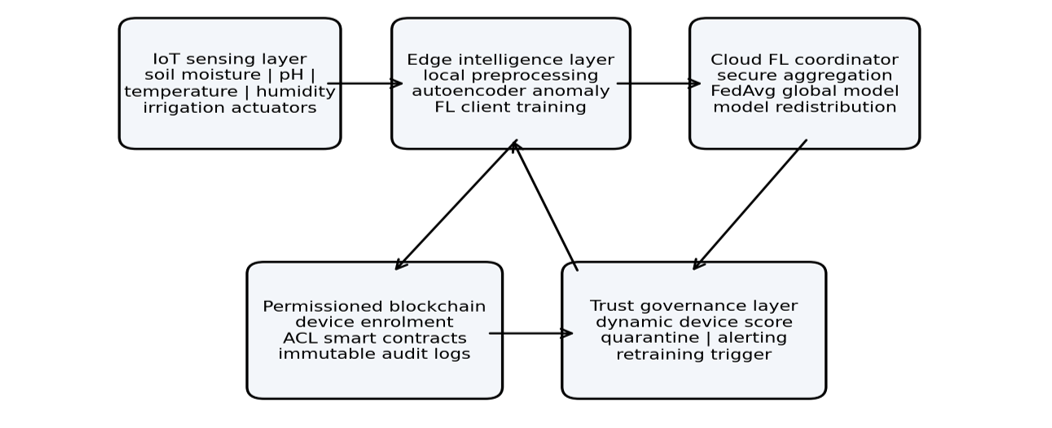
IoT-enabled smart agriculture is reshaping farm management through continuous sensing, remote monitoring, irrigation automation and data-supported decision-making. These benefits also expose farm cyber-physical systems to attacks that can falsify device identity, replay legitimate messages, inject abnormal packets, alter data streams, interrupt services and permit unauthorised access. This study develops and evaluates B-FedAgriIDS, a blockchain-enhanced federated anomaly-detection framework for securing smart-agriculture IoT environments. The framework places autoencoder-based anomaly detection at edge gateways, applies federated averaging to support collaborative learning without centralising raw farm data, and uses a permissioned blockchain to manage device identity, access verification, alert integrity and auditable logging. A comparative empirical design was used to assess a centralised autoencoder baseline, a federated-only autoencoder and the proposed blockchain-enhanced federated model. The proposed model achieved the strongest performance, with 97% detection accuracy and a 4% false alarm rate, compared with 89% accuracy and 12% false alarms for the centralised baseline and 94% accuracy and 8% false alarms for the federated-only model. Blockchain operations remained within an estimated 50-100 ms latency range, which is suitable for monitoring, authentication and alert-recording functions in farm networks. The findings show that combining privacy-preserving learning with permissioned ledger governance can strengthen detection, accountability and operational trust in distributed digital-agriculture systems.
References
Al Asif, M. R., Hasan, K. F., Islam, M. Z., & Khondoker, R. (2022). STRIDE-based cyber security threat modeling for IoT-enabled precision agriculture systems. arXiv. https://arxiv.org/abs/2201.09493
Albanbay, N., Tursynbek, Y., Graffi, K., Uskenbayeva, R., Kalpeyeva, Z., Abilkaiyr, Z., & Ayapov, Y. (2025). Federated learning-based intrusion detection in IoT networks: Performance evaluation and data scaling study. Journal of Sensor and Actuator Networks, 14(4), Article 78. https://doi.org/10.3390/jsan14040078
Barath, S., & Senthil, M. (2026). Federated transformer-blockchain framework for secure and generalized crop disease detection in smart agriculture. Journal of the Saudi Society of Agricultural Sciences, 25, Article 59. https://doi.org/10.1007/s44447-026-00153-9
Hasan, H. R., Musamih, A., Salah, K., Jayaraman, R., Omar, M., Arshad, J., & Boscovic, D. (2024). Smart agriculture assurance: IoT and blockchain for trusted sustainable produce. Computers and Electronics in Agriculture, 224, Article 109184. https://doi.org/10.1016/j.compag.2024.109184
Jaffar, A. Y. (2026). A federated blockchain framework for secure and intelligent smart farming in sustainable industrial agriculture. Scientific Reports. https://doi.org/10.1038/s41598-026-54453-9
Kairouz, P., McMahan, H. B., Avent, B., Bellet, A., Bennis, M., Bhagoji, A. N., Bonawitz, K., Charles, Z., Cormode, G., Cummings, R., D'Oliveira, R. G. L., Eichner, H., El Rouayheb, S., Evans, D., Gardner, J., Garrett, Z., Gascon, A., Ghazi, B., Gibbons, P. B., ... Zhao, S. (2021). Advances and open problems in federated learning. Foundations and Trends in Machine Learning, 14(1-2), 1-210. https://doi.org/10.1561/2200000083
Khraisat, A., Alazab, A., Alazab, M., Obeidat, A., Singh, S., & Jan, T. (2025). Federated learning for intrusion detection in IoT environments: A privacy-preserving strategy. Discover Internet of Things, 5, Article 72. https://doi.org/10.1007/s43926-025-00169-7
Manoj, T., Makkithaya, K., & Narendra, V. G. (2025). A blockchain-assisted trusted federated learning for smart agriculture. SN Computer Science, 6, Article 221. https://doi.org/10.1007/s42979-025-03672-4
McMahan, H. B., Moore, E., Ramage, D., Hampson, S., & Aguera y Arcas, B. (2017). Communication-efficient learning of deep networks from decentralized data. Proceedings of the 20th International Conference on Artificial Intelligence and Statistics, 1273-1282.
Rahmati, M., & Pagano, A. (2025). Federated learning-driven cybersecurity framework for IoT networks with privacy-preserving and real-time threat detection capabilities. Informatics, 12(3), Article 62. https://doi.org/10.3390/informatics12030062
Roman, R., Zhou, J., & Lopez, J. (2013). On the features and challenges of security and privacy in distributed Internet of Things. Computer Networks, 57(10), 2266-2279. https://doi.org/10.1016/j.comnet.2012.12.018
Sathyabama, A. R., & Katiravan, J. (2025). Enhancing anomaly detection and prevention in Internet of Things (IoT) using deep neural networks and blockchain based cyber security. Scientific Reports, 15, Article 22369. https://doi.org/10.1038/s41598-025-04164-4
Wankhede, S. B., & Patel, D. (2025). Federated learning and blockchain approach for securing IoT data. Discover Internet of Things, 5, Article 116. https://doi.org/10.1007/s43926-025-00234-1
Downloads
Published
Issue
Section
Categories
License
Copyright (c) 2026 Alabi Adewale Abayomi, Ojoawo Akinwale Olusola, Olagoke Babatunde Emmanuel, Ogundipe Olasunkanmi Olaogun, Fawole Taiwo Ganiyu, Adeleke Bolarinwa Samson, Jimoh Akeem Akande

This work is licensed under a Creative Commons Attribution 4.0 International License.


