
Modeling Flood Prediction Using Logistic Regression Enhanced with Machine Learning
DOI:
https://doi.org/10.33003/fjs-2026-1015-5390Keywords:
Flood Prediction, Predictive Modelling, Logistic Regression, Random Forest, Hybrid Models, Time-Series AnalysisAbstract
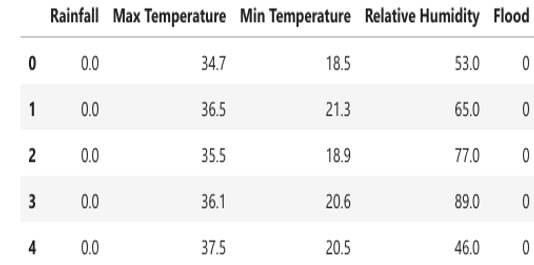
Flooding remains one of the most destructive natural disasters in Nigeria, particularly in Lokoja, Kogi State, due to its location at the confluence of the Niger and Benue rivers. This study develops a data-driven flood prediction model by integrating logistic regression with machine learning techniques to improve early warning systems. Meteorological data, including rainfall, temperature, and relative humidity, were obtained from the Nigerian Meteorological Agency. Data preprocessing, exploratory analysis, and feature engineering were conducted using Python. The dataset (120 records) was split into training (80%) and testing (20%) sets. The model was evaluated using accuracy, precision, recall, and F1-score. Results show high predictive performance with 98.3% accuracy, 100% precision, 90.9% recall, and 95.2% F1-score. The model was deployed as a web-based application using Streamlit for real-time predictions. The findings demonstrate that combining statistical modeling with machine learning improves flood prediction reliability and supports disaster management decision-making.
References
Fereshtehpour, M., Esmaeilzadeh, M., Alipour, R. S., & Burian, S. J. (2024). Impacts of DEM type and resolution on deep learning-based flood inundation mapping. Earth Science Informatics, 17(2). https://doi.org/10.1007/s12145-024-01239-0
Kumar, V., Kedam, N., Sharma, K. V., Mehta, D. J., & Caloiero, T. (2023). Advanced Machine Learning Techniques to Improve Hydrological Prediction: A Comparative Analysis of Streamflow Prediction Models. Water (Switzerland), 15(14). https://doi.org/10.3390/w15142572
Li, W., Zhang, L., Chen, H., Wang, X., & Liu, M. (2023). Dynamic clustering and random forest techniques for flood classification in the Yellow River basin. Water Resources Research, 59(8), e2022WR033445.
Munawar, H. S., Hammad, A. W. A., & Waller, S. T. (2022). Remote Sensing Methods for Flood Prediction: A Review. In Sensors (Vol. 22, Issue 3). https://doi.org/10.3390/s22030960
Nwankwo, C., Ogbonna, C., & Echendu, A. (2022). Flood susceptibility prediction in Nigeria using artificial neural networks and logistic regression models. Environmental Monitoring and Assessment, 194, 531.
Nwankwo, C., Ogbonna, C., & Echendu, A. (2022). Flood susceptibility prediction in Nigeria using artificial neural networks and logistic regression models. Environmental Monitoring and Assessment, 194, 531.
Rahman, T., Asif Syeed, M. M., Farzana, M., Namir, I., Ishrar, I., Nushra, M. H., & Khan, B. M. (2023). Flood Prediction Using Ensemble Machine Learning Model. HORA 2023 - 2023 5th International Congress on Human-Computer Interaction, Optimization and Robotic Applications, Proceedings. https://doi.org/10.1109/HORA58378.2023.10156673
Smith, J., Brown, A., Wilson, M., Johnson, K., & Davis, L. (2021). A disaster prediction knowledge graph for multi-source information integration. International Journal of Disaster Risk Science, 12(3), 345-361.
Zhang, Y., Li, J., Wang, H., Chen, S., & Liu, X. (2023). Disaster classification framework using generative adversarial networks with deep convolutional neural networks. IEEE Transactions on Geoscience and Remote Sensing, 61, 1-15.
Zhao, Q., Wang, F., Liu, S., Zhou, M., & Zhang, J. (2023). Data Handling Model using Big Data Analytics (DHM-BDA) for agricultural disaster management. Computers and Electronics in Agriculture, 208, 107782.
Downloads
Published
Issue
Section
Categories
License
Copyright (c) 2026 Dolapo A. Shobanke, Happiness Olatunde, Emmanuel O. Ajare

This work is licensed under a Creative Commons Attribution 4.0 International License.