
Ecological Risk of Polychlorinated Biphenyls in Soil from Selected Residential Dumpsites in Delta State, Nigeria
DOI:
https://doi.org/10.33003/fjs-2026-1008-5387Keywords:
PCBs, soil, dumpsite, ecological riskAbstract
This study investigated the compositional patterns and ecological risks of polychlorinated biphenyls (PCBs) in soils from selected residential dumpsites in Delta State, Nigeria. Five soil samples were analyzed for 28 PCB congeners using gas chromatography–mass spectrometry (GC–MS) after Soxhlet extraction and clean-up with florisil and silica gel. The concentrations of ∑28 PCBs ranged from 6.88 to 21.25 ng/g, indicating contamination mainly associated with anthropogenic activities. The PCB profiles were dominated by penta-, tetra-, and hepta-chlorinated biphenyls, suggesting contributions from mixed waste sources such as domestic, industrial, electrical, and commercial materials. Ecological risk assessment based on Hakanson’s ecological risk index revealed varying degrees of environmental risk among the dumpsites. Dumpsite A showed low ecological risk, whereas dumpsites C and D exhibited considerable ecological risk levels. The toxic equivalency (TEQ) values of dioxin-like PCBs ranged from 0.007 to 0.104 ng TEQ/g and were below international guideline values, including the Threshold Effect Level (TEL), Probable Effect Level (PEL), and Effect Range Medium (ERM), indicating limited ecological effects. The study highlights the influence of poor waste management practices on PCB contamination and recommends regular monitoring, public awareness, and improved waste disposal measures to minimize environmental and psychological health in the affected communities
References
Abdus-Salam, N., Ibrahim, M.S & Fatoyinbo, F T. (2011) Dumpsite in Lokoja Nigeria, A silient pollution zone for underground water, Journal of environmental science 3 (2), 21-30.
Adetutu, I.A., Iwuoha G.N & Jnr, M H. (2020) Carcinogenicity of dioxin-like polychlorinatedbiphenyls in transformer soil in vicinity of University of Port Harcourt, Choba, Nigeria Chemistry International6(3),144-150.
Adeyi, A.A & Oyeleke P. (2017) Heavy metals and polycyclic aromatic hydrocarbons in soil from E-waste and dumpsite in lagos & Ibaban. Journal of health and pollution7 (15), 71-84
Aganbia, E., Iwegbue, C.M.A & Bice S.M. (2019) Concentrations and risks of polychlorinated biphenyls (PCBs) in transformer oils and the environment of a power plant in the Niger Delta, Nigeria Toxicology Reports6, 933–939.
Baqar, M., Sadef, Y., Ahamad, S.R., Mahmood, A., Qadir, A., Aslam, I., Li J & Zhang, G. (2017) Occurrence, ecological risk assessment, and spatio-temporal variation of polychlorinated biphenyls (PCBs) in water and sediments along River Ravi and its northern tributaries, Pakistan. Environmental Science Pollution Research24,27913-27930.
Dedela, S.A., Sheriff, I., Wu, Q., Hua, Q., Zhang Y & Dibaba, A.K. (2020) Occurrence, distribution of PCBs in urban soil and management of old transformers dumpsite in Addis Ababa, Ethiopia .Scientific African8,2468-2276.
Faroon, O., Jones, D., & DeRosa, C. (2000). Effects of polychlorinated biphenyls on the nervous system. Toxicology and Industrial Health 16(7-8), 305-333.
Fatunsin, O.T., Chukwu, C.N., Folarin, B.T & Olayinka, K.O. (2019) Polychlorinated Biphenyls (PCBs) in Soil Samples from Sites of Different Anthropogenic Activities in Lagos, Nigeria. FUDMA Records of Chemical Sciences1,(3).
Folarin, B.T., Oluseyi, T.O., Oyeyiola, A.O., Olayinka, K.O & Alo, B.I. (2018) Distribution of polychlorinated biphenyls in environmental samples from an electrical power station in Lagos, Nigeria Journal of Taibah university for science12(6), 852 857.
Gomez-gutierrez, A., Garnocho, E., Bayona, J.M & Albaiges, J., (2007) Screening ecological risk assessment of persistent organic pollutant in Mediterranean sea sediment. Environment international 33,867-876
Hakanson, L. (1980). An ecological risk index for aquatic pollution control. A sedimentological approach. Water research, 14, 975-1001.
Ibrahim, E.G., Gushit, J.S., Salami, S.J & Dalen, M.B (2018) Accumulation of Polychlorinated Biphenyls (PCBS) in Soil and Water from Electrical Transformers Installation Sites in Selected Locations in Jos Metropolis, Plateau State, Nigeria Journal of Environmental Analytical Toxicology8,2.
Igbo, J.K., Chukwu, L.O & Oyewo, E.O. (2018) Assessment of polychlorinated Biphenyl in water, sediment and Biota from E-waste dumpsite in Lagos and Osun State, South-West, Nigeria. Journal Applied Science environment management 22(4), 459 – 464.
Irerhievwie, G.O., Iwegbue, C.M.A., Laria. B.B., Tesi, G.O., Nwajeia, G.E & Martincighd B.S (2020) Spatial characteristics, sources, and ecological and human health risks of polychlorinated biphenyls in sediments from some river systems in the Niger Delta, Nigeria. Marine Pollution Bulletin160,111605
Iwegbue, C.M.A., Bebenimibo, E., Tesi, G.O., Egobueze, F.E & Martincigh, B.S (2020) spatial characteristics and risk assessment of polychlorinated biphenyls in surficial sediments around crude oil production facilities in the Escravos River Basin, Niger Delta, Nigeria. Marine pollution bulletin159,111462.
Jacobson, J.L. & Jacobson, S.W. (2003). Prenatal exposure to polychlorinated biphenyls and attention at school age. The Journal of Pediatrics,143(6), 780-788.
Kumar, B., Verma, V.K., Singh, S.K., Kumar, S., Sharma, C.S & Akolkar, A.B. (2014) Polychlorinated biphenyls in residential soils and their health risk and hazard in an industrial city in India, Journal of Public Health Research3,252.
Long, E., Macdonald, D., Smith, S & Calder, F (1995) Incidence of adverse biological effect within range of chemical concentration in marine and estuarine sediment environment management 19,81-97
Long, E.R & Morgan, L.G. (1990). The potential for biological effects of sediments-sorbed contaminants tested in the National Status and Trends Program, US Department of Commerce, Coastal and Eustuarine Assessment Branch. NOAA, Seattle. NOAA Technical Memoranum NOS OMA-52. pp 175.
MacDonald, D.D., Carr, R.S., Calder, F., Long, E.R & Ingersoll, C.G. (1996). Development and evaluation of sediment quality guidelines for Florida coastal waters Ecotoxicol 5,253-278.
Moeckel, C., Breivik, K., N¤st, T H., Sankoh, A., Jones, K.C & Sweetman, A. (2020) Soil pollution at a major West E-waste recycling site: contamination pathways and implications for potential mitigation strategies. Environment international137.
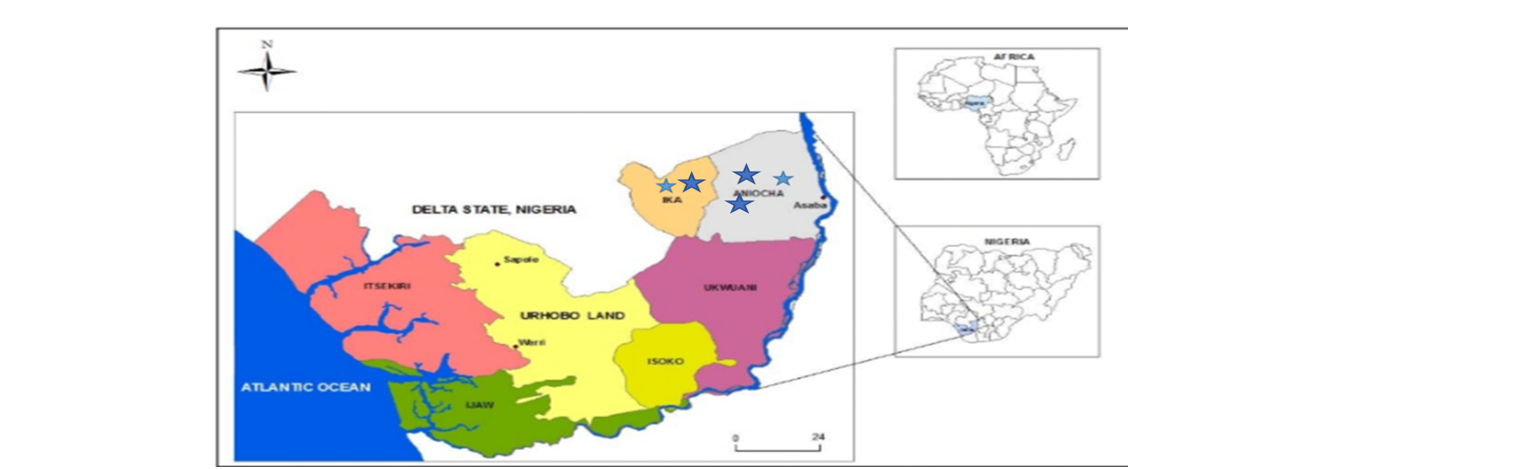
Odemerho, F (2008). A map of Delta State showing Urhoboland and other ethnic nationalities @ waado.org
OSPAR commission (2000) OSPAR commission for the protection of the marine environment of the northeast Atlantic, Quality status report 2000. OSPAR commission London pp54
Peper, M., Klett, M., & Morgenstern, R. (2005). Neuropsychological effects of chronic low-dose exposure to polychlorinated biphenyls (PCB’s): A cross-sectional study. Environmental Health, 4(1), 22.
Pesovski, I., Santos, R., Trajkovik, V., & Henriques, R. (2023). Comparing perception and reality: Exploring test complexity and student performance in higher education. In ICERI2023 Proceedings (pp. 6654-6660). IATED.
Pessah, I.N., Lein, P.J., Seegal, R.F., & Sagiv, S.K. (2019). Neurotoxicity of polychlorinated biphenyls and related organohalogens. Acta Neuropathologica, 138 (3), 363-387.
Schantz, S.L., Widholm, J.J. & Rice, D.C. (2003). Effects of PCB exposure on neuropsychological function in children. Environmental Health Perspectives, 111(3), 357.
Sohali, M., Akber, M.A.S., Equani, S., Podgorski, J., Bhowmik, K.A., Mahmood, A., Ali, N., Sabo-attwoo, T., Bokhari, H & Shen, H. (2017) persistent organic pollutant emission via dust deposition throughout pakistan: spatial patterns, regional cycling and their implication for human health risk in Science of the environment, Elsever1 – 9.
Stewart, P.W., Lonky, E., Reihman, J., Pagano, J. Gump, B.B. (2008). The relationship between prenatal PCB exposure and intelligence quotient (IQ) in 9-year-old children. Environmental Health Perspectives, 116(10), 14-16.
Sun, H., Qi, Y., Zhang, D., X,Q., Li d & Wang J. (2015) Concentrations, distribution, sources and risk assessment of organohalogenated contaminants in soils from Kenya, Eastern Africa. Environmental Pollution209, 177- 185.
Tesi, G.O., & Iniaghe, P.O. (2020).Polychlorinated biphenyls (PCBs) in canned sardines in Nigerian and health risk assessment. Food Addit & Cont - Part B, https://doi.org/10.1080/19393210.2020.1762758
UNEP (2009) Stockholm convention on persistent organic pollutant.http://www.state.govUNEP. Toward Elimination of PCB. Available online: https://www.unep.org/explore-topics/chemicals-waste/what-we-do/ persistent-organic-pollutants/toward-elimination-pcb?
Van den Berg, M., Linda, S B., Michael, D & Peterson, R E.(2006) The 2005 World Health Organization re-evaluation of human and mammalian toxic equivalency factors for dioxins and dioxin-like compounds. Toxicological Science 93:223-41.
Yadav, I.C., Devi, N.L., Li, J & Zhang, G (2017) Polychlorinated biphenyls in Nepalese surface soil;Spatial distribution, air-soil exchange and soil-air partitioning. Ecotoxicology environment safety 144, 498-506
Downloads
Published
Issue
Section
Categories
License
Copyright (c) 2026 Lawson Onojake, Ese Queen Umudi, Innocent Erhieyovwe Obukowho, Blessing Ese Nwakwanogo, Onyekachi Marcelus Odo, Chioma Anthonia Ugwu, Chukwuwuikem Nathanael Ehiedu

This work is licensed under a Creative Commons Attribution 4.0 International License.


