
Aquatic Macrophyte Diversity, Distribution and Community Structure Along River Ethiope, Delta State, Nigeria
DOI:
https://doi.org/10.33003/fjs-2026-1008-5367Keywords:
Aquatic macrophytes, biodiversity, diversity indices, Community structure, River Ethiope, spatial distribution.Abstract
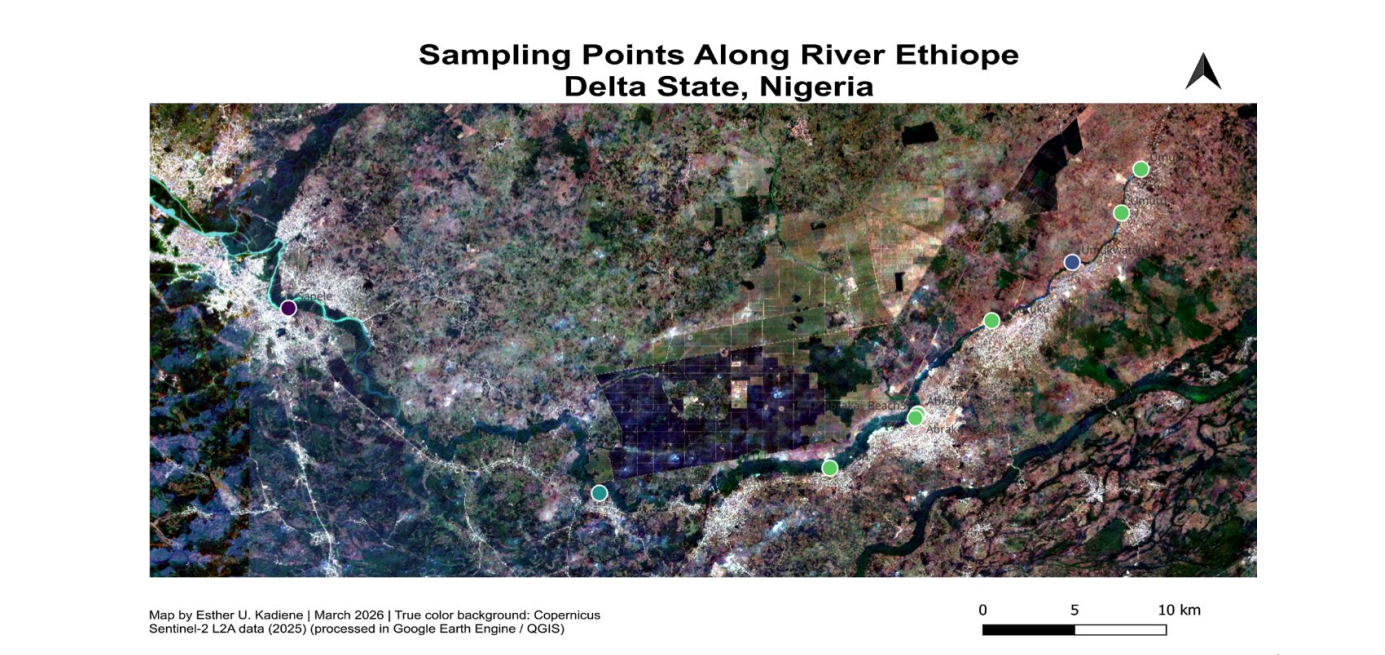
Aquatic macrophytes are important components of freshwater ecosystems, contributing to biodiversity conservation, habitat provision, nutrient cycling, and ecosystem functioning. This study assessed the diversity, distribution, and community structure of aquatic macrophytes along River Ethiope, Delta State, Nigeria. Ten sampling stations were surveyed using a 0.5 × 0.5 m quadrat, supplemented with snorkelling and free-diving observations to document submerged vegetation. Physicochemical parameters were measured in situ, aquatic macrophyte abundance was estimated using diversity indices. About 22 taxa were identified across the study area. The genus Nymphaea was the most represented group, while Nymphaea lotus (Maroon Morph) was the most widely distributed taxon, occurring at all sampling stations (100%). Species richness varied from 2 taxa at Sapele to 17 taxa at Oria. Shannon diversity (H’) ranged from 0.524 at Sapele to 2.595 at Oria, while Simpson diversity (1 − D) ranged from 0.340 to 0.938. Evenness values were generally high (0.755–1.000), indicating relatively balanced species distributions across most stations. Stations within the Abraka axis and Oria supported the highest diversity and vegetation cover, whereas Sapele exhibited reduced richness and diversity. Variations in macrophyte distribution and diversity appeared to correspond with differences in habitat characteristics, hydrological conditions, and levels of anthropogenic disturbance, including dredging, agriculture, waste disposal, and recreational activities. The findings demonstrate that River Ethiope supports a relatively diverse aquatic macrophyte community with considerable spatial variation in composition and distribution. This study provides baseline ecological information that will be useful for biodiversity conservation, ecosystem management and monitoring.
References
Ademola, B. T., Mahuta, S. I., Abdulkarim, B., & Argungu, L. A. (2022). Macrophytes abundance in relation to eutrophication status of peri-urban impoundments in Katsina Metropolis, Nigeria. Bayero Journal of Pure and Applied Sciences, 13(1), Special Conference Edition.
Aghoghovwia, O. A., & Obomunu, V. O. (2022). Diversity of aquatic macrophytes in selected river systems of the Niger Delta, Nigeria. Nigerian Journal of Ecology, 23(1), 13–21.
Agbogidi, O. M. (2014). The flora composition and diversity of Onah Lake, Delta State, Nigeria. International Journal of Ecology and Environmental Sciences, 40(3), 233–240.
Agbogidi, O. M., Ojoghoro, O. J., and Oji, O. P., (2017). Macrophytic vegetation and physico-chemical parameters of River Ethiope at Umutu, Delta State, Nigeria. Nigerian Journal of Water Resources, 3(2), 1–8.
Agbogidi, O. M. (2022). Survey of aquatic vegetation in selected ponds in Abraka, Delta State. Delta State Journal of Science, 10(2), 45–58.
Agbogidi, O. M., Nwabueze, A. A., Edema, E. N., Erhenhi, A. H., & Obi-Iyeke, E. G. (2022). Diversity and life forms of aquatic macrophytes in relation to physicochemical parameters of River Ethiope in Delta State, Nigeria. Annals of Plant Sciences, 11(4), 5040–5050.
Agbogidi, O. M., Nwabueze, A. A., Onochie, P. O., Ukre, R., & Stephen, O. F. (2019). Species diversity of macrophytes and physicochemical parameters of ponds of Abraka Inland, Delta State, Nigeria. European Journal of Botany.
Agbogidi, O. M., Odjegba, V. J., & Okoh, S. O. (2022). Spatial variation in aquatic vegetation along the Ethiope River. African Journal of Aquatic Ecology, 4(1), 56–67.
Agbogidi, O. M., & Ogbemudia, C. O. (2023). Performance of Pistia stratiotes (L.) as affected by water-soluble fractions of crude oil in Abraka, Delta State, Nigeria. Science World Journal, 18(4), 615–618.
Agori, E. A., Odjegba, V. J., & Okoh, S. O. (2024). Assessment of anthropogenic impact on water quality of the River Ethiope, Delta State, Nigeria. Nigerian Journal of Water Resources, 16(1), 75–90.
Akawo, N. O., Odita, G. N., Nwaiku, F., Azifuaku, J. N., & Igbeka, A. N. (2025). MULTIVARIATE ANALYSIS AND WATER QUALITY INDEX ASSESSMENT OF RIVER ADOFI, SOUTH-SOUTH NIGERIA. FUDMA JOURNAL OF SCIENCES, 9(9), 339-346.
Akinfolarin, O. M., Ossai, V. C., & Konne, J. L. (2025). Assessment of water quality along River Ethiope, Delta State. Journal of Modern Chemistry & Chemical Technology, 16(2).
Beckett, D. C., Aartila, A. C., & Miller, A. C. (1992). Invertebrate abundance of Potamogeton nodosus: Effects on plant surface area and condition. Canadian Journal of Zoology, 70, 300–306.
Barinova, S., Lozano, V. L., Afanasyev, S., Leite, T., Branco, P., Gomez Isaza, D. F., ... & Cianfanglione, K. (2024). Multi-Interacting Natural and Anthropogenic Stressors on Freshwater Ecosystems: Their Current Status and Future Prospects for 21st Century. Water, 16(11).
Chambers, P. A., Lacoul, P., Murphy, K. J., & Thomaz, S. M. (2008). Global diversity of aquatic macrophytes in freshwater. Hydrobiologia, 595(1), 9–26. https://doi.org/10.1007/s10750-007-9001-1
Daisi, O. M., Adeniyi, I. F., Ayeku, P. O., & Ogunmola, O. P. (2022). Aquatic macrophytes diversity and distribution: A case study of Ifewara Reservoir, Osun State, Nigeria. Nigerian Journal of Technological Research, 17(1).
Dienye, H. E., Olopade, O. A., & Ikwuemesi, J. C. (2017). Macrophytes in Niger Delta Inland Waters. International journal of Horticulture, Agriculture and Food science (IJHAF), 1(1).
Erhenhi, A. O. (2023). Assessment of the water quality index (WQI) of River Ethiope for drinking water purposes in southern Nigeria. International Journal of Innovative Science and Research Technology, 8(6), 3295–3300.
Havel, J. E., Kovalenko, K. E., Thomaz, S. M., Amalfitano, S., & Kats, L. B. (2015). Aquatic invasive species: Challenges for the future. Hydrobiologia, 750(1), 147–170. https://doi.org/10.1007/s10750-014-2166-0
Hillmann, E. R., Rivera-Monroy, V. H., Nyman, J. A., & La Peyre, M. K. (2020). Estuarine submerged aquatic vegetation habitat provides organic carbon storage across a shifting landscape. Science of the Total Environment, 717, 137217. https://doi.org/10.1016/j.scitotenv.2020.137217
Istvanovics, V., Honti, M., Kovacs, A., & Osztoics, A. (2008). Distribution of submerged macrophytes along environmental gradients in large, shallow Lake Balaton (Hungary). Aquatic Botany, 88(4), 317–330.
Kayranli, B., Scholz, M., Mustafa, A., & Hedmark, A. (2010). Carbon storage and fluxes within freshwater wetlands: A critical review. Wetlands, 30(1), 111–124. https://doi.org/10.1007/s13157-009-0003-4
Kemp, W. M., & Murray, L. (1986). Oxygen release from roots of the submersed macrophyte Potamogeton perfoliatus L.: Regulating factors and ecological implications. Aquatic Botany, 26, 271–283.
Kent, M. (2012). Vegetation Description and Data Analysis: A Practical Approach (2nd ed.). Wiley-Blackwell.
Lawal, N., Kuiwa, T. S., Jabbi, A. M., & Aminu, A. M. (2021). Incidence of freshwater aquatic macrophytes in relation to the nutrients content of Gwaigwaye and Mairuwa reservoirs, Funtua, Nigeria. UMYU Journal of Microbiology Research, 6(2).
Maryland Department of Natural Resources. (n.d.). Importance of submerged aquatic vegetation (SAV).
Madsen, J. D. (1999). Point intercept and line intercept methods for aquatic plant management. APCRP Technical Notes Collection, U.S. Army Engineer Research and Development Center, Vicksburg, MS.
Maranho, L. T., & Gomes, M. P. (2024). Morphophysiological adaptations of aquatic macrophytes in wetland-based sewage treatment systems: Strategies for resilience and efficiency under environmental stress. Plants, 13(20), 2870.
Neale, P. J., Williamson, C. E., & Banaszak, A. T. (2023). The response of aquatic ecosystems to the interactive effects of stratospheric ozone depletion, UV radiation, and climate change. Photochemistry and Photobiology Sciences, 22, 1093–1127.
Nezbrytska, I., Usenko, O., Konvets, I., Leontieva, T., Abramiuk, I., Goncarova, M., & Bilous, O. (2022). Potential use of aquatic vascular plants to control cyanobacterial blooms: A review. Water, 14(1727). https://doi.org/10.3390/w14111727
NOAA Fisheries. (2020). Submerged aquatic vegetation: A habitat worth SAV-ing.
Nie, Z., Zheng, Z., Zhu, H., Sun, Y., Gao, J., Gao, J., Xu, P., & Xu, G. (n.d.). Effects of submerged macrophytes (Elodea nuttallii) on water quality and microbial communities of largemouth bass (Micropterus salmoides) pond.
Okewole, A. I., Oke, A. O., & Adeleke, M. T. (2023). Metal uptake and phytoremediation capacity of aquatic macrophytes in polluted river systems. Sustainability, 15(20), 14933. https://doi.org/10.3390/su152014933
Onochie, P., & Amarie, E.-O. (2023). The Macrophytic Vegetation of River Ethiope at the Umuaja Ukwani Local Government Area of Delta State, Nigeria. Engineering Proceedings, 37(1), 103. https://doi.org/10.3390/ECP2023-14650
Orth, R. J., Williams, M. R., Marion, S. R., Wilcox, D. J., Carruthers, T. J. B., Moore, K. A., Kemp, W. M., Dennison, W. C., Rybicki, N., Bergstrom, P., & Batiuk, R. A. (2010). Long-term trends in submersed aquatic vegetation (SAV) in Chesapeake Bay, USA, related to water quality. Estuaries and Coasts, 33, 1144–1163.
Oyareme, P., & Osaji, C. A. (2021). Composition and distribution of aquatic macrophytes in River Ethiope at Abraka, Delta State, Nigeria. Nigerian Journal of Botany, 34(2), 141–150.
Oyareme, V., & Osaji, E. I. O. (2021). The effects and level of catalase enzyme activity in different species of aquatic macrophytes in two Niger Delta rivers, including the Ethiope. Open Access Library Journal, 8(1), 1–11. https://doi.org/10.4236/oalib.1107368
Petruzzella, A., Manschot, J., van Leeuwen, C. H., Grutters, B. M., & Bakker, E. S. (2018). Mechanisms of invasion resistance of aquatic plant communities. Frontiers in Plant Science, 9.
Pielou, E.C. (1966). The measurement of diversity in different types of biological collections. Journal of Theoretical Biology, 13, 131–144. https://doi.org/10.1016/0022-5193(66)90013-0
Rai, P.K. (2008). Heavy metal pollution in aquatic ecosystems and its phytoremediation using wetland plants: An ecosustainable approach. International Journal of Phytoremediation, 10(2), 133-160.
Sand-Jensen, K., Riis, T., & Larsen, S. E. (2023). Modeling macrophyte growth and biomass dynamics in river systems: Insights for ecosystem management. Ecological Modelling, 482, 110109. https://doi.org/10.1016/j.ecolmodel.2023.110109
Shannon, C.E., & Weaver, W. (1949). The Mathematical Theory of Communication. University of Illinois Press, Urbana.
Simpson, E.H. (1949). Measurement of diversity. Nature, 163, 688. https://doi.org/10.1038/163688a0
Strickland, J. D. H., & Parsons, T. R. (1972). A practical handbook of seawater analysis. Journal of the Fisheries Research Board of Canada, 167, 311.
Tian, L., He, Q., Hong, Y., Liu, C., & Yu, D. (2019). Effects of water quality adjusted by submerged macrophytes on the richness of the epiphytic algal community. Frontiers in Plant Science, 10, 44. https://pmc.ncbi.nlm.nih.gov/articles/PMC6334159/
Uka, U. N., Uzuegbu, U., & Arimoro, F. O. (2009). Aquatic weeds problems in Nigeria: Causes, impacts and control. Journal of Fisheries and Aquatic Science, 4(5), 252–261. https://doi.org/10.3923/jfas.2009.252.261
van Donk, E., & van de Bund, W. J. (2002). Impact of submerged macrophytes including charophytes on phyto- and zooplankton communities: Allelopathy versus other mechanisms. Aquatic Botany, 72(3–4), 261–274. https://doi.org/10.1016/s0304-3770(01)00205-4
Vallisneria americana. (n.d.). Plant Directory. University of Florida IFAS. https://plant-directory.ifas.ufl.edu/plant-directory/vallisneria-americana/
Vukov, D., Zelnik, I., & Germ, M. (2026). Aquatic macrophytes as indicators of ecological status: advances and challenges 25 years after WFD adoption. Frontiers in Environmental Science, 14, 1878010.
Warfe, D. M., & Barmuta, L. A. (2006). Habitat structural complexity mediates food web dynamics in a freshwater macrophyte community. Oecologia, 150, 141–154.
Wetzel, R. G. (2001). Limnology: Lake and river ecosystems (3rd ed.). Academic Press.
Mueller-Dombois, D., & Ellenberg, H. (1974). Aims and Methods of Vegetation Ecology. John Wiley & Sons, New York.
Zhu, M., Zhu, G., Nurminen, L., Wu, T., Deng, J., Zhang, Y., Qin, B., & Ventelä, A.-M. (2015). The influence of macrophytes on sediment resuspension and the effect of associated nutrients in a shallow and large lake (Lake Taihu, China). PLOS ONE, 10(5), e0127915.
Downloads
Published
Issue
Section
Categories
License
Copyright (c) 2026 Esther Kadiene, Daniel Biaoku, Favour Akponine, Precious Nwachukwu

This work is licensed under a Creative Commons Attribution 4.0 International License.


