
Assessment of Wind Energy Potential across Different Köppen Climatic Zones of Nigeria Using RETScreen Expert
DOI:
https://doi.org/10.33003/fjs-2026-10(ANB-K)-5357Keywords:
Wind Energy Potential, Retscreen Expert, Weibull Distribution, Wind Power Density, Köppen Climatic Zones, Capacity FactorAbstract
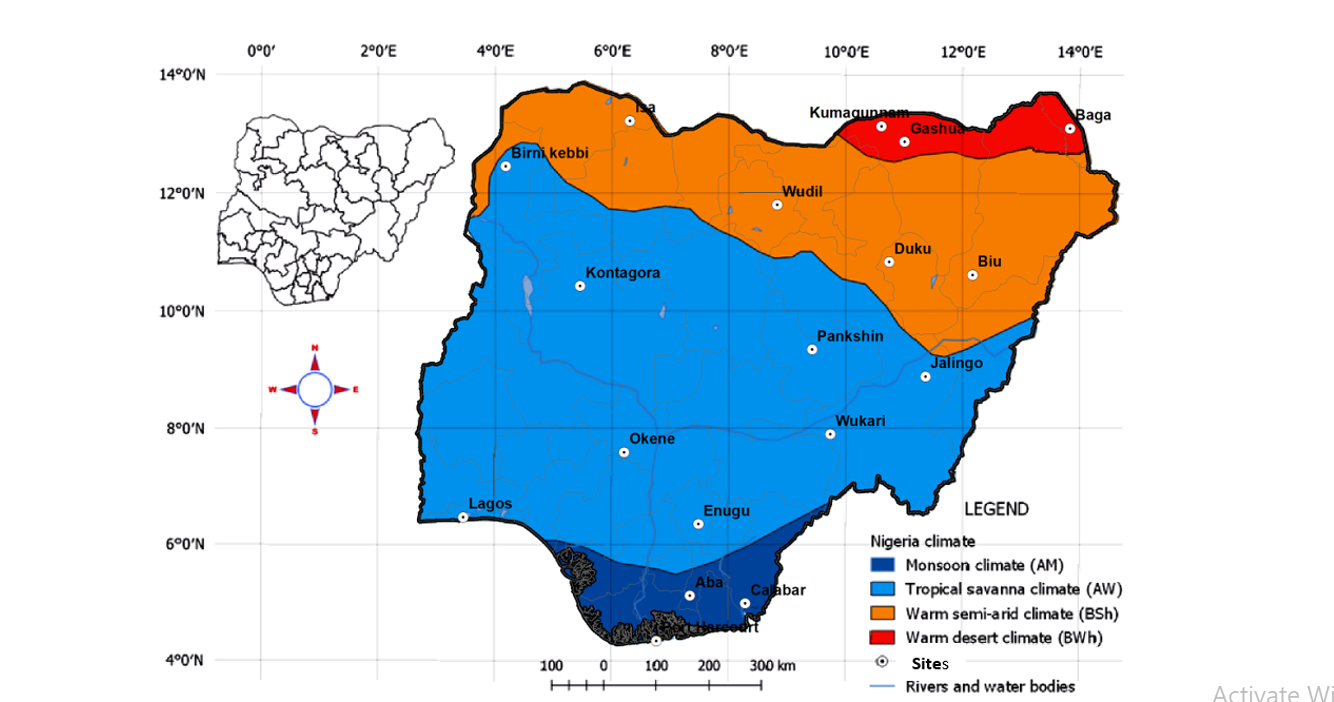
The increasing demand for clean and sustainable energy has intensified the need to evaluate Nigeria’s wind energy resources across different climatic regions. This study assessed the wind energy potential of selected stations within Nigeria’s Köppen climatic zones using Weibull statistical modelling and the RETScreen (Renewable Energy Technologies Screen) Expert platform. Weibull shape and scale parameters were estimated to determine Wind Power Density (WPD) and extrapolated hub-height wind characteristics. The computed WPD values were subsequently used in RETScreen simulations to estimate Annual Energy Generation (AEG), Capacity Factor (CF), and Greenhouse Gas (GHG) reduction potential using the Vestas V90. The results revealed significant climatic variability in wind energy potential across Nigeria. Stations located within the northern arid and semi-arid climatic zones (BWh and BSh) generally exhibited stronger wind resources and better turbine performance than stations within the humid southern climatic zones. Baga recorded the highest WPD of 181.8 W/m², corresponding to an AEG of 3220 MWh/year, CF of 18.38%, and GHG reduction potential of 3330 tCO₂/year, indicating moderate suitability for wind power development. In contrast, Aba and Port Harcourt exhibited extremely low wind resource conditions that resulted in non-feasible turbine outputs. The climatic suitability ranking followed the order: BWh > BSh > Aw > Am, confirming northern Nigeria as the most promising region for utility-scale wind energy development. The study demonstrates that integrating Weibull modelling with RETScreen Expert provides a reliable approach for regional wind energy assessment and sustainable energy planning.
References
Abdullahi, L. K., & Limangba, I. J. (2026). Seasonal Pollution Patterns in West Africa: A Review of Atmospheric Chemical Processes during the Monsoon and Harmattan. FUDMA Journal Of Sciences, 10(2), 26-37. https://doi.org/10.33003/fjs-2026-1002-4474
Adeyinka, A. M., Esan, O. C., Ijaola, A. O., & Farayibi, P. K. (2024). Advancements in hybrid energy storage systems for enhancing renewable energy-to-grid integration. Sustainable Energy Research, 11(1), 26.
Agoundedemba, M., Kim, C. K., & Kim, H. G. (2023). Energy status in Africa: challenges, progress and sustainable pathways. Energies, 16(23), 7708.
Ahmed, M., Zhang, Y., & Chen, L. (2024). Advances in wind resource assessment techniques and renewable energy modeling. Renewable and Sustainable Energy Reviews, 189, 114001.
Ajayi, K. E., Nwaogazie, I. L., Amadi, A. H., & Ola, V. D. (2024). Assessing the impact of climate change on wind energy potential in Nigeria’s coastal states: A future perspective. International Journal of Research and Scientific Innovation, 11(11), 46–62.
Ajrah, M. S. A., & Sumsudeen, R. M. (2024). Feasibility analysis of the offshore wind energy potential in Bahrain using the RETScreen software. In 8th IET Smart Cities Symposium (SCS 2024), 255-260.
Akdağ, S. A., & Dinler, A. (2021). A new method to estimate Weibull parameters for wind energy applications. Energy Conversion and Management, 50(7), 1761–1766.
Aljudaya, A., Michailos, S., Ingham, D. B., Hughes, K. J., Ma, L., & Pourkashanian, M. (2024). Techno-economic assessment of molten salt-based concentrated solar power: case study of linear fresnel reflector with a fossil fuel backup under Saudi Arabia’s climate conditions. Energies, 17(11), 2719.
Ameh, A. A., Attabo, A., Oluseyi, O. O., Ajayi, O., Oyedepo, S. O., & Afolalu, S. A. (2023). Assessment of the wind energy potential and economic viability of selected sites along Nigeria’s coastal and offshore locations. Frontiers in Energy Research, 11, 1186095. https://doi.org/10.3389/fenrg.2023.1186095
Akinsanola, A. A., & Ogunjobi, K. O. (2014). Analysis of rainfall and temperature variability over Nigeria. Global Journal of Human-Social Science: B Geography, geo-sciences, environmental disaster management, 14(3), 1-17.
Akpootu, D. O., Okpala, C. N., Iliyasu, M. I., Ohaji, D. E., Idris, M., Abubakar, M. B., & Aina, A. O and Abdulsalami, M (2022). Investigation of wind power potential in two selected locations in the Coastal Region of Nigeria. In Science Forum (Journal of Pure and Applied Sciences) 22 (1), 95-103.
Akporhonor, G. K., Otuagoma, S. O., & Akporhonor, T. A. (2023). Nigerian wind energy status. Proceedings of the Institution of Mechanical Engineers, Part A: Journal of Power and Energy, 48(2), 1–15.
Arya, S. P. (2001). Introduction to Micrometeorology (2nd ed.). Academic Press.
Astanei, D., Nemes, C., Munteanu, F., & Ciobanu, A. (2016). Annual energy production estimation based on wind speed distribution. International Conference and Exposition on Electrical and Power Engineering (EPE) IEEE, 862-867.
Attabo A.A., Ajayi O.O., Oyedepo S.O. and Afolalu S.A. (2023), Assessment of the wind energy potential and economic viability of selected sites along Nigeria’s coastal and offshore locations. Front. Energy Res. 11:1186095. doi: 10.3389/fenrg.2023.1186095
Ayoade, J. O. (2008). Tropical climatology for West Africa. Spectrum Books Ltd.
Bashiru, O., Ochem, C., Enyejo, L. A., Manuel, H. N. N., & Adeoye, T. O. (2024). The crucial role of renewable energy in achieving the sustainable development goals for cleaner energy. Global Journal of Engineering and Technology Advances, 19(3), 011-036.
Dinneya-Onuoha, E. (2025). Unlocking renewable energy materials in Nigeria: availability, application, and roadmap for sustainability. RSC Sustainability, 3(6), 2534-2566.
Edeh I. & Okpso S.O. (2026). Sustainable Energy Development in Nigeria: Present and The Future - A Review. International Research Journal of Applied Sciences, Engineering and Technology 12(02), 24 – 46.
Elkelawy, M., Atta, Z. A., & Seleem, H. (2024). Technological advances, efficiency optimization, and challenges in wind power plants: A comprehensive review. Pharos Engineering Science Journal, 1(1), 57-65.
Elkhatat, A., & Al-Muhtaseb, S. (2024). Climate change and energy security: a comparative analysis of the role of energy policies in advancing environmental sustainability. Energies, 17(13), 3179.
Fatigun, A. T., Akoshile, C. O., Ajibola, T. B., & Salau, R. O. (2017). Evaluation of wind energy potential of Ikeja, Southwest, Nigeria using two-parameter weibull distribution function. Evaluation, 7(09), 11 - 22.
Global Wind Energy Council (2026). Global Wind Report 2026. Madrid.
Igbawua, T., Tyonvenda, A. A., Sombo, T., & Echi, I. M. (2025). Spatio-temporal assessment of aerosol-induced atmospheric heating rates in Nigeria. Journal of the Nigerian Society of Physical Sciences, 7, 1918. https://doi.org/10.46481/jnsps.2025.1918
International Renewable Energy Agency (2024). Renewable Capacity Statistics 2024. Abu Dhabi, United Arab Emirates.
Issa, N., Adamu, A. A., Ibrahim, M. M., Iboh, S., Riagbayire, F. V. (2025). Feasibility Study for Wind Data Analysis Across Nigeria's 36 States and the Federal Capital Territory, Abuja. American Journal of Science, Engineering and Technology. 10(3), 141-157. https://doi.org/10.11648/j.ajset.20251003.16
Izuchukwu Precious, O., Zino Izu, O., Frank Chudi, A., Theresa Ojevwe, A., & Chinwe Sheila, N. (2025). The role of environmental governance in combating climate change: Analyzing COP28 Agreements and their Implementation. Journal of Integrity Ecosystems and Environment, 3(3), 12-26.
Jimoh, S. T., & Chetty, N. (2026). Comparative analysis of wind speed probability distributions for wind energy potential in Southwestern Nigeria. Discover Energy. 6(25). 1-23 https://doi.org/10.1007/s43937-026-00135-6 https://doi.org/10.1007/s43937-026-00135-6
Köse, B. (2025). Weibull Parameter Estimation Using Empirical and AI Methods: A Wind Energy Assessment in Izmir. Biomimetics, 10(10), 709.
Kottek, M., Grieser, J., Beck, C., Rudolf, B., & Rubel, F. (2006). World map of the Köppen–Geiger climate classification updated. Meteorologische Zeitschrift, 15(3), 259–263.
Manwell, J. F., McGowan, J. G., & Rogers, A. L. (2021). Wind energy explained: Theory, design and application (3rd ed.). Wiley.
National Renewable Energy Laboratory (2023). Wind resource assessment and classification guidelines. Golden, Colorado, USA.
Natural Resources Canada. (2024). RETScreen Expert clean energy management software. Government of Canada.
Nigerian Meteorological Agency (NiMet). (2023). Climate review bulletin for Nigeria. Abuja, Nigeria.
Nwachukwu, D. N., & Morka, J. C. (2024). Wind energy resource assessment in Nigeria: A methodological approach. Nigerian Journal of Physics, 33(4), 172–176.
Nwozor, A. A., Chukwuma, E., & Okonkwo, C. E. (2021). Renewable energy adoption and sustainable development in Nigeria. Journal of Energy Policy Studies, 7(3), 211–225.
Obioha, A. O., Chineke, T.C. & Okafor, O.N. (2025). Spatial Variability of key climate and air quality parameters across some Nigerian cities. Communication In Physical Sciences, 12(5), 1738-1745. https://dx.doi.org/10.4314/cps.v12i5.22
Peel, M. C., Finlayson, B. L., & McMahon, T. A. (2007). Updated world map of the Köppen–Geiger climate classification. Hydrology and Earth System Sciences, 11(5), 1633–1644.
Richard, O. N., & Eseosa, O. (2022). Evaluation of wind energy potentials in some selected areas in the six geo-political regions in Nigeria. Journal of Alternative Renewable Energy Sources, 8(1), 20-37.
Saleh, H. M., & Hassan, A. I. (2024). The challenges of sustainable energy transition: A focus on renewable energy. Applied Chemical Engineering, 7(2), 2084.
Seidu, I., Salisu, S., Masud, A. A., Musa, U., & Almustapha, D. M. (2024). Wind energy assessment in Auchi, Nigeria using Weibull distribution and NASA data. Arid Zone Journal of Engineering, Technology and Environment, 20(2), 1–15.
Teimourian, H.; Abubakar, M.; Yildiz, M.; Teimourian, A. A Comparative Study on Wind Energy Assessment Distribution Models: A Case Study on Weibull Distribution. Energies 2022, 15, 5684. https:// doi.org/10.3390/en15155684
Wang, T., Li, X., & Zhao, Y. (2024). Global trends in wind energy development and technological advancement. Energy Strategy Reviews, 52, 101332.
Wawo, M. I., Magaji, Y. R., Shehu, U., & Naisa, A. H. (2023). RETScreen feasibility analysis of wind power plant in Kano, Nigeria. NIPES Proceedings in Science and Technology, 3(2), 124–130. https://doi.org/10.379333/nipesproc/3.2.2023.19
Downloads
Published
Issue
Section
Categories
License
Copyright (c) 2026 Chidozie Okpala

This work is licensed under a Creative Commons Attribution 4.0 International License.


