
Deterministic Chaos in Precipitation and Atmospheric Temperature Time Series over North-Central Nigeria: A Recurrence Quantification Analysis Approach
DOI:
https://doi.org/10.33003/fjs-2026-1010-5346Keywords:
chaos, recurrence plots, recurrence quantification analysis, recurrence rate, determinismAbstract
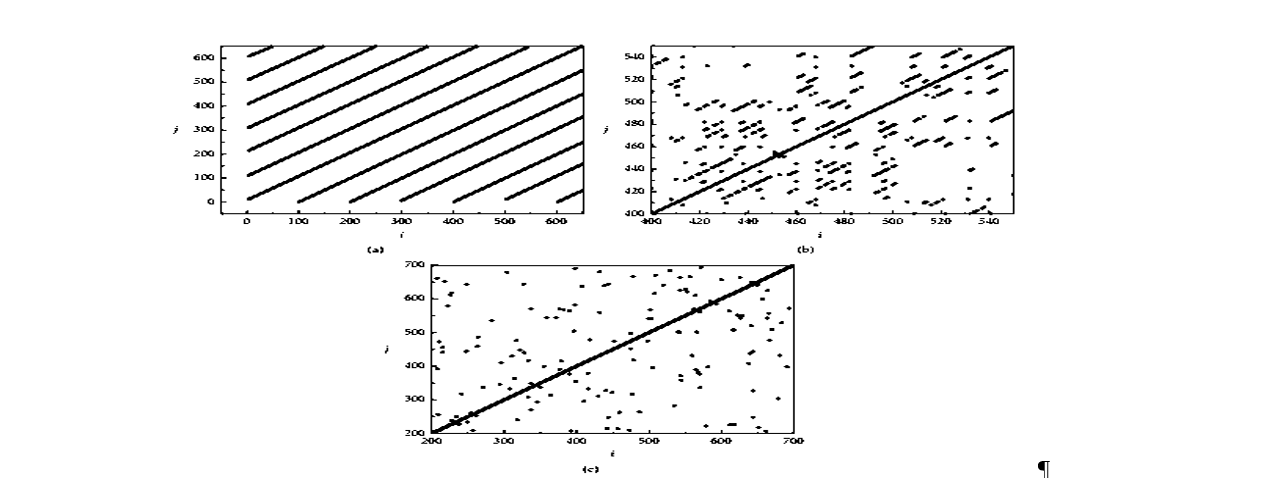
This work is focused at assessing the chaotic features in precipitation and atmospheric temperature records over North-Central Nigeria using recurrence quantification analysis. The mean daily precipitation and atmospheric temperature data for the seven states in North-Central Nigeria were collected from the Modern Era Retrospective Reanalysis (MERRA-2) spanning from 1982-2020. Recurrence plots (RP) were constructed based on the reconstitution of phase space via the method of delays while Lyapunov exponents and recurrence statistics were also computed. The results obtained show that the recurrence plots for precipitation comprise of points that are not arranged in shorter diagonal lines but form a congruent chequered pattern which is regular throughout the RP while the RPs for atmospheric temperature showed regular patterns with very short diagonal lines parallel to the line of identity (LOI) indicating chaos. The Lyapunov exponents were positive but low values (< 0.014) indication deterministic chaos while the recurrence statistics computed showed the recurrence rate of temperature has very low values (0.30-0.69 %) across all the sampled states but that of precipitation has higher values (09.83-28.24 %) as a result of its fixed seasonality. The determinism values for temperature also had lower values (0.099-0.182 %) while that of precipitation recorded higher values (75.48-88.85 %) implying more sensitive to distortions like greenhouse gases emissions from human anthropogenic activities. These results are a confirmation of deterministic chaos in the dynamics of the climate of North-Central Nigeria which is has manifested in floods, heat waves and droughts over the years.
References
Adediji A. E., Olusola, O. I and Njah, A. N. (2018) Comparative study of chaotic in hourly wind speed using recurrence quantification analysis. AIP Advances, 8(025102) 1-13. https://doi.org/10.1063/1.4998674
Bichi, J.A, Tijjani, B. I. and Tikyaa, E.V. (2026). Analysis of spatial and temporal variation of deterministic chaos in tropospheric radio refractivity across twelve locations in Nigeria using recurrence quantification analysis. Theor Appl. Climatol., 157(2026), 360. https://doi.org/10.1007/s00704-026-06281-0
Bigdeli, N. and Afshar K. (2009). Characterization of Iran electricity market indices with pay-asbid payment mechanism. Physica A, 388(8), 1577-1592
Caesarendra, W., Kosasih, P., Tieu, K. and Moodie, C. (20130. An application of nonlinear feature extraction-A case study for low-speed slewing bearing condition monitoring and prognosis. IEEE/ASME International Conference on Advanced Intelligent Mechatronics: Mechatronics for Human Wellbeing. AIM 2013.1713-1718.10.1109/AIM.2013.6584344.
Echi, I.M., Tikyaa, E.V. and Eweh, E.J., Tyovenda, A.A. and Igbawua, T. (2025) Investigation of the spatial distribution of deterministic chaos in some meteorological variables across Nigeria. African Scientific Reports, 4, 280. https://doi.org/10.46481/asr.2025.4.2.280
Eckmann J.P, Kamphorst. S.O., Ruelle D. (1987). Recurrence plots of dynamical systems. Europhys Lett, 5, 937-977.
Fraser, A.M. and Swinney, H.L. (1986). Independent Coordinates for Strange attractors from mutual information. Phys. Rev. A, 33(2), 1134-1140. https://doi.org/10.1103/PhysRevA.33.1134
Fuwape I. A., Ogunjo S. T., Oluyamo S.S. and Rabiu A.B. (2016). Spatial variation of deterministic chaos in mean daily temperature and rainfall over Nigeria. Theor Appl. Climatol., 2016, springer-verlag Wien. DOI 10.1007/S00704-016-1867-X.
Global Modelling and Assimilation Office (GMAO) (2025). inst3_3d_asm_Cp: MERRA-2 3D IAU State, Meteorology Instantaneous 3-hourly (p-coord, 0.625X0.5 L42) Version 5.12.4. Greenbelt. MD, USA:Goddard Space Flight Center Distributed Active Archive Center (GSFC DAAC), Access Enter User Data Access Date. https://doi.org/10.5067/VJAFPL1CSIV. https://gmao.gsfc.nasa.gov/gmao-products/merra-e/data-access_merra-2
Goswami, B. (2019). A brief introduction to nonlinear time series analysis and recurrence plots. Vibration, 2, 332-268. https://doi.org/3390/vibration/2040021
Hakki, E. (2006). On the Predictability of Time Series by Metric Entropy. M.Sc. Thesis, Graduate School of Engineering and Sciences, Izmir Institute of Technology, p.115.
Kennel, M.B., Brown, R. and Abarbanel, H. D. I. (1992). Determining embedding dimension for phase space reconstruction using a geometrical reconstruction. Phys Rev. A, 45(2), 3403-3411.
Krakovka, A., Mezeiova K. and Budacova H. (2015). Use of false nearest neighbors for selecting variable and embedding parameters for state space reconstruction. Journal of complex systems, 2015, 932750.
Letellier, C. Rabarimanantsoa, H., Achour, L. Cuvelier, A. Muir, J.F. (2007). Recurrence plots for dynamical analysis of non-invasive mechanical ventilation. Trans A Math Phys Eng Sci., 366(1865) 621-634. https://doi.org/10.1098/rsta.2007.2114
Marwan, N. (2011) How to avoid potential pitfalls in recurrence plot-based data analysis. International Journal of Bifurcation and Chaos, 21(4), 1003–1017. DOI: 10.1142/S0218127411029008
Marwan, N. and Kurths, J. (2005). Time structures in recurrences in plots. Phys Lett A, 336(4), 349-357.
Marwan, N., Romano, M. C., Thiel, M., and Kurths, J. (2007). Recurrence plots for the analysis of complex systems, Phys Rep., 438, 237-329. arXiv:1709.09971v1
Miralles, R., Carrion, A., Looney, D., Lara, G. and Mandic, D. (2015). Characterization of the complexity in short oscillating time series: An application to seismic airgun detonations. Journal of the Acoustical Society of America 138, 1595-1603. http://dx.doi.org/10.1121/1.4929694
Ogunjo, S. T., Adediji, A. T., Bada, J. B. (2015). Investigating chaotic features in solar radiation over a tropical station using recurrence quantification analysis. Theor Appl Climatol. 2015. DOI: 10.1007/s00704-015-1642-4
Packard, N., Crutchfield, J., Farmer, J. and Shaw, R. (1980). Geometry from a time Series. Phys. Rev. Lett., 45, 712-716. https://doi.org/10.1103/PhysRevLett.45.712
Rosenstein, M., Collins, J.J. and De Luca, C. (1993). A practical method for calculating largest Lyapunov exponents from small data sets. Phys. D, 65, 117-134. https://doi.org/10.1016/0167-2789(93)90009-P
Schinkel, S., Dimigen, O. and Marwan, N. (2008). Selection of Recurrence Threshold for Signal Detection. European Phys. J. Special Topics, 164, 45-53.
Takens, F. (1981). Detecting Strange Attractors in Turbulence. Lecture Notes in Mathematics, 898, 366-381. https://doi.org/10.1007/BFb0091924
Topographic-maps.com (2026). Topography Maps: Nigeria. https://en-ng.topographic-map.com/map-4t3kgt/nigeria
Velickov, S. (2006). Nonlinear Dynamics and chaos with applications to Hydrodynamics and Hydrological modelling. London: Taylor and Francis Group Plc, 76-79.
Wada, O. (2025). The North-Central Development Commission: A new-dawn for the region. Premium times. Retrieved 23 June 2025. https://www.premiumtimesng.com/opinion/772834-the-north-central-development-commission-a-new-dawn-for-the-region-by-omojo-wada.html
Wallot, S. (2017). Recurrence quantification analysis of process and products of discourse: A tutorial in R. Discourse process, 2017. Doi.10.1080/0163853X.2017.1297921.
Wen, Z. Guoling, F. and Qunqun, L. (2016). The Application of Recurrence Quantification Analysis in Detection of Abrupt Climate Change. Discrete Dynamics in Nature and Society, 2016(2689429), 7 http://dx.doi.org/10.1155/2016/26894292
Wolf, A., Swift, J.B., Swinney, H. L. and Vastano, J. A. (1985). Determining Lyapunov Exponents from a Time Series. Physica D, 16, 285.
Ye, H., Deyle, E. R., Gilarranz, L. J. and Sugihara, G. (2015). Distinguishing time-delayed causal interactions using convergent cross mapping. Scientific reports, 5(1), 14750.
Zbilut, J. P., and Webber, C. J. (1992). Embeddings and delays as derived from quantification of recurrence plots. Physics Letters A, 171, 199-203.
Zhang, W. Feng G. and Liu G. (2016). The application of Recurrence quantification analysis in detection of Abrupt climate change. Discrete dynamics in nature and society, 2016, 1-7. http://dx.dio.org/10.1155/2016/2689429.
Downloads
Published
Issue
Section
Categories
License
Copyright (c) 2026 Emmanuel Vezua Tikyaa, Terkaa Timothy Tile, Alexander N. Amah, Daniel Abi Otor

This work is licensed under a Creative Commons Attribution 4.0 International License.


