
DIURNAL AND NOCTURNAL WIND POWER DENSITY ASSESSMENT IN RIVERINE AND COASTAL ZONES OF NIGERIA USING ERA5 DATA
DOI:
https://doi.org/10.33003/fjs-2025-0912-4322Keywords:
Power Density, Cumulative Probability, Diurnal, Nocturnal, Wind speedAbstract
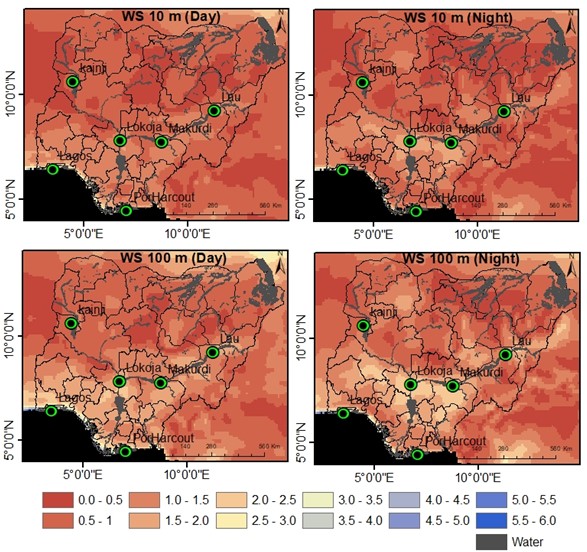
This study evaluated the diurnal and nocturnal wind power density across six locations in Nigeria: Port Harcourt, Lau, Kainji, Lagos, Lokoja, and Makurdi. The observed values were compared with the on-grid wind power benchmark of 100 W/m². The results reveal significant spatial and temporal variability in wind power potential. Diurnally, Lagos (117.7 W/m²) and Port Harcourt (106.8 W/m²) exceed the on-grid threshold, indicating high suitability for grid-connected wind systems. Nocturnal power density is generally lower but close to on-grid bench mark in Lagos (98.8 W/m²) and Port Harcourt (88.8 W/m²). In contrast, Lau, Kainji, Lokoja, and Makurdi fall below on-grid requirement with power densities of 77.5 (50.2), 38.1 (49.6), 22.2 (39.5), and 37.1 (59.9) W/m² respectively for diurnal (nocturnal) conditions, suggesting limited potential for large-scale applications. Generally, the mean cut-off wind speed of 3 and 4 m/s for turbine operation was achieved in all the locations. Arguably, the findings highlight the coastal advantage, clear diurnal–nocturnal asymmetry, and the necessity for site-specific planning when deploying wind energy infrastructure.
References
Adaramola, M. S., & Oyewola, O. M. (2011). On wind speed pattern and energy potential in Nigeria. Energy Policy, 39(5), 2501–2506. https://doi.org/10.1016/j.enpol.2011.02.016
Adaramola, M. S., Oyewola, O. M., Ohunakin, O. S. & Akinnawonu, O. O. (2014). Performance evaluation of wind turbines for energy generation in Niger Delta, Nigeria. Sustainable Energy Technologies and Assessments, 6, 75–85. https://doi.org/10.1016/j.seta.2014.01.001
Audu, M. O., Terwase, A. S., & Isikwue, B. C. (2019). Investigation of wind speed characteristics and its energy potential in Makurdi, north central, Nigeria. SN Applied Sciences, 1(2), 178. https://doi.org/10.1007/s42452-019-0189-x
Ayodele, T. R., Jimoh, A. A., Munda, J. L., & Agee, J. T. (2013). A statistical analysis of wind distribution and wind power potential in the coastal region of South Africa. International Journal of Green Energy, 10(8), 814–834.
Ayodele, T. R., Ogunjuyigbe, A. S. O., & Amusan, T. O. (2016). Wind power utilization assessment and economic analysis of wind turbines across fifteen locations in the six geographical zones of Nigeria. Journal of Cleaner Production, 129, 341–349. https://doi.org/10.1016/j.jclepro.2016.04.060
Bilir, L., Imir, M., Devrim, Y., & Albostan, A. (2015). Seasonal and yearly wind speed distribution and wind power density analysis based on Weibull distribution function. International Journal of Hydrogen Energy, 40(44), 15301–15310. https://doi.org/10.1016/j.ijhydene.2015.04.140
Carta, J. A., & Mentado, D. (2007). A continuous bivariate model for wind power density and wind turbine energy output estimations. Energy Conversion and Management, 48(2), 420–432. https://doi.org/10.1016/j.enconman.2006.06.019
Eboibi, B., Eboibi, O., Okubio, E., & Iyasele, C. (2017). Evaluation of wind energy potential in the south-south geopolitical zone of Nigeria. Journal of Applied Sciences and Environmental Management, 21(7), 1301–1306.
Fagbenle, R. O., Katende, J., Ajayi, O. O., & Okeniyi, J. O. (2011). Assessment of wind energy potential of two sites in North-East, Nigeria. Renewable Energy, 36(4), 1277–1283. https://doi.org/10.1016/j.renene.2010.10.003
Hassler, B., & Lauer, A. (2021). Comparison of reanalysis and observational precipitation datasets including ERA5 and WFDE5. Atmosphere, 12(11), 1462. https://doi.org/10.3390/atmos12111462
Jiang, Q., Li, W., Fan, Z., He, X., Sun, W., Chen, S., ... & Wang, J. (2021). Evaluation of the ERA5 reanalysis precipitation dataset over Chinese Mainland. Journal of hydrology, 595, 125660. https://doi.org/10.1016/j.jhydrol.2020.125660
Katinas, V., Gecevicius, G., & Marciukaitis, M. (2018). An investigation of wind power density distribution at location with low and high wind speeds using statistical model. Applied Energy, 218, 442–451.
Li, M., Shen, Y., Yao, J., Ye, D., Fan, J., & Simmonds, I. (2022). An assessment of observed wind speed and wind power density over China for 1980–2021. Wind Energy, 25(12), 2052–2070. https://doi.org/10.1002/we.2783
Nze-Esiaga, N., & Okogbue, E. C. (2014). Assessment of wind energy potential as a power generation source in five locations of South Western Nigeria. Journal of Power and Energy Engineering, 2, 1–13. https://doi.org/10.4236/jpee.2014.25001
Oluleye, A., & Adeyewa, D. (2016). Wind energy density in Nigeria as estimated from the ERA interim reanalysed data set. British Journal of Applied Science and Technology, 17(1), 1–17. https://doi.org/10.9734/BJAST/2016/13340
Omonigho, O. E., Samuel, O. O., & Olu, A. J. (2019). Assessment of wind energy potential for the generation of power in coastal and Sahel savannah locations in Nigeria. Journal of Electrical and Electronic Engineering, 4, 54–60. https://doi.org/10.11648/j.jeece.20190404.12
Oyedepo, S. O., Adaramola, M. S., & Paul, S. S. (2012). Analysis of wind speed data and wind energy potential in three selected locations in south-east Nigeria. International Journal of Energy and Environmental Engineering, 3(1), 7.
Udo, N. A., Oluleye, A., & Ishola, K. A. (2017). Investigation of wind power potential over some selected coastal cities in Nigeria. Innovative Energy & Research, 6(1).
Downloads
Published
Issue
Section
Categories
License
Copyright (c) 2025 Grace Adagba, Tertsea Igbawua, Emmanuel Vezua Tikyaa

This work is licensed under a Creative Commons Attribution 4.0 International License.


