
Synergistic Effect of Pb Resistant Bacteria and L. macroides US3 Biostimulant in Ecorestoration of Pb-Treated Soil
DOI:
https://doi.org/10.33003/fjs-2026-1013-5345Abstract
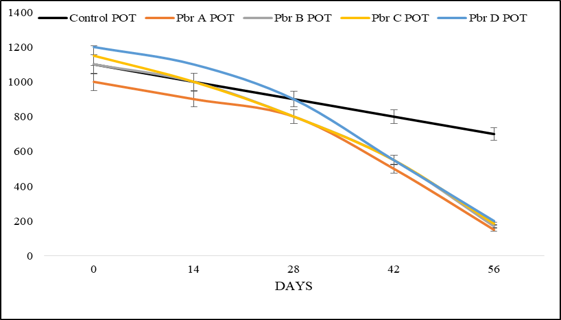
Lead pollution poses a formidable threat to agriculture, bioaccumulating in crops, and ultimately harming human health. Even low-level exposure can significantly reduce crop yields, diminish nutritional value, and precipitate economic losses and food insecurity. To combat this threat, we investigated the efficacy of a novel biostimulant, Lysinibacillus macroides US3, previously isolated from the rhizosphere of a plant with enhanced plant growth attributes to promote ecorestoration of a Pb-remediated soil. Four Pb-resistant bacterial (LRB) strains: Bacillus infantis K66, Halopseudomonas xiamenensis B13, Lysinibacillus fusiformis KAF67, and Pseudomonas spp. A27 harbouring the gene cluster PbrABCT were employed in the treatment of Pb contaminated soil. The treatment efficacy was remarkable, with final Pb removal percentages of 85%, 82%, 83%, and 83%, respectively while control had a 41% removal. To achieve ecorestoration and facilitate agricultural reuse of soil, maize seeds were planted in the treated soil, and 10% w/v of US3 biostimulant was introduced as liquid culture into the pots except the control pot. Post-cultivation analysis revealed enhanced plant growth and biomass yield in US3 inoculated pots, 48% Pb uptake by maize in control pots while undetected in inoculated pots, 53% residual Pb in control soil while undetected in inoculated soil. The synergistic application of Pb-resistant bacteria and US3 biostimulant effectively ecorestored Pb-stressed soil, demonstrating a promising approach for sustainable Pb mitigation. This study highlights the potential of microbial-based solutions for environmental remediation and agricultural sustainability.
References
Abdelkrim, S., Jebara, S. H., Saadani, O., Chiboub, M., Abid, G., Jebara, M. (2018). Effect of Pb‐resistant plant growth‐promoting rhizobacteria inoculation on growth and Pb uptake by Lathyrus sativus. Journal of Basic Microbiology, 58(7), 579-589.
Allen, Entwistle, J., & Dean, J. R. (2020). Human health risk from Pb in urban street dust in northern UK cities. Environmental Chemistry, 12(1), 209–218. https://doi.org/10.1007/s10311-013-0436-0
Belimov, A.A.; Kunakova, A.M.; Safronova, V.I.; Stepanok, V.V.; Yudkin, L.Y.; Alekseev, Y.V.; Kozhemyakov, A.P (2002). Employment of rhizobacteria for the inoculation of barley plants cultivated in soil contaminated with Pb and cadmium. Microbiology
Chiwetalu, U., Egwuagu, O. M., & Ugwu, K. C. (2022). Lead accumulation in maize grains, leaves and other parts of the plant: A possible route for lead poisoning. FUDMA Journal of Sciences, 6(3), 51–58.
Cowdhury, E., O’Brien, S., Tromas, N., Bayer, F., Luján, A. M., van Veen, E. M., Hodgson, D. J., & Buckling, A. (2020). Ecological selection of siderophore-producing microbial taxa in response to heavy metal contamination. Ecology Letters, 21(1), 117–127. https://doi.org/10.1111/ ele.12878
Cruz-Hernández, M.A.; Mendoza-Herrera, A.; Bocanegra-García, V.; Rivera, G. Azospirillum spp. from Plant Growth-Promoting Bacteria to Their Use in Bioremediation. Microorganisms (2022). 10, 1057. https://doi.org/10.3390/microorganisms10051057
Das, S., Jean, J. S., Kar, S., Chou, M. L., & Chen, C. Y. (2014). Screening of plant growth-promoting traits in arsenic-resistant bacteria isolated from agricultural soil and their potential implication for arsenic bioremediation. Journal of hazardous materials, 272, 112-120.
Ehis-Eriakha C. B. and Adetunji. C. O. 2022. Recent Advances in the Application of Biostimulants Derived from Beneficial Microorganisms: Agriculture and Environmental perspective. In: C. O. Adetunj, D. G. Panpatte, Y. K.
Jhala. Recent Advances in the Microbial and Agricultural Biotechnology: An Environmental and Food Security Hotspot. CRC Press, Taylor and Francis. 42 pages
Ehis-Eriakha, C.B and Akemu S. E. (2022). Impact of heavy metal pollution on the biotic and abiotic components of the environment. South Asian Journal of Research in Microbiology. 13(3): 38-54.
Ehis-Eriakha C. B., Chikere Blaise Chioma, Akemu Stephen Eromosele (2024). A comparative assessment of biostimulation potential in microbiome-based ecorestoration of polycyclic aromatic hydrocarbon polluted soil. Brazilian Journal Of Microbiology. DOI: 10.1007/s42770-024-01556-y
Gul, I., Adil, M., Lv, F., Li, T., Chen, Y., Lu, H., & Feng, W. (2024). Microbial strategies for Pb remediation in agricultural soils and wastewater: mechanisms, applications, and future directions. Frontiers in Microbiology, 15, 1434921. https://doi.org/10.3389/fmicb.2024.1434921
Jiang Y (2020). Measurement of trace heavy metals in food with nutrient function claims by microwave digestion furnance method. Shimadzu Excellence in Science, 1(1)
Ju, L., Gao, B., Hao, H., Zhou, H., Lu, J., & Sun, K. (2020). Lead contamination in sediments in the past 20 years: a challenge for China. Science of Total Environment, 640–641, 746–756. https://doi.org/10.1016/j.scito tenv.2018.05.330
Li, Rong, Q. L., Zhou,W., & Liang, G. Q. (2020). Which of soil microbes is in positive correlation to yields of maize (Zea mays L.)? Plant Soil Environment, 63, 574–580
Mitra A, Chatterjee S, Kataki S, Rastogi RP, Gupta DK (2021) Bacterial tolerance strategies against lead toxicity and their relevance in bioremediation application. Environmental Science and Pollution Research 28: 4271-14284.
Nawaz, T., Saud, S., Gu, L., Khan, I., Fahad, S., & Zhou, R. (2024). Cyanobacteria: harnessing the power of microorganisms for plant growth promotion, stress alleviation, and phytoremediation in the Era of sustainable agriculture. Plant Stress, 100399.
Qiao, W., Zhang, Y., Xia, H., Luo, Y., Liu, S., Wang, S., & Wang, W. (2019). Bioimmobilization of lead by Bacillus subtilis X3 biomass isolated from lead mine soil under promotion of multiple adsorption mechanisms. Royal Society open science, 6(2), 181701.
Sevak, P. I., Pushkar, B. K., & Kapadne, P. N. (2021). Lead pollution and bacterial bioremediation: a review. Environmental Chemistry Letters, 19(6), 4463-4488.
Shan, B., Hao, R., Zhang, J., Li, J., Ye, Y., & Lu, A. (2023). Microbial remediation mechanisms and applications for Pb-contaminated environments. World Journal of Microbiology and Biotechnology, 39(2), 38. https://doi.org/10.1007/s11274-022-03484-1.
Wang, Y., Narayanan, M., Shi, X., Chen, X., Li, Z., Natarajan, D., & Ma, Y. (2022). Plant growth-promoting bacteria in metal-contaminated soil: Current perspectives on remediation mechanisms. Frontiers in Microbiology, 13, 966226.
Zhang, Y., Zhao, S., Liu, S., Peng, J., Zhang, H., Zhao, Q., & Chen, C. (2022). Enhancing the phytoremediation of heavy metals by combining hyperaccumulator and heavy metal-resistant plant growth-promoting bacteria. Frontiers in Plant Science, 13, 912350.
Downloads
Published
Issue
Section
Categories
License
Copyright (c) 2026 Chioma Bertha Ehis-Eriakha, Esther Omoye 0shiomane Momodu, Fred Coolborn Akharaiyi, Koplamma Nenchini Bala

This work is licensed under a Creative Commons Attribution 4.0 International License.


