Radiological Assessment and Inhabitants Risk Evaluation of Primordial Radionuclides in Soils of Tambuwal LGA, Nigeria
DOI:
https://doi.org/10.33003/Keywords:
Gamma-ray Spectrometry, Primordial Radionuclides, Hazard Indices, Tambuwal, Radiation Protection, Soil Sample.Abstract
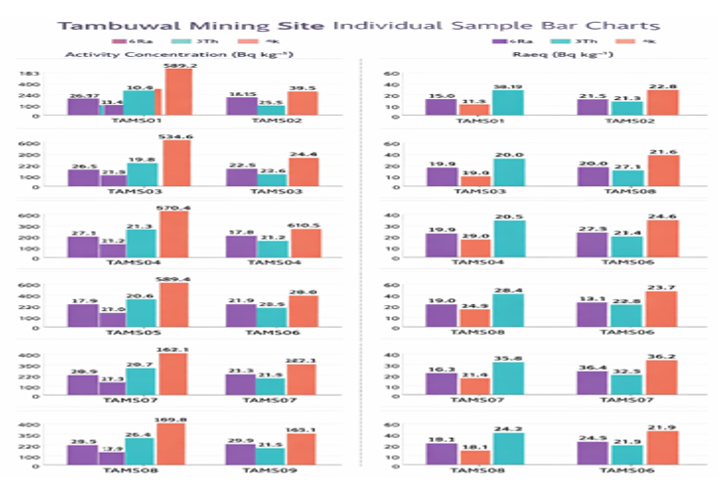
Natural background radiation from primordial radionuclides in soil represents a significant component of public radiation exposure, particularly in regions with distinctive geochemical compositions. This study systematically evaluated the baseline activity inventory of primordial radionuclides in surficial soil across Tambuwal, Sokoto State, Nigeria, and quantified associated terrestrial gamma radiation exposure to the local population. Activity concentrations of ²²⁶Ra, ²³²Th, and ⁴⁰K were measured using high-resolution gamma-ray spectrometry with a Hyperpure Germanium (HPGe) detector. Activity ranges were 19.50–125.50 Bq·kg⁻¹ for ²²⁶Ra, 21.90–62.50 Bq·kg⁻¹ for ²³²Th, and 278.04–815.03 Bq·kg⁻¹ for ⁴⁰K. The mean ²²⁶Ra concentration (73.68 Bq·kg⁻¹) exceeded the UNSCEAR world average (35.0 Bq·kg⁻¹) by more than twofold, while mean ⁴⁰K activity (648.66 Bq·kg⁻¹) markedly surpassed the global average (420 Bq·kg⁻¹); conversely, mean ²³²Th activity (42.00 Bq·kg⁻¹) was comparable to the world average (45 Bq·kg⁻¹). This distinctive enrichment pattern reflects the local soil matrix geochemistry. The mean radium equivalent activity (Raeq = 183.68 Bq·kg⁻¹) was below the recommended limit of 370 Bq·kg⁻¹. Both mean external (Hₑₓ = 0.50) and internal (Hᵢₙ = 0.70) hazard indices satisfied the safety threshold of unity. The mean absorbed dose rate (86.45 nGy·h⁻¹) and annual effective dose (106.03 μSv·y⁻¹) exceeded global benchmarks (~57 nGy·h⁻¹ and 100 μSv·y⁻¹, respectively). Although, hazard indices remain within permissible limits, the moderately elevated dose metrics indicate signals warranting periodic monitoring. These findings establish Tambuwal as a moderate radiological risk zone, providing a critical georeferenced baseline for nuclear safety evaluations and evidence-based environmental management in northwestern Nigeria.
Downloads
Published
Issue
Section
Categories
License
Copyright (c) 2026 Yusuf Musa Ahijjo, Adamu Baba-Kutigi, Mazhar Hussain, Adamu Idris, Dahiru Dahuwa, Umar Aminu

This work is licensed under a Creative Commons Attribution 4.0 International License.