
Morpho-Physiological Screening of Some Selected Rice (Oryzae sativa) Varieties for Salinity Stress Tolerance in Gashua Yobe State Nigeria
DOI:
https://doi.org/10.33003/fjs-2026-1009-5322Keywords:
Rice, Salinity, Tolerance, Susceptibility, StressAbstract
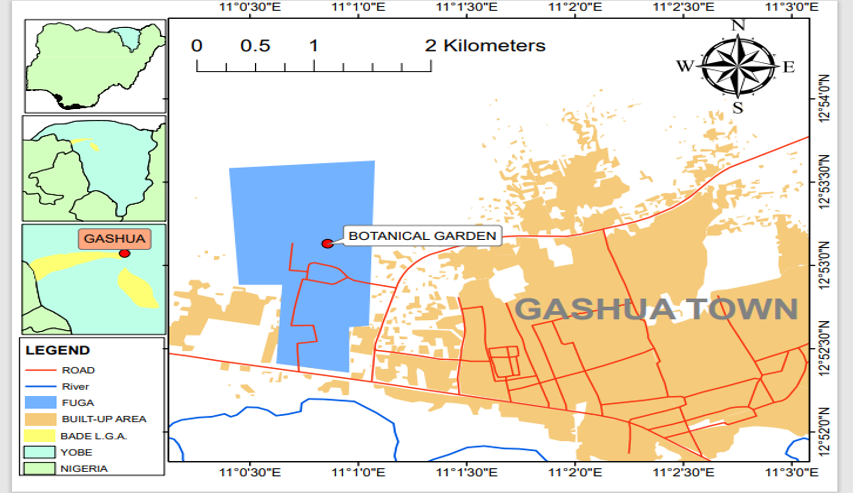
Rice is one of the most important cereal crops and a primary food source for nearly half of the global population. In Nigeria, (Oryza sativa L.) is widely cultivated and consumed, but its production is increasingly threatened by environmental stresses such as salinity and drought, which significantly reduce yield and farmer productivity. This study evaluated the morpho-physiological responses of selected rice varieties to salinity stress at the Botanical Garden of the Department of Biological Sciences, Federal University Gashua, Yobe State, Nigeria. Eight rice varieties, comprising four improved types (Faro 42, Faro 44, Faro 61, And Nerica) and four local landraces (Yar Masaba, Yar Sani, Jamila, and Jarani Bazawara), were assessed using a pot experiment. Seedlings were transplanted into pots containing 4kg of soil and exposed to salinity treatments of 0, 3, 6, and 9 dS/m using sodium chloride (NaCl) one month after germination. The experiment followed a randomized complete design. Data were collected on germination percentage, plant height, leaf chlorophyll content, leaf area, 50% wilting, and regeneration potential, and analyzed using analysis of variance. Results showed that salinity significantly (P < 0.05) affected all measured parameters across the varieties. However, Faro 42, Faro 44, and Nerica demonstrated moderate tolerance by maintaining relatively higher growth and physiological performance. In contrast, Yar Sani was highly susceptible, showing marked reductions under increasing salinity. The findings highlight promising varieties for cultivation in salt-affected areas and emphasize the value of morpho-physiological traits in screening for salinity tolerance.
References
Banumathy, S., Kiruthikadevi, U., Arunachalam, P., Renuka, R., Thirumurugan, T., Raveendran, M., (2021). Screening of Salt introgressed backcross inbred lines of rice under hydroponic condition for salinity tolerance. Cereal. Res. Commun. 49, 235–243. https://doi.org/10.1007/s42976-020-00102-4.
Bashir M. M., Lawan A. S., Usman A., Jibril S. M. , Nuraddeen M. , Rukayya K. M. (2024). Morpho-Physiological Assessment of Some Rice (Oryza Sativa L.) Genotypes for Salinity Stress Tolerance, Dutse Journal of Pure and Applied Sciences (DUJOPAS), Vol. 10 No. 2c. pp 188-200.
Chen, T., Shabala, S, Niu, Y., Chen, Z., Shabala, L., Meinke., H. (2021b) Molecular Mechanisms of Salinity Tolerance in Rice. Crop Journal 9, 506-520.
Efisue, A, A. and Dike, C, C. (2020). Screening Rice (Oryza sativa. L) for Salinity Tolerance for Yield and Yield Components in Saline Stressed Environment. American Journal of Agriculture and Forestry 8(1): 15-21.
Hayatu M., Muhammad S. Y., Habibu U. A. (2014). Effect of Water Stress on the Leave
Relative Water Content and Yield of some Cowpea Varieties (Vigna unguilata (L)
Walp.)Genotypes. Inter. Journal of Sci. and Tech. Reserch Vol. 3 ISSue 7.
Heidari, M. (2011).effect of salinity stresss on growth, chlorophyll content and osmotic component of two basil (Occimum basilum L.) geneotypes. 11(2).
Hossain, M.S., Persicke, M., Kalinowski, J., (2015). Genome-wide association study in rice reveals role of salinity stress-responsive genes in salt tolerance. Front. Plant Sci. 6, 712. https://doi.org/10.3389/fpls.2015.00712.
Hussain, S., Zhang, J. H., Zhong, C., Zhu, L. F., Cao, X. C., Yu, S. M., Allen, B. J., Hu, J. J. and Jin, Q. Y. (2017). Effects of salt stress on rice growth, development characteristics, and the regulating ways: Journal of Integrative Agriculture, 16(11): 2357–2374
Ikhajiagbe, B. and Omoregie, U. E (2020) Growth, yield, genetic parameters and random amplified polymorphic DNA (RAPD) of five rice varieties treated with sodium azide and sown under different saline conditions. Bulletin of the National Research Centre 44:89
Ikyaagba, E.T. (2008). Plant biodiversity and Ethno botanical potential of University of Agriculture Makurdi wildlife park and Ikwe Game Reserves, Igbo Benue State Nigeria; (Unpublished thesis in the Department of Forest Resources Management University of Ibadan, Ibadan Nigeria 1-123pp).
Leridon, T. (2020). World Population outlook: Explosion or implosion? Popular. Soc. , 573, 1-4.
Li, C., Guan, J., Liang, W.H., Yao, S., He, L., Wei, X.D., Zhao, L., Zhou, L.H., Zhao, C., Zhao, Zhu, Z., Huang, S., Wang, C., Zhang, D., Lu, K., Chen, T., Chen, T.,( 2025). OsWRKY72 enhances salt tolerance in rice via SKC1-mediated Na+ regulation.
Plant Stress, 100962. https://doi.org/10.1016/j.stress.2025.100962.
Mansuri, R., Shobbar, Z.S., Babaeian Jelodar, N., Ghaffari, M., Mohammadi, S.M., Daryani, P., (2020). Salt tolerance involved candidate genes in rice: an integrative meta-analysis approach. BMC. Plant Biol. 20, 1–14
Puvanitha, S. and Mahendran, S. (2017). Effect of Salinity on Plant Height, Shoot and Root Dry Weight of Selected Rice Cultivars, Scholars Journal of Agriculture and Veterinary Science, 4(4):126-131.
Saleh, A. and Ahmed, A. (2019). Solid Waste Management Practice and Challenges in Gashua, Yobe State, Nigeria. Nigerian Journal of Environmental Sciences and Technology, 3(2): 298-303.
Senanayake, R. M. N. H., Herath, H. M. V. G., Wickramesinghe, I. P., Udawela, U. A. K. S.
and Sirisena, D. N. (2017). Phenotypic Screening of Rice Varieties for Tolerant to Salt Stressat Seed Germination, Seedling and Maturity Stages. Tropical Agricultural
Research, 29(1).
Shivaji, S., Singh, S. P., Neupane, M. P., and Meena, R. K. (2014). Effect of NPK Levels.
Singh, A., 2022. Soil salinity: a global threat to sustainable development. Soil Manage 38, 39–67. https://doi.org/10.1111/sum.12772.
Singh, V., Singh, A.P., Bhadoria, J., Giri, J., Singh, J., TV, V., Sharma, P.C., 2018. Differential expression of salt-responsive genes to salinity stress in salt-tolerant and salt-sensitive rice (Oryza sativa L.) at seedling stage. Protoplasma 255, 1667–1681.
Zamani, E., Bakhtari, B., Razi, H., (2024). Comparative morphological, physiological, and biochemical traits in sensitive and tolerant maize genotypes in response to salinity and pb stress. Sci. Rep. 14, 31036. https://doi.org/10.1038/s41598-024-82173-5.
Downloads
Published
Issue
Section
Categories
License
Copyright (c) 2026 Tijjani Abubakar, Abdurrahman Dunoma, Tahir Sani Tahir

This work is licensed under a Creative Commons Attribution 4.0 International License.


