
Socio-Economic Contribution of Selected Non-Timber Forest Products to Rural Livelihoods of Ipetu Ikeji Forest Reserve, Osun State
DOI:
https://doi.org/10.33003/Keywords:
NTFPs, Livelihood, Ipetu-Ikeji, Forest ReserveAbstract
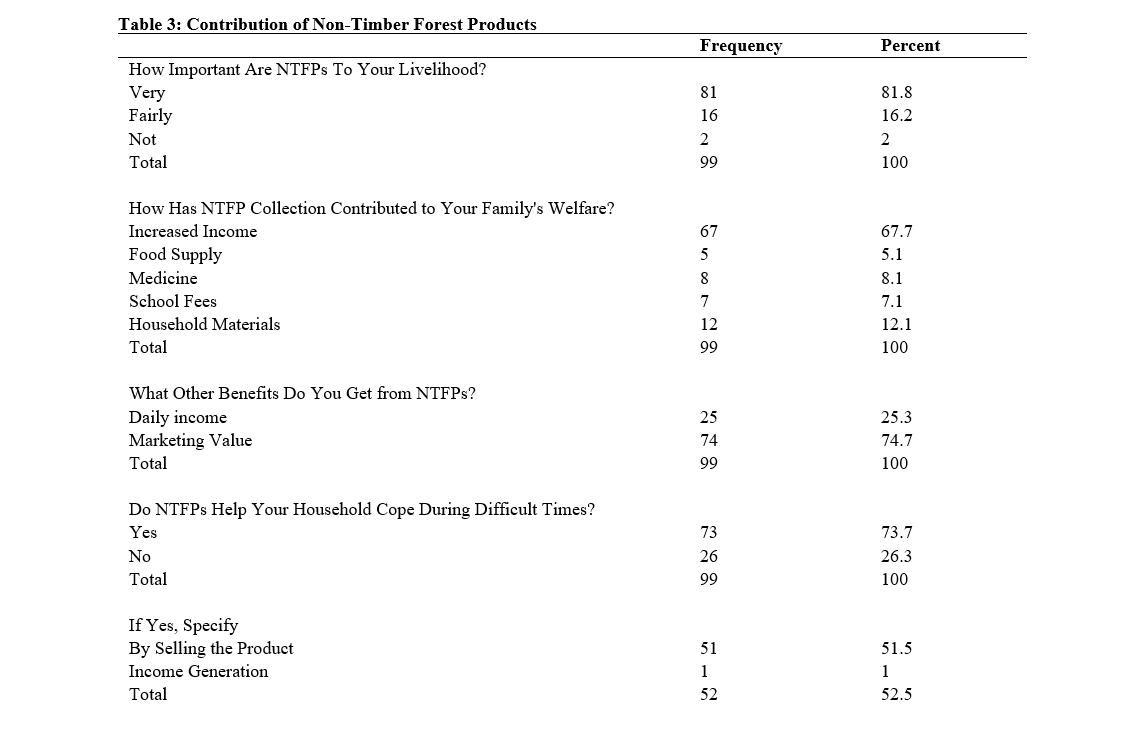
Forest is a land area covered with trees which serves as habitant for flora and faunas. It is a vital component of ecosystem that provides a wide range of goods and services for support, human well-being and livelihoods. This study examined the socio-economic contribution of selected Non-Timber Forest Products (NTFPs) to the rural livelihoods of communities surrounding Ipetu-Ikeji Forest Reserve in Osun State, Nigeria. It specifically identified the major NTFPs utilized in the area and assessed their contributions to household welfare and livelihood sustainability. A two-stage sampling technique was adopted in selecting respondents from the study area. A total of 125 questionnaires were administered, and 99 were retrieved and analyzed using descriptive statistics such as frequency and percentage. The findings revealed that the majority of respondents were female (77.8%), married (70.7%), and within the economically active age range of 31–40 years (65.7%). Bitter kola (Garcinia kola) was identified as the most common and most utilized NTFP. The study further showed that NTFPs contribute significantly to household livelihoods through income generation, food supply, medicinal uses, and payment of school fees. Most respondents (81.8%) considered NTFPs very important to their livelihoods, while 80.8% affirmed that income from NTFPs improved household welfare. The study concluded that NTFPs play a vital role in supporting rural livelihoods and reducing poverty among forest-dependent households around Ipetu-Ikeji Forest Reserve. The study therefore recommends sustainable forest management practices, improved access to training, and support for cooperative societies to enhance the long-term benefits of NTFPs to rural communities.
References
Agbogidi, O. M. (2010). Ethno-botanical survey of the non-timber forest products in Sapele Local Government Area of Delta State, Nigeria. African Journal of Plant Science, 4(6), 183–189.
Aiyeloja, A. A., & Ajewole, O. I. (2006). Non-timber forest products’ marketing in Nigeria. A case study of Osun State. Educational Research and Reviews, 1(2), 52–58.
Aiyeloja, A. A., Oladele, A. T., & Ezeugo, O. E. (2012). Evaluation of non-timber forest products trade in Ihiala local government area, Anambra State, Nigeria. International Journal of Science and Nature, 3(2), 366–372.
Angelsen, A., Jagger, P., Babigumira, R., Belcher, B., Hogarth, N. J., Bauch, S., Börner, J., Smith-Hall, C., & Wunder, S. (2014). Environmental income and rural livelihoods: A global-comparative analysis. World Development, 64(Suppl 1), S12–S28. https://doi.org/10.1016/j.worlddev.2014.03.006
Anoh, R. A., Ogar, D. A., Alobi, A. O., & Ifebueme, N. M. (2019). Contributions of selected non-timber forest products to socio economic lives in Oban Hills Forest Reserve, Nigeria. Asian Journal of Research in Agriculture and Forestry, 4(1), 1–13. https://doi.org/10.9734/ajraf/2019/v4i130055
Arnold, J. E. M., & Pérez, M. R. (2001). Can non-timber forest products match tropical forest conservation and development objectives? Ecological Economics, 39(3), 437–447. https://doi.org/10.1016/S0921-8009(01)00236-1
Berkes, F. (2012). Sacred ecology (3rd Ed.). Routledge.
Bore, N. C. (2014). A struggle between livelihood and forest conservation [Master's thesis, University of Nairobi]. Institute of Development Studies, University of Nairobi.
Chidebere-Mark, N. M., Ejike, R. D., & Akwiwu, U. N. (2016). Economics of non-timber forest products (NTFPs) marketing in Ikwuano Local Government Area, Abia State, Nigeria. European Journal of Agriculture and Forestry Research, 4(2), 1–8.
Chilalo, M., & Wiersum, K. (2011). The role of non-timber forest products for livelihood diversification in South-west Ethiopia. Ethiopian Journal of Environmental Studies and Management, 4(1), 44–59. https://doi.org/10.4314/ejesm.v4i1.8
Ellis, F. (2000). Rural livelihoods and diversity in developing countries. Oxford University Press.
Farinola, L. A., Famuyide, O. O., Nosiru, M. O., & Ogunsola, A. J. (2014). Survey of identified non-timber forest products and their role in the rural livelihood of inhabitants of Omo Forest Reserve, Ogun State. International Journal of Agriculture and Forestry, 4(4), 317–324. https://doi.org/10.5923/j.ijaf.20140404.09
Fisher, M. (2004). Household welfare and forest dependence in Southern Malawi. Environment and Development Economics, 9(2), 135–154. https://doi.org/10.1017/S1355770X03001222
Kolade, T. A. (2021). Non-timber forest products (NTFPs) needs assessment of forest community dwellers in Ondo State, Nigeria [Unpublished dissertation]. Federal University of Technology, Akure.
Mahapatra, A. K., & Mitchell, C. P. (2011). Role of non-timber forest products in rural livelihoods. Forest Policy and Economics, 13(3), 177–188. https://doi.org/10.1016/j.forpol.2011.01.002
Olujobi, O. J., & Olajuyigbe, B. J. (2020). Socio-economic contributions of forest products to rural livelihood in Nigeria. Journal of Agriculture and Crops, 6(8), 105–112. https://doi.org/10.32861/jac.68.105.112
Ostrom, E. (1990). Governing the commons: The evolution of institutions for collective action. Cambridge University Press.
Shackleton, S., Delang, C. O., & Angelsen, A. (2011). From subsistence to safety nets and cash income: Exploring the diverse values of non-timber forest products for livelihoods and poverty alleviation. Forest Policy and Economics, 13(6), 476–485. https://doi.org/10.1016/j.forpol.2011.05.011
Vedeld, P., Angelsen, A., Bojö, J., Sjaastad, E., & Berg, G. K. (2007). Forest environmental incomes and the rural poor. Forest Policy and Economics, 9(7), 869–879. https://doi.org/10.1016/j.forpol.2006.05.008
World Agroforestry Centre. (2006). Agroforestry tree database. ICRAF.
World Bank. (2016). Poverty and shared prosperity 2016: Taking on inequality. World Bank Publications.
Downloads
Published
Issue
Section
Categories
License
Copyright (c) 2026 Yetunde Balikis Ayetan, Olajumoke Odeyale, Oluwasegun Babatunde Fadipe, Adebayo O. Onisile

This work is licensed under a Creative Commons Attribution 4.0 International License.


